A research team at Ulsan National Institute of Science and Technology (UNIST) has uncovered how cancer cells selectively produce only the biomolecules necessary for promoting cancer metastasis during the exosome formation process.
Exosomes are a type of extracellular vesicles (EVs) secreted by cells, serving as messengers for intercellular communication and signal transmission, often referred to as "cellular couriers" or "avatars of the cellular system."
Cancer cells secrete exosomes containing various substances to create an environment favorable to themselves, thereby promoting cancer metastasis. In particular, exosomes are known to be a major cause of cancer progression by inhibiting the efficacy of anticancer drugs.
The research teams led by Professor Youngchan Chae from the Department of Life Sciences at UNIST and Professor Pangil Seo from the Korea Brain Research Institute have, for the first time, revealed that the GPR143 protein selectively sorts the biomolecular substances required during the exosome formation process in cancer cells.
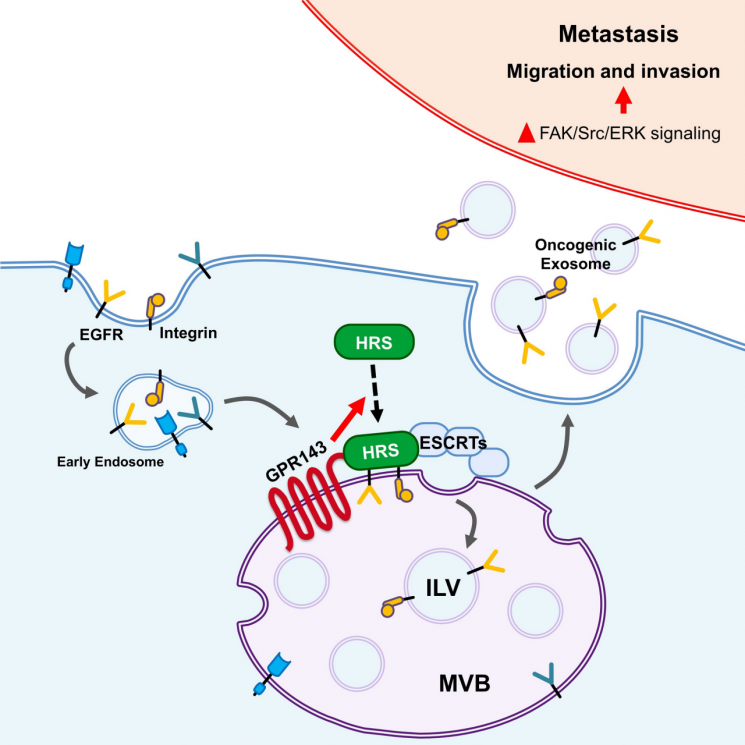
Unlike normal cells, cancer cells secrete large amounts of exosomes that alter surrounding cells, promote blood vessel formation, and inhibit immune cell functions, thereby creating an environment conducive to cancer growth and metastasis.
They also determine the site of metastasis and precondition the environment of the target organ, participating in the entire process of cancer spreading throughout the body. However, the detailed mechanism by which cancer cells selectively produce exosomes containing only the biomolecules necessary for metastasis had remained unclear until now.
The research team discovered that cancer cells overexpressing the GPR143 protein secrete large amounts of exosomes that promote metastasis. They also confirmed that GPR143 binds to proteins essential for cancer cell growth and migration within the cancer cells and transports them first to the exosomes.
Furthermore, the team confirmed increased expression of the GPR143 protein in various cancer types, including breast cancer, skin cancer, and colorectal cancer.
They demonstrated that exosomes secreted from these cancers trigger all processes necessary for cancer to metastasize to other organs, such as increasing cancer cell migration speed, invasion, and new blood vessel formation.
Additionally, the team conducted experiments administering exosomes secreted by GPR143-expressing cancer cells to animal models. For the first time, they proved that cancer cells engraft and grow in other organs via blood vessels, inducing cancer metastasis.
Professor Youngchan Chae of the Department of Life Sciences stated, “This study discovered the mechanism by which cancer cells form exosomes that can induce metastasis. We expect this to aid in developing diagnostic markers to predict patients with a high likelihood of metastasis and therapeutics that can effectively block cancer metastasis.”
The research findings were published online on February 27 in the world-renowned journal Developmental Cell. The study was supported by the National Research Foundation of Korea, the University Leading Research Center (Cancer Chair Research Center for Intercellular Signal Communication), and the Ulsan Metropolitan City.
© The Asia Business Daily(www.asiae.co.kr). All rights reserved.

















