Unified Voice on Anti-Americanism and Multilateralism
Xi Jinping Invited by Putin, Expected to Visit China Within the Year
Chinese President Xi Jinping reaffirmed the partnership between China and Russia through a summit meeting with Russian President Vladimir Putin. While China secured practical benefits by expanding economic cooperation such as energy trade, it also strengthened its anti-American stance in alliance with Russia by voicing support for multilateralism. However, despite gaining international attention as a 'mediator,' the solution to the Ukraine war did not go beyond the fundamental principle of 'peace and dialogue.'
According to the Chinese Ministry of Foreign Affairs on the 22nd, President Xi and President Putin issued a joint statement after their meeting the previous day, emphasizing the strengthening of the comprehensive and strategic partnership between the two countries. In the statement, the two leaders stressed the Ukraine war, stating, "Both sides adhere to the purposes and principles of the UN Charter and respect international law," and asserted, "We oppose any country or group harming the legitimate security interests of other countries for military, political, or other gains."
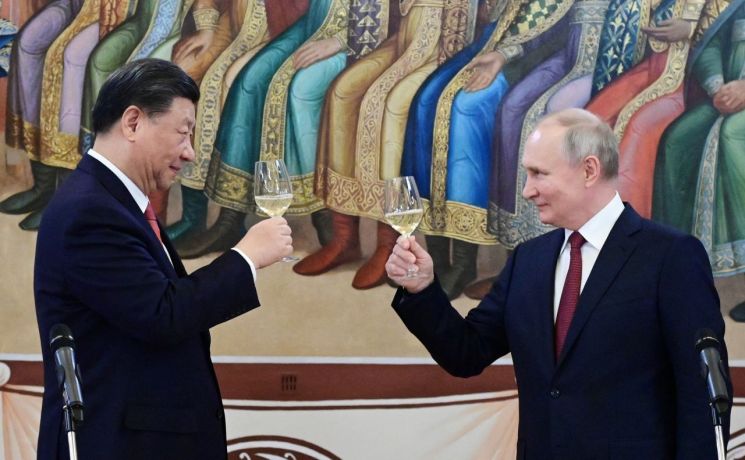
Consolidation of Anti-American Alliance... "Opposition to Unilateral Sanctions"
In the statement, the two leaders declared, "We will provide support to protect each other's interests, especially sovereignty, territorial integrity, and security," and argued, "The United States must stop actions that undermine global strategic stability." They continued, "Regional confrontations must be prevented, and fanning the flames avoided," emphasizing, "Responsible dialogue is the best way to find appropriate solutions." This is a continuation of China's stance on the Ukraine war.
Regarding the Korean Peninsula issue, both sides also expressed anti-American sentiments. The statement said, "Both sides have jointly advocated for the realization of denuclearization of the Korean Peninsula and the establishment of a peace and security mechanism on the Peninsula," adding, "Sanctions and pressure on North Korea should not be applied; they do not work, and only dialogue and negotiation are the sole paths to resolving the Korean Peninsula issue." It further argued, "The United States should respond to North Korea's legitimate and reasonable concerns and create conditions for resuming dialogue."
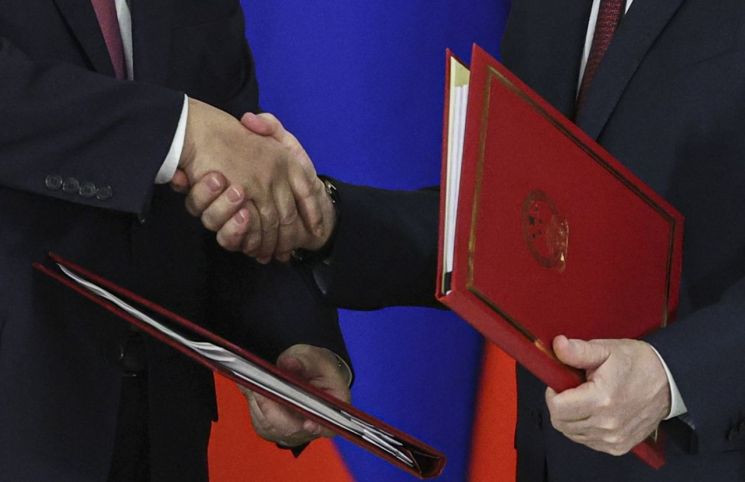
Significant Increase in Trade by 2030
While both sides reiterated fundamental remarks on geopolitical crises such as the war and the Korean Peninsula issue, they presented more concrete directions regarding economic cooperation. In particular, they announced plans to improve cooperation along the 4,300 km border region and dramatically increase trade volume between the two countries.
President Putin, in a press conference following the meeting, explained that energy cooperation between the two countries was discussed in detail and that Russia could supply at least 98 bcm (1 bcm = 1 billion cubic meters) of gas to China by 2030. He added, "We are ready to help Chinese companies replace Western companies that have left Russia," expressing hope that "by combining the potential of both countries, we can become world leaders in fields such as artificial intelligence (AI) and information and communications technology (IT)." President Xi also stated, "China is willing to expand cooperation with Russia in trade, investment, supply chains, large projects, energy, and high-tech sectors," and announced, "We have agreed to increase oil trade with Russia."
Trade between the two countries reached $190.3 billion (approximately 248.7792 trillion KRW) last year, marking a 29.3% increase compared to the previous year. Under Western sanctions, China has replaced Europe as Russia's largest energy importer, while Russia has increased its dependence on Chinese products ranging from semiconductors to automobiles.
President Putin particularly expressed his intention to support the globalization of the yuan. He emphasized, "Russia supports the use of the yuan, and this should be further encouraged." He explained that Russia plans to expand the use of the yuan in settlements with countries in Asia, Africa, and Latin America.
"Bilateral Relations Unshaken by Changes in International Situation"
Chinese media highly praised this summit, self-assessing that it demonstrates the firm friendship between the two countries despite recent global changes. Li Haidong, a professor at the China Foreign Affairs University, told the state-run Global Times (GT), "The high level of mutual trust and mature relationship built between the leaders of China and Russia shows that the two countries can withstand profound changes occurring worldwide."
GT emphasized, "The core message this summit sends to the world is that the Ukraine crisis and the deterioration of Russia-West relations cannot affect China-Russia relations." It added, "Most countries, including Russia and Ukraine, highly appreciate China's sincerity in promoting peace and ceasefire in the Ukraine crisis," while "the United States openly opposes and criticizes China's efforts."
Wang Wenbin, spokesperson for the Chinese Ministry of Foreign Affairs, also criticized the U.S. at a regular briefing the previous day, stating, "China is not a party to the crisis and has not provided weapons to any party involved in the conflict," and "The United States says it wants to maintain peace but continues to pour weapons into the battlefield." When asked by U.S. media whether China is willing to jointly promote peace negotiations between Russia and Ukraine with the U.S., he replied, "China is willing to continue playing a constructive role," adding, "Whether peace talks can be realized should be asked of the U.S. side."
Meanwhile, the Chinese Ministry of Foreign Affairs also revealed that President Xi invited President Putin to the third Belt and Road Forum for International Cooperation this year. Accordingly, following Xi's visit to Russia, there is a high possibility that President Putin will visit China later this year.
© The Asia Business Daily(www.asiae.co.kr). All rights reserved.


















