Domestic mid-sized pharmaceutical company Boryung (formerly Boryung Pharmaceutical) is heading to space. Kim Jeong-gyun, the third-generation owner and CEO of Boryung, is driving the space healthcare business with strong momentum. Instead of focusing on new drugs or healthcare, which are traditional pharmaceutical future growth engines, the company is targeting the future of 'space healthcare.' This is an unusual and controversial item. Inside and outside the company, shareholders and investors tend to lean more toward concern than expectation. However, it seems premature to predict failure simply because it is an uncharted and unfamiliar path that previous generations have not taken.
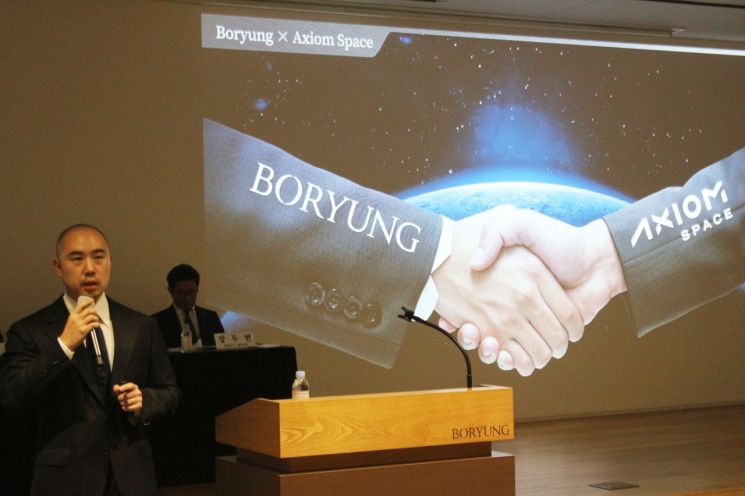 Kim Jeong-gyun, CEO of Boryung, is presenting on the space healthcare business at the shareholders' meeting held on the morning of the 21st at Boryung headquarters in Jongno-gu, Seoul.
 [Photo by Boryung]
On the morning of the 21st, CEO Kim personally explained the progress and goals of the space healthcare business project, ‘Care in Space (CIS),’ at the shareholders' meeting held at the company’s headquarters in Jongno-gu, Seoul. He devoted about an hour solely to the presentation (PT) on the space healthcare business during the meeting. Kim stated, "The goal is to secure technologies necessary for human survival in space and to establish infrastructure for technology research and development (R&D)," adding that he will continue to challenge and actively invest in the space business.
Boryung’s space business reflects CEO Kim’s strong will. Kim is the eldest son of Boryung Chairwoman Kim Eun-sun and the grandson of the founder, Kim Seung-ho, chairman of Boryung Pharmaceutical. He became CEO through the shareholders' meeting in March last year and currently serves as co-CEO alongside the former CEO Jang Doo-hyun. Boryung’s full-scale entry into the space healthcare industry began in early last year, coinciding with Kim’s appointment. His sincerity toward the space business is also evident in his CEO letter. In a letter posted on the company website on the 17th, Kim emphasized, "We have focused on the problems the human body faces in the unknown environment of space and on securing technologies and infrastructure necessary for research and development for human survival in space," adding, "Boryung will not remain a company that only operates in pharmaceuticals." Since there is currently no company focusing on health issues in space, the intention is to preempt the market.
However, the specific direction of the space healthcare business has not yet been determined. A Boryung official explained, "We will keep various possibilities of space healthcare open and continue to explore," but added, "We are still in the stage of exploring business directions while keeping various possibilities open." One of the proposed directions for the space healthcare business is researching and developing pharmaceuticals for people staying in space. There is also potential for new drug development utilizing the unique characteristics of microgravity in space. In a microgravity environment, intact protein crystals can form, which is advantageous for the essential process of understanding the protein structures of diseases.
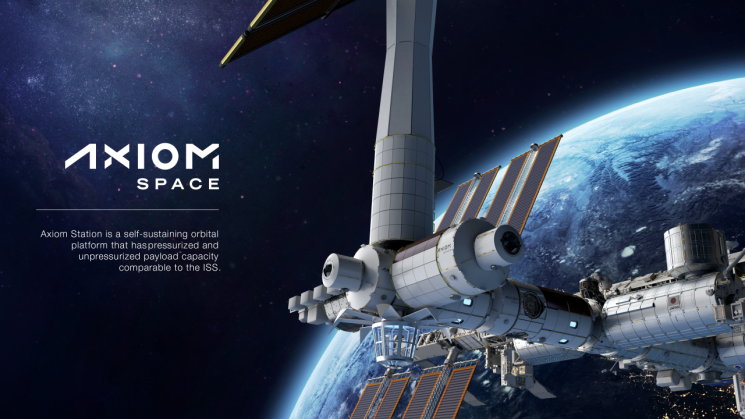 Axiom Space's planned world's first commercial space station, 'Axiom Station' [Photo provided by Boryeong]
Boryung’s commitment to the space business is also reflected in its name change and investment execution. In March last year, through a shareholders' meeting, the company changed its name from ‘Boryung Pharmaceutical’ to ‘Boryung.’ The reason was to expand the business beyond pharmaceuticals, which can also be seen as preparation for entering the space business.
Under CEO Kim’s leadership, the company has made large-scale investments in space companies. A representative example is the strategic investment of $50 million (approximately 64.9 billion KRW) in December last year in Axiom Space, a U.S. company building a private space station. This is a large-scale investment amounting to 13.7% of Boryung’s equity capital and was the second investment following an earlier $10 million (approximately 12.9 billion KRW) investment made earlier last year. Axiom is constructing the world’s first commercial space station, the Axiom Station. During the shareholders' meeting, CEO Kim announced plans to establish a joint venture with Axiom Space in Korea, indicating that cooperation between the two companies is expected to expand gradually.
While focusing on the space business, Boryung has moved to sell its major bio-affiliate, Boryung Biopharma. This is in stark contrast to major conglomerates like Lotte, which are actively entering the bio industry. Boryung Biopharma develops and produces its own vaccines for influenza and hepatitis, and currently, Dongwon Group is pursuing acquisition through a memorandum of understanding with Boryung. Some interpret this sale as a move to secure funds necessary for new business ventures such as space healthcare and for management succession. However, CEO Kim refrained from commenting on the affiliate sale, stating, "There is nothing to respond to regarding this matter," and "Since nothing has been finalized, it is inappropriate to comment."
Shareholders’ views on CEO Kim’s focus on the space business reveal concerns. While some shareholders expressed support for Kim’s entry into the space business, questions during the Q&A session reflected skepticism about the business. Some shareholders pointed out that Kim’s presentation mainly focused on the space healthcare business rather than pharmaceutical new drug R&D.
Kim seemed aware of this, repeatedly apologizing during the presentation, saying, "Communication about the changes that have been ongoing since last year was insufficient. I apologize for not providing proper information to the shareholders." This is interpreted as a response to the sharp stock price drop following the announcement of the investment in Axiom Space last year, which was perceived negatively by the stock market. At that time, securities firms expressed doubts about Boryung’s large-scale investment in the space business, lowering investment ratings and target prices. Some securities firms even excluded Boryung from their corporate analysis list, citing concerns about increased financial volatility with further investments in the space business.
The uncertainty of the business outlook also appears to be a challenge Kim must address. When asked by a shareholder about the timing of profit generation from the CIS project, Kim replied, "I do not know when profits can be made or how large they will be," but added, "If you trust and wait, we will deliver results." When asked about specific additional investment plans for the CIS project, he said, "I apologize for not being able to clearly explain how much and how investments will be made in the future. Please watch over us a little longer," but confidently stated, "The level of motivation and commitment to the CIS project is world-class."
© The Asia Business Daily(www.asiae.co.kr). All rights reserved.
![User Who Sold Erroneously Deposited Bitcoins to Repay Debt and Fund Entertainment... What Did the Supreme Court Decide in 2021? [Legal Issue Check]](https://cwcontent.asiae.co.kr/asiaresize/183/2026020910431234020_1770601391.png)


















