Opposition Party Predicts Forceful Action Against the Ruling Party
Possibility of Presidential Veto Exercise
The amendment to the Grain Management Act, which mandates the government to compulsorily purchase surplus rice production, is expected to be processed at the National Assembly plenary session on the 23rd. Although Speaker Kim Jin-pyo intervened as a mediator, the gap between the ruling and opposition parties' positions has not been narrowed.
Oh Young-hwan, the floor spokesperson for the Democratic Party of Korea, explained at a pre-briefing before the National Assembly floor strategy meeting on the 21st, "The Grain Management Act is expected to be the agenda for the plenary session on Thursday (the 23rd) as a first step," adding, "The Democratic Party intended to accept, amend, and submit the Speaker's mediation proposal, and the Speaker urged the government and ruling party to participate, deciding to put it on the agenda for the first plenary session in March."
Earlier, the Democratic Party had unilaterally referred the amendment to the Grain Management Act directly to the plenary session on January 30. Initially, they attempted to pass the amendment at the plenary session on the 27th of last month, but Speaker Kim postponed the vote by exercising his authority, demanding bipartisan agreement. At that time, Speaker Kim stated that if no agreement was reached, the amendment would be put to a vote according to the Democratic Party's revised proposal at the first plenary session in March.
Joo Ho-young, the floor leader of the People Power Party, and Park Hong-geun, the floor leader of the Democratic Party, met the previous afternoon under Speaker Kim's chairmanship to discuss the amendment to the Grain Management Act, but failed to narrow their differences. Floor Leader Joo said, "The Speaker requested both parties to narrow their opinions further to enable a consensual resolution, while the Democratic Party stated their intention to handle it at the next plenary session as previously promised," adding, "We will check if there is room for further agreement, but our position remains unchanged that we cannot accept it as long as compulsory purchase is a premise."
On the same day, Kim Sung-hwan, chairman of the Policy Committee, also said at a policy briefing, "Despite the Speaker proposing an additional mediation plan, the government and ruling party still have not responded," adding, "If this situation continues, it seems inevitable to process the bill for rice price normalization as previously intended." However, he also said, "We will observe the government's position for a few more days."
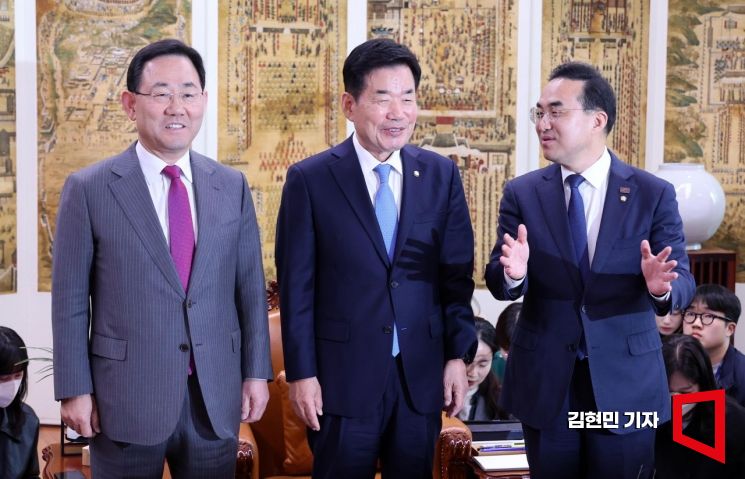 Speaker of the National Assembly Kim Jin-pyo, People Power Party Floor Leader Joo Ho-young, and Democratic Party Floor Leader Park Hong-geun are meeting on the 20th at the Speaker's Office in Yeouido, Seoul. Photo by Kim Hyun-min kimhyun81@
In addition, Chairman Kim of the Policy Committee stated, "Our party plans to promptly promote policies that increase farmers' income and partially reduce rice production through the so-called farming-type solar power support law," adding, "From the farmers' perspective, we will pursue policies that allow them to produce solar power and rice simultaneously, coordinating rice supply and demand in a positive way that reduces the total amount of rice while increasing farmers' income."
The amendment to the Grain Management Act includes provisions that require the government to compulsorily purchase rice if the surplus production exceeds 3% of demand or if the rice price during the harvest season falls by more than 5% compared to the same period last year. The Democratic Party argues that the surplus production threshold can be adjusted to between 3% and 5%, and the price drop range to between 5% and 8%. On the other hand, the People Power Party maintains a stance that it cannot accept the compulsory purchase itself.
The government also opposes compulsory purchase, arguing that it causes rice prices to fall. In particular, the Presidential Office has hinted at exercising the presidential veto if the amendment to the Grain Management Act passes. If the presidential veto is exercised, the National Assembly must re-deliberate and vote again. The re-vote requires a quorum of more than half of the total members and a two-thirds majority of those present, making cooperation from other parties such as the Justice Party inevitable.
© The Asia Business Daily(www.asiae.co.kr). All rights reserved.

















