Even Market Economy Principles Collapse
US Law Firms Move Toward Class Action Lawsuits
The merger between UBS and Credit Suisse (CS), rapidly executed under the mediation of the Swiss government, has shaken the foundations of the market economy and even earned the derogatory label of a "banana republic." Above all, the government's most glaring failure in this merger process was exposing the harsh reality of the Swiss financial market, which had been regarded as the safest financial hub for decades.
Bloomberg reported on the 20th (local time) that the Swiss government is facing criticism for significantly undermining the fundamental principles of market economy?competition law and shareholder rights?during the merger of CS, which was experiencing a liquidity crisis, with UBS. The merger with UBS, which the Swiss government was considering as a "last resort," was completed at lightning speed just five days after the controversy erupted and only two days after negotiations began.
There were major disagreements between the parties involved and the government as the negotiation mediator over key points such as the acquisition price and government guarantees, with many twists and turns before reaching a consensus. However, what seemed like an impregnable negotiation was swiftly concluded within two days. Foreign media pointed out that the Swiss government's desperation to restore confidence in the safety of the Swiss banking system played a role in this rapid resolution.
The Swiss government skipped all procedures, including the shareholders' meeting for merger approval and parliamentary discussions on government financial support, to complete the deal over the weekend before Asian stock markets opened. According to local Swiss regulations, the government must undergo parliamentary review when providing emergency funds exceeding 500 million Swiss francs (approximately 703 billion KRW), but the government ignored this procedure and promised up to 100 billion Swiss francs in additional liquidity and up to 9 billion Swiss francs in government guarantees for the CS-UBS merger. It also nullified the regulation requiring shareholders to be given six weeks to discuss the acquisition approval.
At a press conference announcing the merger held the previous day in Bern, Switzerland, Marlene Amstad, Chairwoman of the Swiss Financial Market Supervisory Authority (FINMA), responded to related questions from the press by stating, "Financial stability takes precedence over competition issues."
The integration process aims to be completed within the year, but the antitrust regulatory approval procedures in major countries remain a variable. With this merger, a mega bank with assets totaling $1.6 trillion (approximately 2,100 trillion KRW) will be created, raising concerns about antitrust issues. After the merger, UBS's asset size will far exceed Goldman Sachs's total assets of $1.44 trillion, and the investment assets under management will reach $5 trillion (approximately 6,500 trillion KRW).
The decision to fully write off 16 billion Swiss francs worth of Additional Tier 1 (AT1) hybrid capital securities issued by CS during this merger process is also expected to cause significant aftershocks. These bonds, known as "CoCo bonds," offer higher yields than traditional bonds but carry the risk of principal and interest loss during crises. This is the first time since the global financial crisis that a major global bank has forcibly written off bonds due to financial distress. Bond experts warn that this could send shockwaves through financial markets, especially in Europe.
Bloomberg pointed out that this merger revealed an unpleasant truth about Switzerland, which had been considered a safe haven for stable bond and equity investors due to its low legal uncertainty. Wealthy individuals worldwide flocked to Swiss banks because they were politically and economically stable and had predictable variables. However, this merger has shaken the very foundation of Switzerland's financial market competitiveness.
This hasty merger, which disregards competition law and shareholder rights, has sparked controversy as something that happens in a "banana republic" (a derogatory term for countries experiencing political instability due to dictatorship and corruption). Alexander Kern, Professor of Law and Finance at the University of Zurich, sharply criticized the Swiss government's crisis management as a panic that undermined the rule of law and damaged Switzerland's financial market status.
The merger is also expected to lead to litigation risks. Bloomberg reported that Queen Emmanuel Urquhart & Sullivan, a multinational law firm based in the United States, plans to hold meetings among representatives from its Zurich, New York, and London offices to proceed with lawsuits seeking compensation for bond investors.
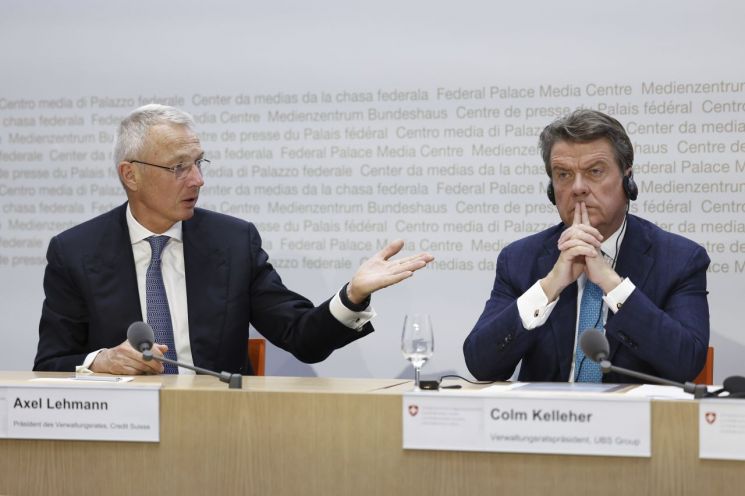 Axel Lehmann, Chairman of the Board of Credit Suisse (CS) (left), is speaking next to Colm Kelleher, Chairman of UBS, at a press conference held in Bern, Switzerland, on the 19th (local time).
 [Image source=AP Yonhap News]
© The Asia Business Daily(www.asiae.co.kr). All rights reserved.
![Clutching a Stolen Dior Bag, Saying "I Hate Being Poor but Real"... The Grotesque Con of a "Human Knockoff" [Slate]](https://cwcontent.asiae.co.kr/asiaresize/183/2026021902243444107_1771435474.jpg)
















