Recently, the CEO of a mid-sized construction company in the Ulsan and Gyeongnam regions took an extreme step due to financial difficulties. All construction sites managed by the company have come to a halt, and a sales project with a 90% completion rate has also been suspended. Several small specialized construction companies in the region that collaborated with this company have also faced bankruptcy risks as they have not received payments.
According to industry sources on the 21st, local construction sites in provincial areas are staggering due to large-scale unsold properties and a downturn in the real estate market. While the Seoul real estate market is showing signs of recovery following the government's 1·3 real estate measures, provincial areas are experiencing a further decline in investment, leading to an increase in closures of small and medium-sized construction companies, exacerbating difficulties.
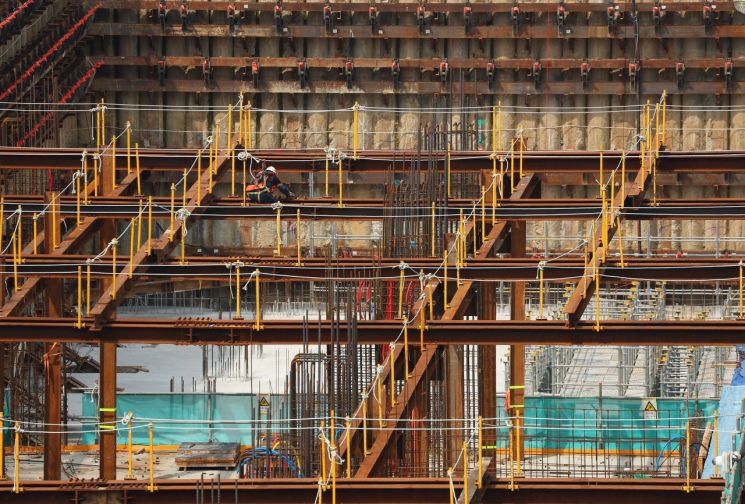
According to the Construction Industry Knowledge Information System (KISCON), as of the 20th, 803 general and specialized construction companies have closed this year (excluding 19 withdrawals). This averages to about 10 closures per day.
This represents a 13.9% increase compared to 718 closures in the same period last year and is the highest number since 821 closures were recorded in 2016. The number of construction companies filing for closure during the same period in previous years was 728 in 2017, 651 in 2018, 607 in 2019, 629 in 2020, and 614 in 2021.
Closures are concentrated in provincial areas. As of this date, 94 construction companies based in Seoul have filed for closure, accounting for 11.5% of all closures. In the metropolitan area excluding Seoul, 227 companies (186 in Gyeonggi, 41 in Incheon) have closed, representing 27.8%, while the remaining 482 companies (61.7%) are located in provincial areas.
The main causes of the increase in construction company closures are tightening financial markets and rising raw material prices. The burden of loan interest increased due to the rise in the base interest rate, and combined with the real estate market downturn, construction companies faced severe liquidity problems. Additionally, rising raw material costs and a shrinking sales market led to decreased profitability.
Large construction companies managed to endure using their own cash reserves, but small and medium-sized companies could not withstand the pressure. Particularly, since most small and medium-sized construction companies operate based in provincial areas, closures among these companies in the provinces have inevitably increased.
However, the provincial construction industry views the government's 1·3 real estate measures as having influenced the rise in closures among provincial construction companies. By lifting regulations on Seoul and the metropolitan area through the 1·3 measures, investment and sales markets in provincial real estate have been contracted.
An official from a small and medium-sized construction company in the Gyeongnam region said, "Since the 1·3 measures, not only has it become difficult to secure PF loans in the provinces, but even the subscription market has frozen solid. Investors (financial institutions) and buyers (subscribers and purchasers) only focus on Seoul and the metropolitan area and completely ignore the provinces."
Another official from the sales industry explained, "After the lifting of regulations in Seoul and the metropolitan area, many buyers in provincial sales markets have given up not only on subscriptions but also on contracts."
According to the Ministry of Land, Infrastructure and Transport, the number of unsold houses nationwide in January reached 75,359 units, the highest in 10 years and 2 months since November 2012. Notably, about 85% of these, 63,102 units, are concentrated in provincial areas outside the metropolitan region. The volume of unsold houses in the provinces alone has exceeded the government's risk threshold of 62,000 units. Daegu, which has the highest number of unsold units (13,565), has completely halted approvals for new housing projects, and other provinces with high supply such as Gyeongbuk (9,221 units) and Chungnam (8,653 units) are also facing severe situations.
An official from the construction industry in Daegu said, "In fact, the construction and real estate market in Seoul and the metropolitan area has never been at its worst. The truly serious situation is in the provincial real estate market, and urgent special measures are needed."
Han Mundo, a professor in the Department of Finance and Real Estate at Yonsei University's Graduate School of Political Economy, stated, "Small and medium-sized construction companies in the provinces, which lack surplus funds, do not have the stamina to withstand the current real estate market downturn and rising interest rates. Without special measures for the provincial real estate market, a wave of closures among provincial construction companies is expected.”
© The Asia Business Daily(www.asiae.co.kr). All rights reserved.
![From Hostess to Organ Seller to High Society... The Grotesque Scam of a "Human Counterfeit" Shaking the Korean Psyche [Slate]](https://cwcontent.asiae.co.kr/asiaresize/183/2026021902243444107_1771435474.jpg)
















