IPCC 6th Assessment Report
Due to increasing greenhouse gas emissions, it is projected that the Earth's surface temperature will rise by an average of 1.5 degrees Celsius by 2040 compared to the pre-industrial era. The international community has warned that urgent efforts to reduce carbon dioxide emissions are needed across 195 countries worldwide to curb global temperature rise.
The Intergovernmental Panel on Climate Change (IPCC) announced on the 19th (local time) at the plenary session held in Interlaken, Switzerland, that it had unanimously approved the "IPCC Sixth Assessment Report Synthesis Report," which emphasized the urgency of integrated short-term climate action. This is the first such report in nine years since the Fifth Assessment Report in 2014.
The IPCC assessment reports serve as key reference materials for various international climate change negotiations. Since 1990, the IPCC has published assessment reports containing evidence on climate change and related policy directions at intervals of 5 to 6 years. The Fifth Assessment Report, approved in 2014, was used as scientific evidence for the 2015 Paris Climate Agreement. The Sixth Assessment cycle began in 2015, and the synthesis report released on this day encompasses six working group and special reports published between 2018 and 2022.
The IPCC expects the global average temperature increase to reach 1.5 degrees Celsius by 2040. The 1.5-degree target was agreed upon by the international community in the 2015 Paris Climate Agreement to limit global warming. The global surface temperature rose by 1.1 degrees Celsius over the recent decade from 2011 to 2020 compared to 1850?1900. The IPCC estimated the average temperature for 2081?2100 compared to 1995?2014 and projected that the Earth's temperature could rise by 1.4 to 4.4 degrees Celsius within the 21st century. If temperatures rise, the intensity and extent of extreme weather events will increase, and adverse effects on socio-economic aspects such as food security and life expectancy will be inevitable.
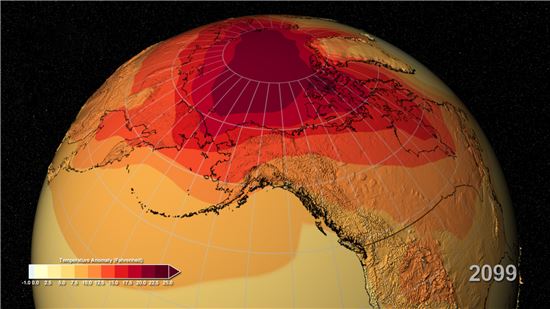 ▲The Earth continues to warm due to global warming. [Photo by NASA]
The IPCC emphasized that "to limit warming, greenhouse gas emissions including carbon dioxide must reach net zero (carbon neutrality)." The problem is that if the current fossil fuel infrastructure is maintained, the potential carbon dioxide emissions are expected to exceed the remaining carbon budget needed to keep temperature rise within 1.5 degrees. The IPCC estimates the remaining carbon emission allowance to limit temperature rise to 1.5 degrees at about 500 GtCO2. Considering that greenhouse gas emissions in 2019 were approximately 60 GtCO2eq, it is calculated that maintaining temperature rise within 1.5 degrees will be difficult unless related policies are strengthened.
The IPCC warned, "Based on policies implemented up to 2020, greenhouse gas emissions in 2030 are expected to exceed those stated in the Nationally Determined Contributions (NDCs)," and "if policies are not strengthened, the Earth's temperature is projected to rise by 3.2 degrees Celsius above pre-industrial levels by 2100." This underscores the need for efforts in the industrial sector to reduce greenhouse gases through demand management, energy and material efficiency, circular resource flows, mitigation technologies, and innovative changes in production processes.
Accordingly, the IPCC stressed that political will is paramount to transition toward climate-resilient development pathways. Climate-resilient development refers to the process of applying greenhouse gas mitigation and adaptation measures to support sustainable development. This report is expected to be used as a key reference in international climate change negotiations such as the United Nations Framework Convention on Climate Change (UNFCCC). In particular, it will serve as an important input when conducting the "Global Stocktake," a mechanism to assess progress toward the long-term temperature goals of the Paris Agreement this year.
© The Asia Business Daily(www.asiae.co.kr). All rights reserved.
















