Last Year's Consecutive Derailment Accidents
'Rail Safety Enhancement Measures' Follow-up Actions
Priority Replacement of Seoul~Geumcheon-gu Office Section, High-Speed and Conventional Line Connection in Daejeon Section
The government has decided to completely replace the rails on conventional lines with a high proportion of high-speed train operations with rails designed for high-speed lines to prevent derailment accidents. The regular inspection and management standards for tracks, including conventional lines used by high-speed trains, will also be significantly strengthened.
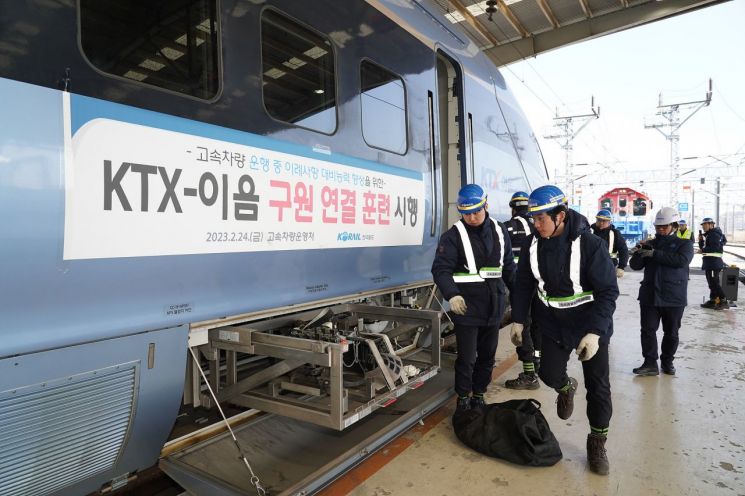
On the 21st, the Ministry of Land, Infrastructure and Transport announced that to prevent derailment accidents, conventional lines with a high proportion of high-speed train operations will be fully replaced with rails for high-speed lines, and track maintenance standards will be significantly strengthened to the level of high-speed lines. This is a follow-up measure to the government's "Rail Safety Enhancement Plan" announced to prevent the high-speed rail derailment accidents that occurred consecutively at Daejeon Yard Station and Yeongdeungpo Station last year.
According to the Ministry, the two derailment accidents that occurred in the second half of last year happened on conventional line sections used by high-speed trains. The rails on conventional lines have somewhat lower strength compared to those on high-speed lines, while the train operation density is higher, making surface defects more likely to occur, which poses a threat to rail safety.
Accordingly, the government has decided to completely replace the rails on conventional line sections with a high proportion of high-speed train operations, such as the Gyeongbu Conventional Line section from Seoul to Geumcheon-gu Office and the high-speed to conventional connecting line section in Daejeon, with rails designed for high-speed lines.
In addition, periodic grinding work will be carried out regularly, and ultrasonic inspection of turnouts will be expanded to manage these sections at the level of high-speed lines. For aging conventional lines with a high proportion of high-speed train operations, the government plans to actively start replacing rails and turnouts this year and complete the replacements by 2025.
First, the most deteriorated section from Noryangjin to Geumcheon-gu Office (both directions, 23 km) will be fully replaced with high-speed rails within this year, and turnouts will be replaced by next year. Furthermore, the sections from Seoul to Noryangjin (both directions, 11.6 km) and the high-speed to conventional connecting line in Daejeon (both directions, 20.8 km) will have rails and turnouts replaced by 2025.
When KTX passes through conventional line sections, the difference in rail and high-speed train wheel profiles causes increased rail wear and surface defects. By replacing these with high-strength, high-hardness, and high-resistance rails designed for high-speed lines, rails suitable for high-speed trains will be installed, which is expected to improve the safety of train operations.
The regular inspection and management standards for tracks, including conventional lines used by high-speed trains, will also be significantly strengthened. If problems such as track misalignment occur repeatedly three or more times based on regular inspection results, the causes will be analyzed to establish fundamental improvement measures, and the high-speed to conventional connecting lines will be designated as vulnerable sections for more thorough management.
Moreover, the grading and repair/replacement standards for rail surface defects, previously applied only to high-speed lines, will now be applied equally to all conventional lines. Rail inspection results will classify surface cracks by type and length into four grades, and based on the grade, special management, urgent repairs, or immediate replacement will be implemented.
Additionally, regular rail grinding work, previously conducted only on high-speed lines to improve rail surface defects and performance, will be expanded to conventional line sections with a high proportion of high-speed train operations or high design speeds.
To detect track abnormalities early, the measurement frequency of vehicle-borne vibration acceleration on high-speed lines will be shortened from once every two weeks to once a week, and the ultrasonic inspection frequency of major conventional line sections will be increased from once a year to twice a year.
A research project to introduce a track grading system will also be launched within this year. The government plans to start a study this year to classify track grades based on train operation speed and frequency and to differentiate inspection and maintenance standards accordingly.
Jung Chaegyo, Director of Rail Safety Policy at the Ministry of Land, Infrastructure and Transport, said, "To fundamentally resolve concerns about rail safety caused by last year's derailment accidents, we will faithfully implement rail safety enhancement measures such as revising track maintenance guidelines and improving quality through track upgrades to firmly establish the foundation for rail safety."
© The Asia Business Daily(www.asiae.co.kr). All rights reserved.
!["The Woman Who Threw Herself into the Water Clutching a Stolen Dior Bag"...A Grotesque Success Story That Shakes the Korean Psyche [Slate]](https://cwcontent.asiae.co.kr/asiaresize/183/2026021902243444107_1771435474.jpg)
















