Democratic Party Provincial and City Council Members Emphasize Preparing Future Food Sources
Advanced Industry Special Committee to Strive for Battery Advanced Industry Special Zone Designation
There was a call to prepare for the post-steel industry era for the future of Gwangyang City.
It was predicted that the secondary battery industry, which is being established as infrastructure, will be the alternative to the steel industry.
On the 19th, Seo Dong-yong, a member of the National Assembly (Democratic Party of Korea, Suncheon·Gwangyang·Gokseong·Gurye-eul), expressed this opinion during a meeting with members of the Jeonnam Provincial Assembly and Gwangyang City Council affiliated with the Democratic Party of Korea in the Gwangyang area.
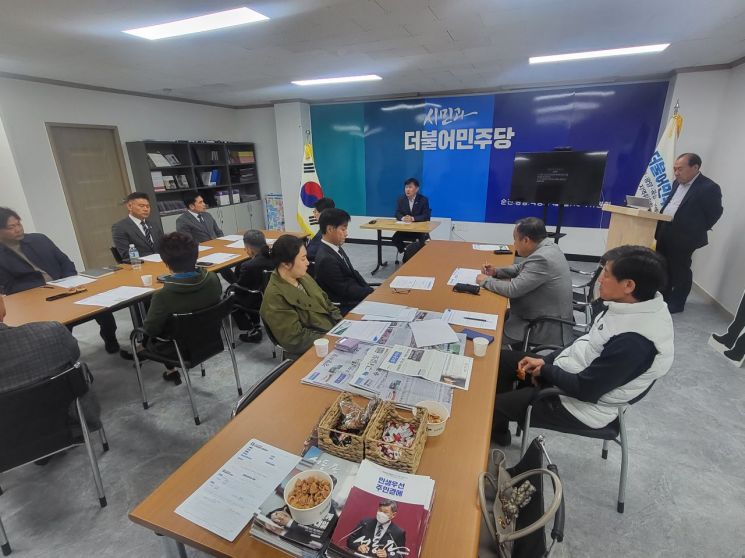
At the meeting, Assemblyman Seo stated, “By 2050, POSCO faces the challenge of producing steel through carbon neutrality,” and added, “Currently, hydrogen reduction steelmaking using FINEX technology is being prepared, and the industry evaluates that the technological capability is world-class.”
However, he pointed out, “Although much research is being conducted on hydrogen reduction technology, there are still many negative views on whether it can achieve the same productivity as now,” and “This also implies the possibility that POSCO’s steel production may lose competitiveness.”
Therefore, he said, “We have witnessed in many places that cities that thrived on a single industry decline rapidly when that industry declines,” and “Since the success of hydrogen reduction steelmaking cannot be guaranteed, it is time for Gwangyang City to diversify its industries.”
As a promising future industry for Gwangyang City after the steel industry, he pointed to the battery industry.
He said, “An eco-friendly lithium secondary battery recycling testbed is being established in the Iksin Industrial Complex and will begin full-scale operation from March,” and “It is expected that waste batteries will flood in from 2025, and if technology to recycle them is developed and related industries are concentrated in Gwangyang, it will generate significant added value.”
In particular, he emphasized, “POSCO Future M’s cathode material factory is currently operating, and if an additional factory is established in the Yulchon Industrial Complex, it will be possible to build a battery industry cluster along with waste battery recycling,” and “If preparations are made well from now on, regardless of the success of hydrogen reduction steelmaking, the future of Gwangyang City can be secured.” He also called for the entire local community to work together for this.
Assemblyman Seo Dong-yong said, “Considering the future of Gwangyang City, now is the most important and critical time, so political considerations are unnecessary,” and “Gwangyang City is preparing to designate an advanced industrial special zone related to the battery industry, and as a member of the National Assembly’s Special Committee on Advanced Industries, I will fully serve as a bridge with the government.”
He added to the provincial and city council members, “We must think together about Gwangyang City’s future industries, present opinions, and cooperate as much as possible.”
Meanwhile, at the meeting, Kim Tae-gyun, vice chairman of the Jeonnam Provincial Assembly, three provincial assembly members, Seo Young-bae, chairman of the Gwangyang City Council, and eight city council members attended. The meeting also broadly discussed agenda reports for the Gwangyang City Council’s extraordinary session and civil complaints related to the entry of waste disposal companies in the Hwanggeum district.
Asia Economy Honam Reporting Headquarters, Reporter Heo Seon-sik hss79@asiae.co.kr
© The Asia Business Daily(www.asiae.co.kr). All rights reserved.

















