Park Hong-geun, the floor leader of the Democratic Party of Korea, on the 20th, reacted against the People Power Party's criticism of the proposal to expand the number of lawmakers included in the electoral district reform plan referred to the plenary committee by the Political Reform Special Committee, calling it a political ploy. He argued that the discussion on electoral system reform is being used to overturn public opinion based on political calculations, despite the proposal being merely a 'proposal for discussion' at the plenary committee.
At an emergency discussion meeting analyzing and evaluating the Yoon Suk-yeol-Kishida Japan-Korea summit held at the National Assembly that day, Park told reporters, "Where is the proposal to increase the number of National Assembly members?" He added, "It is not the Speaker's proposal but the advisory body's proposal, and even the People Power Party's caucus decided to refer it to the plenary committee. Procedurally, a proposal is needed for this, and since the proposals from both ruling and opposition parties have not been finalized, the advisory body's proposal was submitted. Individual lawmakers will listen to various opinions, and once the proposals are gathered, they will be organized, isn't that right?"
He explained that the discussion about expanding the number of lawmakers mentioned by Kim Ki-hyun, the leader of the People Power Party, and other leadership members is merely a 'proposal' for the sake of discussion.
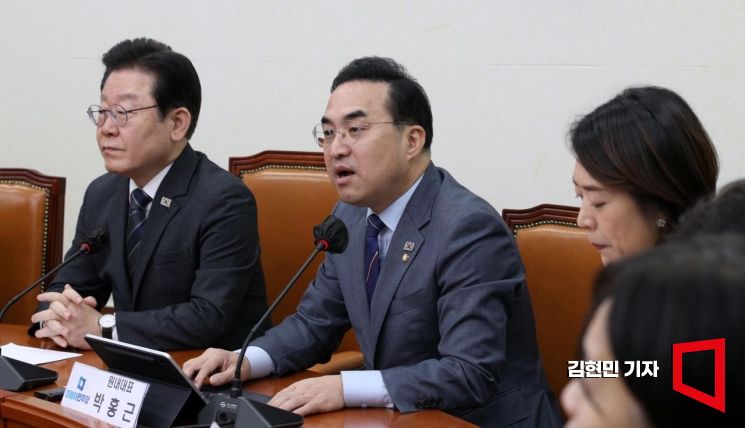 Park Hong-geun, floor leader of the Democratic Party of Korea, is speaking at the Supreme Council meeting held at the National Assembly in Yeouido, Seoul, on the 17th. Photo by Kim Hyun-min kimhyun81@
Earlier, on the 17th, the subcommittee of the Political Reform Special Committee decided to submit improvement plans including ▲single-member districts and regional parallel proportional representation ▲single-member districts and regional semi-compensatory proportional representation ▲mixed urban-rural medium-sized districts and regional proportional representation to the plenary committee. These proposals were not discussed within the Political Reform Special Committee but were discussed by the Speaker's advisory committee. Kim Young-bae, a Democratic Party member who participated in the subcommittee, explained to reporters, "During the draft resolution discussion today, the most important point was that although there were several proposals, the People Power Party decided at their caucus to focus discussions on the Speaker's advisory committee's proposal. Therefore, to facilitate smooth discussions, respecting other parties within a broad framework, it was agreed that the plenary committee would proceed focusing on the Speaker's advisory committee's proposal."
Regarding this, Park said, "The issue of increasing the number of lawmakers has not been specifically discussed within our proposal, and it is difficult to gain public consent. Yet, they are trying to block discussions on this issue by building walls and claiming it aligns with public sentiment. I believe such political cunningness will never be properly evaluated by the public."
He continued, "If there are people who want to listen because the Speaker's advisory body has presented various opinions, then they should listen. But unilaterally labeling the other side as selfishly protecting their own interests without agreement is a bad political behavior," he criticized.
Regarding the Democratic Party's stance on expanding the number of lawmakers, he said, "Would our lawmakers readily agree to increase the number of seats? From the perspective of the negotiating groups of both ruling and opposition parties, we should respect the Speaker's position and gather the best possible solutions that reflect the political reforms the public desires."
On interpretations that the presidential office intervened in the process of halting discussions on electoral law amendments by raising the controversial issue of increasing the number of lawmakers, he said, "The ruling party may have had prior communication with the presidential office to quickly shift this difficult public opinion environment. That is quite possible," he said.
© The Asia Business Daily(www.asiae.co.kr). All rights reserved.

















