Blocked from External Information in Educational Facilities
Facing Difficulties in Social Reintegration
A memorial ceremony was held in Japan to mark the 28th anniversary of the Aum Shinrikyo subway sarin gas attack. Since the assassination of former Prime Minister Shinzo Abe in July last year, awareness of the harm caused by cults has increased, leading to growing interest in the victims of the past Aum Shinrikyo gas attack. The so-called 'second-generation religious children,' who were found in Aum Shinrikyo's facilities at the time and have now become adults, are being recognized as a serious social problem due to reports of social maladjustment and suicide cases.
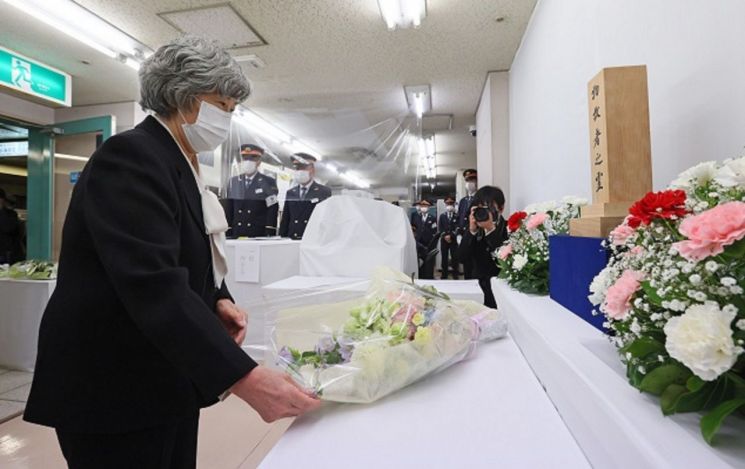 A bereaved family member is placing flowers at the Om Shinrikyo sarin gas terror memorial altar set up at Kasumigaseki Station of Tokyo Metro. (Photo by Japan Public Security Intelligence Agency)
According to NHK, on the 20th, to mark the 28th anniversary of the Aum Shinrikyo subway sarin gas attack, station staff at Kasumigaseki Station on the Tokyo Metro, where the sarin gas was released, held a moment of silence at 8 a.m., the time the incident occurred, to honor the victims. Tokyo Metro has created memorial spaces by installing flower stands at all stations where victims were reported.
On March 20, 1995, Aum Shinrikyo executives, acting under the orders of the cult leader, released highly toxic sarin gas on the subway during rush hour. The attack resulted in 14 deaths and over 6,000 people suffering serious injuries.
Japanese media outlets have also launched follow-up reports. In particular, the Mainichi Shimbun addressed the issue of 'second-generation religious children,' which emerged as a social problem in Japan following the shooting of former Prime Minister Shinzo Abe last year, by focusing on the children who were in Aum Shinrikyo after the sarin gas attack. The term 'second-generation religious children' refers to children who suffered neglect and abuse due to their parents' excessive devotion to religion.
Mainichi reported on the stories of children who left the cult's facilities after the incident and were placed under protective care in child counseling centers. At the time, the police conducted a thorough search of the cult's stronghold facilities in Yamanashi Prefecture and entrusted about 110 children to child counseling centers nationwide. Mainichi stated that it obtained information about the situation at that time through a disclosure request to Yamanashi Prefecture, which protected the largest number of children.
According to records, the children lived in the facilities completely cut off from all information and were unaware that the sarin gas attack had occurred. In fact, testimonies from officials indicate that the children believed they were being attacked with poison gas and stayed indoors without coming outside. In a health check conducted at the Yamanashi Prefecture Child Counseling Center, which was protecting 53 children, 25 children (47.2%) were diagnosed with anemia or malnutrition. Forty-seven children (88.7%) were shorter than the average height for their age group, representing the majority. The counseling center's records noted that some children, despite being hungry and having a strong appetite, did not know how to use chopsticks, and because the cult did not send them to school, they lacked general knowledge.
Subsequent psychological tests also revealed the cult's harmful effects. In a psychological test where children were asked to draw pictures, less than 10% drew a picture of their entire family, and none of the adolescent children drew any family members. Mainichi analyzed that this was because cult leader Shoko Ishihara forced a belief that transcended parent-child relationships, causing families to live separately. It was also reported that many children could not remember their parents' faces or were reluctant to meet them even when parents came to visit during protective care.
 On March 20, 1995, patients exhibiting symptoms of poisoning lined up in the hospital corridor following the sarin gas attack by the Aum Shinrikyo cult. (Photo by Japan Public Security Intelligence Agency)
The children struggled to adapt to society due to the beliefs formed within the cult. Saki (a pseudonym), a second-generation Aum Shinrikyo member interviewed by Mainichi in January, confessed that she was ostracized as a cult member at school and could not continue her studies. She eventually thought that the only place that accepted her was Aum Shinrikyo and returned to the cult. Saki also said that even after leaving the cult, she was so accustomed to religion that she could not reintegrate into society, and some other second-generation Aum Shinrikyo members, fearing being pulled back, took their own lives.
Japan's Ministry of Health, Labour and Welfare established guidelines to protect second-generation religious children and notified them nationwide starting at the end of last year. Masaki Kito, who currently serves as the attorney for the second-generation religious children victim support group, urged, “Unless the government investigates religious organizations and creates a system to publicly disclose the names of groups with extreme doctrines, child abuse caused by religion cannot be reduced.” He also called for measures to define doctrines that violate the constitution, such as prohibitions on dating and restrictions on freedom of marriage, as abuse.
© The Asia Business Daily(www.asiae.co.kr). All rights reserved.
![User Who Sold Erroneously Deposited Bitcoins to Repay Debt and Fund Entertainment... What Did the Supreme Court Decide in 2021? [Legal Issue Check]](https://cwcontent.asiae.co.kr/asiaresize/183/2026020910431234020_1770601391.png)
















