Search Engine Market Share Still Google 93%
MS Bing Daily Users Surpass 100 Million, Changes Expected
The heat of the generative artificial intelligence (AI) 'battle' between Microsoft (MS) and Google is intensifying. Although Google still holds an absolute advantage in the search engine market, the number of users of MS Bing, which features AI chatbot services, is increasing, accelerating the pace of pursuit. Recently, the front line of the AI battle has expanded to the enterprise software market in the 'second round.'
As predictions pour in that AI chatbots will completely change the way modern people live and work, competition between the two companies to seize market leadership is expected to intensify further.
◆ The 'First Round' War Lasting Over a Month... Has the Search Engine Market Changed?
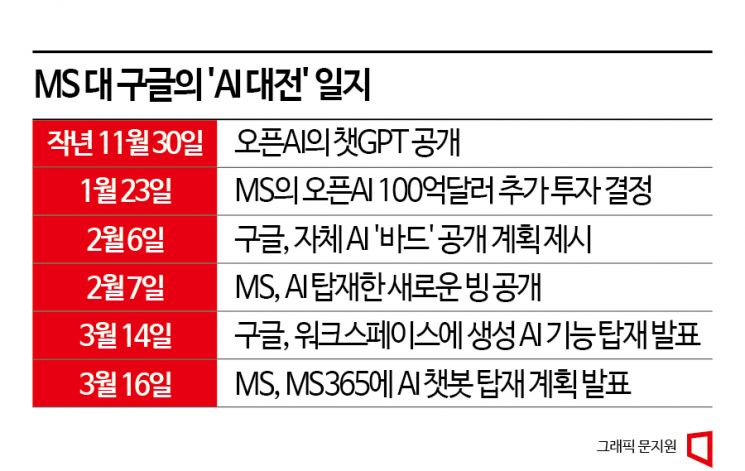
The AI chatbot showdown between Google and MS in the search engine market began in early last month. Google first announced on the 6th that it would unveil its own AI chatbot, 'Bard,' within weeks. The next day, on the 7th, MS released Bing and Edge search engines equipped with AI chatbot functions. Immediately after the announcement, it seemed as if AI chatbots would rapidly transform the search engine market. There were expectations that MS would shake the status of Google, the 'absolute leader' with over 90% market share.
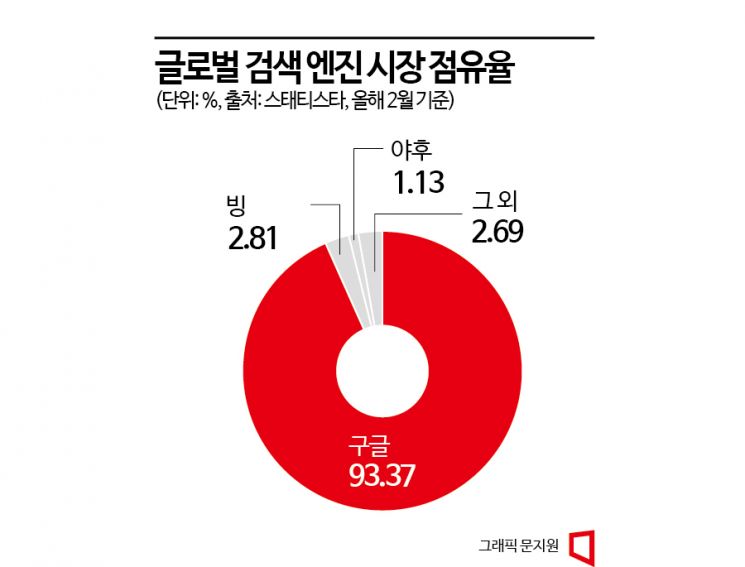
One month after the announcements, the search engine market has not shifted significantly. According to market research firm StatCounter, Google's global search engine market share rose from 92.9% in January to 93.37% in February. During the same period, Bing, ranked second, saw its share drop from 3.03% to 2.81%. Since both companies' AI chatbots are still in the testing phase before official public release, it is considered too early for significant market share changes.
Notably, both Google and MS's AI chatbots have caused market fluctuations by making errors after their release.
Google's Bard, during a demonstration event, incorrectly stated in a video that NASA's James Webb Telescope "played a role in taking the first picture of a planet outside the solar system," which was later proven false. Following this news on the 8th of last month, Google's parent company Alphabet's stock price plunged 8% in a single day. MS also made factual errors, such as stating that a wireless vacuum cleaner's drawback was a 'short cord.'
The US online media Axios reported, "This (AI war) is not a sprint but a marathon. Companies have spent years developing the technology up to this point, and it will take more time to perfect it."
However, MS, backed by the success of ChatGPT, continues to advance. On the 8th, MS announced via a blog post that since the release of Bing with AI chatbot, over one million additional users have joined, and Bing's daily active users have surpassed 100 million. They also reported an increase in daily search volume. MS founder Bill Gates warned last month that ChatGPT would change society as much as the internet and pose a threat to Google's search-related revenue.
MS has also been actively working to secure online advertising, the core revenue source of the search engine market. According to Business Insider and others, MS held briefings worldwide over the past month to attract advertisers. Since dominating the search engine market directly correlates with advertising revenue, MS provided information on how advertisers could utilize AI chatbots. For example, when asked to plan a vacation, the chatbot responds with an answer and includes a flight booking link in the annotation section.
Advertising is the fundamental revenue source for search engines. Currently, Google holds over 90% of the search engine market share. Google's advertising revenue last year was $224 billion (approximately 294 trillion KRW). In comparison, MS's search engine advertising revenue in the past 12 months was only $18 billion. Although this is an increase from $10 billion a year ago, it remains vastly insufficient compared to Google.
◆ 'Second Round' Escalates to the Office... Now Google Chases MS
The AI chatbot war between MS and Google has expanded to the second round in just over a month. Both companies are moving to dominate the enterprise software market used in offices. This market is where MS, which had to challenge Google as the second in the search engine field, is the 'absolute leader.' According to The Wall Street Journal (WSJ), MS holds an 85% market share in enterprise software, while Google holds 14%. MS is estimated to have earned $41 billion last year from its enterprise software 'MS365.'
On the 14th, Google announced it would integrate generative AI into Workspace, emphasizing the expansion of its massive AI ecosystem. In Google's Workspace, AI can assist with writing emails or other tasks to enhance productivity. Two days later, on the 16th, MS unveiled 'MS365 Copilot,' announcing plans to embed AI chatbots into MS365 applications such as Word, Excel, PowerPoint, Outlook, and Teams.
Business Insider reported, "MS is chasing Google Search. Now Google is resisting by attacking MS Office."
The AI chatbot competition between the two sides is intensifying. US economic media Fortune reported that on the same day Google announced AI integration into Workspace, it also announced generative AI support for the Vertex AI platform for developers. Thomas Kurian, CEO of Google Cloud Business, reportedly revealed this product even though internal discussions on pricing had not yet taken place. This was seen as a demonstration of how fierce the AI technology race is.
Both companies reportedly reacted sensitively to the timing of announcements. According to Axios, Google notified on the 13th, a day before, that it would hold a press conference on the 14th?two days earlier than MS's AI announcement related to MS365 scheduled for the 16th. Last month, Google also hastily mentioned Bard when MS was expected to announce AI chatbots integrated into Bing and Edge.
© The Asia Business Daily(www.asiae.co.kr). All rights reserved.



















