Medical School Quotas Increased by 3,616 Students Over 10 Years
Compared to 10 years ago, the number of students taking the College Scholastic Ability Test (CSAT) has decreased, but the enrollment quotas of top-tier universities have rather increased.
According to Jongro Academy on the 20th, the number of CSAT test takers for the 2023 academic year was 447,669, a 28.0% (173,667) decrease compared to 621,336 in the 2013 academic year.
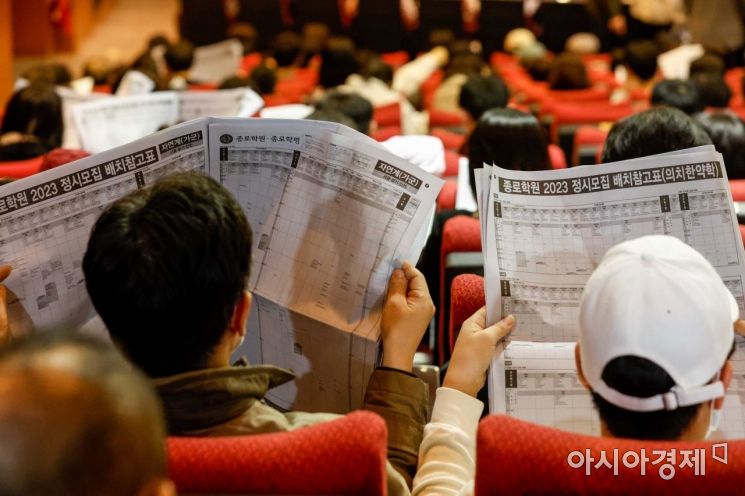 On the 11th, parents and examinees attending the 'Jongno Academy, 2023 Regular Admission Strategy Briefing' held at the 600th Anniversary Hall of Sungkyunkwan University in Jongno-gu, Seoul, are looking at the placement test chart. Photo by Kang Jin-hyung aymsdream@
In fact, during the same period, the enrollment quotas of Seoul National University, Korea University, and Yonsei University increased by 423 students from 11,088 in 2013 to 11,511 in 2023. The quotas of 10 major universities in the Seoul area also increased by 1,376 students during the same period.
The medical field also saw a significant increase in enrollment quotas as admissions shifted from professional graduate schools to undergraduate selection. The number of medical field admissions increased by 3,616 from 2,980 to 6,596 during the same period. The increase in enrollment quotas based on undergraduate selection was △Medical schools 1,475 (95.9%) △Dental schools 392 (164.7%) △Korean medicine schools 7 (1.0%) △Veterinary schools 0 (0%).
Specialized science and engineering universities also increased by 880 students during the same period due to the government's science and engineering promotion policies, with the establishment of Korea University of Energy Science and Technology and Daegu Gyeongbuk Institute of Science and Technology (DGIST).
While the school-age population has generally decreased, leading to fewer students overall, the enrollment quotas of top-tier universities have increased, resulting in more cases of students entering top universities with relatively lower scores than 10 years ago.
The top grade in the CSAT, grade 1, is given to students in the top cumulative 4%, but since the total number of students has decreased, the number of grade 1 students has also declined. The number of students with grade 1 in Korean was 30,054 ten years ago but has now decreased by 11,196 to 19,858, and mathematics also saw a decrease of 5,902 students.
This explains why recently students with grades 2 to 3 in the regular admission have been admitted to the highest-ranking universities.
Lim Seong-ho, CEO of Jongro Academy, analyzed, "The fact that students with grade 3 were able to enter top-tier universities was partly due to the high discriminative power of mathematics, but also because the university admission threshold has lowered, which acted as a complex factor."
© The Asia Business Daily(www.asiae.co.kr). All rights reserved.

















