National Assembly Political Reform Special Committee Proposal to Expand Number of Lawmakers
Ruling Party Leadership Strongly Opposes "Absolutely No 50 Member Increase"
Jo Kyung-tae "Today, 100 Member Reduction Public Petition"
As the next year's general election for the National Assembly approaches, controversy is spreading as the National Assembly is pushing for a plan to expand the current 300 seats. The expansion of the number of National Assembly members has been a recurring topic in every general election, but it has always been blocked by public opposition. This time as well, difficulties are expected as opposition is pouring in from the very beginning.
Kim Gi-hyeon, leader of the People Power Party, said at the party's Supreme Council meeting held at the National Assembly on the 20th, "The Democratic Party, which took the lead in creating the 'semi-proportional representation system,' a nationality-unknown and identity-unknown electoral system, must be corrected, but suddenly the issue of increasing the number of members is coming up by exploiting that gap," adding, "Our party will never allow the number of members to increase under any circumstances."
Joo Ho-young, floor leader of the same party, also stated at the meeting, "It was made clear at the party members' meeting that the number of members should not be increased," and criticized, "Since there are problems with the current single-member district system, there is an opinion to change the electoral system to avoid factional politics by adopting a large multi-member district system as much as possible, but this was not reflected at all, and two proposals to increase the number of members by 50 seats were submitted and passed."
Reorganization Plan of the Political Reform Special Committee: Expansion of National Assembly Members from 300 to 350
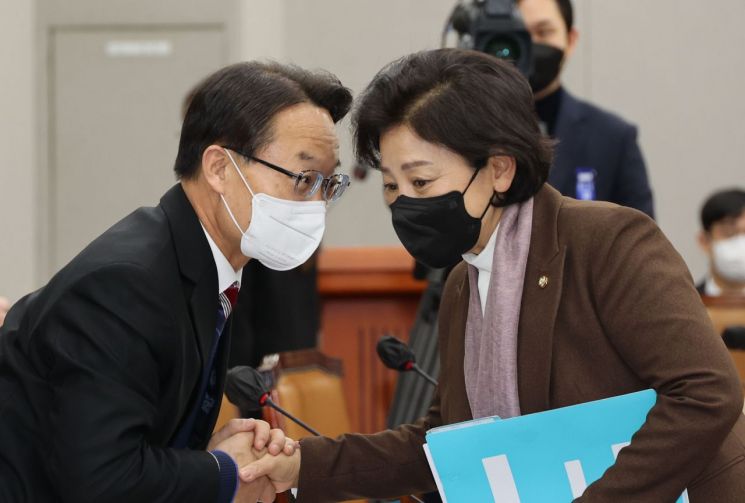
Earlier, on the 17th, the National Assembly's Political Reform Special Committee held a subcommittee meeting on political relations law improvement and resolved three electoral system reform plans to be discussed at the plenary committee. All three plans compressed by the Political Reform Special Committee aimed to expand proportionality. In particular, Plan 1 combines the single-member district system with regional and parallel proportional representation. It maintains the current single-member district system (one member per electoral district) and elects proportional representatives based on the party vote share regardless of the results in the district elections. Plan 2 is a 'single-member district + regional semi-proportional representation system,' where if a party does not fill seats equivalent to its vote share in the district, the proportional representatives are allocated accordingly. Both Plan 1 and Plan 2 increase the number of proportional representatives by 50 compared to the current system, raising the total number of members to 350. The three reform plans approved this time are broadly similar to the proposal submitted by Speaker Kim last month.
To increase proportional representatives under the current electoral system, the number of district seats must be reduced, which is expected to face strong opposition from incumbent members. Therefore, the Political Reform Special Committee proposed a kind of compromise plan to increase the number of proportional representative seats.
However, opposition remains high. According to a public opinion poll conducted by the Political Reform Special Committee in January, 57.7% disagreed with expanding the number of members, more than twice the 29.1% who agreed. This perception is interpreted as influenced by distrust of members' privileges and concerns about budget increases. The subcommittee's resolution stated that it would consider 'freezing members' salaries and personnel expenses,' but practical difficulties are involved. According to the National Assembly Secretariat, as of 2019, one National Assembly member receives an annual salary of about 151.76 million KRW. Including office operation costs, the annual expense exceeds 600 million KRW. Even if personnel expenses are frozen, it is not easy to cover the costs for an additional 50 members without specific alternatives. Regarding this, Speaker Kim Jin-pyo proposed on CBS Radio on the 1st of last month a plan to freeze personnel budgets for five years in case of member increase.
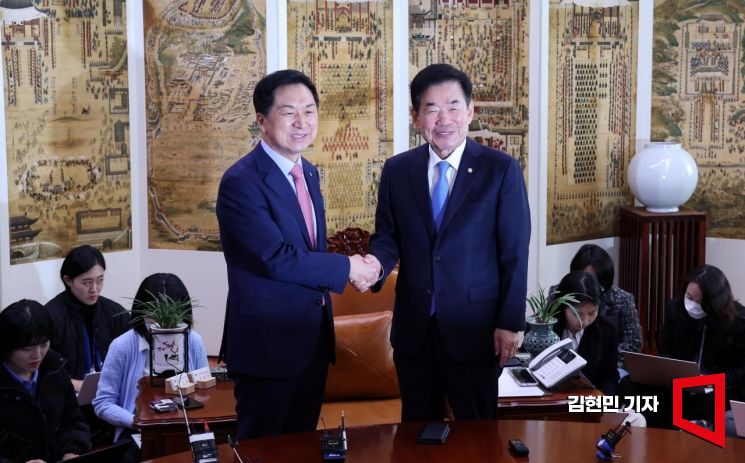 Kim Ki-hyun, leader of the People Power Party, is shaking hands with Kim Jin-pyo, Speaker of the National Assembly, at the Speaker's office in Yeouido, Seoul on the 20th. Photo by Kim Hyun-min kimhyun81@
People Power Party Lawmaker Cho Kyung-tae: "Starting Signature Campaign to Reduce Number of Members by 100"
Immediate opposition from district-based members facing the upcoming general election is another hurdle. They react sensitively not only to the reduction of district members but also to the public opinion changes that may arise from expanding the total number of members. In fact, People Power Party lawmaker Cho Kyung-tae held a press conference at the National Assembly Communication Office on the morning of the same day, urging, "The National Assembly's discussion to increase the number of members by 50 must be stopped immediately." The five-term veteran lawmaker said, "Through my legislative activities, I have felt that 200 seats are sufficient for the National Assembly," and argued, "The number of members should be reduced by at least 100 through the abolition of proportional representation and redistricting." To this end, Cho announced that he would start a public signature campaign to reduce the number of National Assembly members from that day.
Earlier, Daegu Mayor Hong Joon-pyo also claimed on his Facebook, "The United States fixed the number of House members at 435 in 1917, and even though the population has increased two and a half times, there has been no increase in members. By US standards, we only need 80 members, but we have 300," arguing that the current number of seats should rather be reduced under existing law.
According to the National Election Commission's 'Comparative Study of Electoral Systems in Various Countries,' as of last year, the population per National Assembly member in Korea is 170,000, ranking fourth highest among 36 OECD countries. The country with the highest population per member is the United States, with 770,000 per member in the House of Representatives and 630,000 per member when including both houses. In contrast, Germany has 130,000 per member (140,000 per member in the House), and France has 70,000 per member (110,000 per member in the House), meaning major OECD countries have fewer people per member than Korea.
Lee Kang-yoon, director of the Korea Social Opinion Institute, explained, "Regardless of whether the public is persuaded, it is sufficient if the political circle makes a grand decision," adding, "The basis for argument is always prepared." He further diagnosed, "What is important is not whether to expand the number of members, but whether to maintain the single-member district system or introduce a large multi-member district system. Discussions should proceed on this level, and the decision on whether to expand the number should be made as necessary." A Political Reform Special Committee official said, "The plans approved by the subcommittee are for intense pro and con debates at the plenary committee," leaving room for interpretation, "The key is who can approach the public more persuasively." The Political Reform Special Committee plans to hold a plenary meeting on the 22nd to make a final decision on whether to submit the resolution.
© The Asia Business Daily(www.asiae.co.kr). All rights reserved.


















