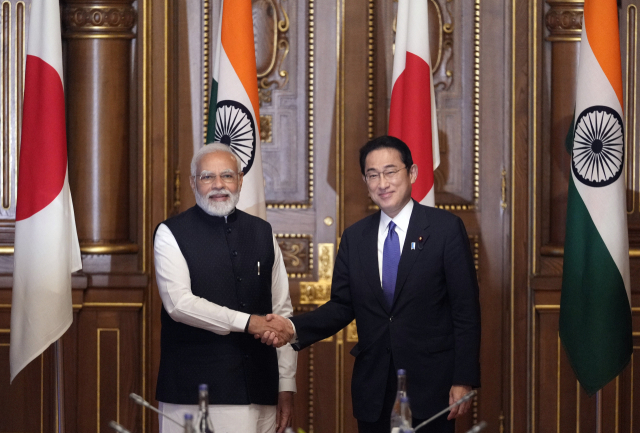
 Fumio Kishida (right), Prime Minister of Japan, and Narendra Modi, Prime Minister of India, are shaking hands during a summit meeting in Tokyo on May 24 last year.
 [Image source=EPA Yonhap News]
Prime Minister Kishida, who set out for a visit to India from the 19th to the 22nd, is expected to strongly urge the Indian side to join the international coalition pressuring Russia ahead of his meeting with Indian Prime Minister Narendra Modi.
On the 20th, Bloomberg cited a senior Japanese government official saying that Kishida is likely to pressure India during the summit held that day to cooperate on energy sanctions or provide weapons support as part of anti-Russian coordination.
On the second day of his visit to India, Prime Minister Kishida is scheduled to meet with Prime Minister Modi, who is chairing this year’s Group of 20 (G20). Earlier, when announcing his tour plans on the 10th, Kishida expressed his intention to "communicate closely to strengthen cooperation among the leaders of the G7 and G20."
A senior Japanese government official said Kishida is expected to request support from India to build a strong anti-Russian front against Russia’s invasion of Ukraine. In particular, Kishida reportedly wants to understand India’s stance from the perspective of a developing country.
The reason Kishida is making efforts to persuade India is that, unlike the G7 countries that have formed an anti-Russian coalition, India has maintained a neutral stance on the Russia-Ukraine conflict.
India has so far taken an independent approach, not siding with either the West or Russia regarding the Russia-Ukraine invasion. Maintaining neutrality to prevent great powers from exerting excessive influence over the country is a traditional diplomatic approach for India. While India is a member of the U.S.-led security dialogue Quad, it has also maintained close relations with Russia since the Cold War era to counterbalance Pakistan and China. Moreover, since Russia’s invasion of Ukraine, India has shown signs of growing closer to Russia, including more than doubling its imports of Russian oil.
In this context, Kishida appears to feel the need to assert Japan’s presence as the chair country of the G7.
During his visit, Kishida is expected to announce a new plan to realize a "free and open Indo-Pacific," a concept advocated by Japan. The plan is likely to include Japan spending $2 billion over three years to provide equipment and training to ASEAN (Association of Southeast Asian Nations) to help improve maritime border and surveillance capabilities.
It is also expected to include expanding Japan’s official development assistance (ODA) to developing countries to support infrastructure development.
Furthermore, Japan plans to increase its official development assistance (ODA) to developing countries to support high-quality infrastructure development.
Bloomberg explained, "India is currently in a military standoff with China over its border, and Japan is in conflict with China over ownership of islands in the East China Sea," adding, "Both Japan and India are concerned about China’s expanding influence related to territorial disputes, and this shared concern will influence the friendly security relationship between the two countries."
© The Asia Business Daily(www.asiae.co.kr). All rights reserved.

















