Recruitment Scale to Expand by 21.6% in the First Half of Next Year
Low Birthrate Labor Shortage... Raising Starting Salaries to Attract Talent
While 55% of South Korea's large corporations announced no plans for new hires in the first half of this year, Japan, whose working-age population is the lowest among OECD countries, is facing a situation where companies are significantly increasing their hiring plans due to labor shortages. With a shortage of workers, companies have begun a wave of starting salary increases to secure young talent.
On the 20th, the Nihon Keizai Shimbun (Nikkei), together with the polling agency Nikkei Research, surveyed 5,097 major companies about their hiring plans for next year. The number of companies that responded they have plans to hire university graduates in the first half of next year increased by 21.6% compared to this year. This is the second-highest growth rate since 2006, a period of economic expansion since 2000. The hiring scale is expected to reach 106,271 people.
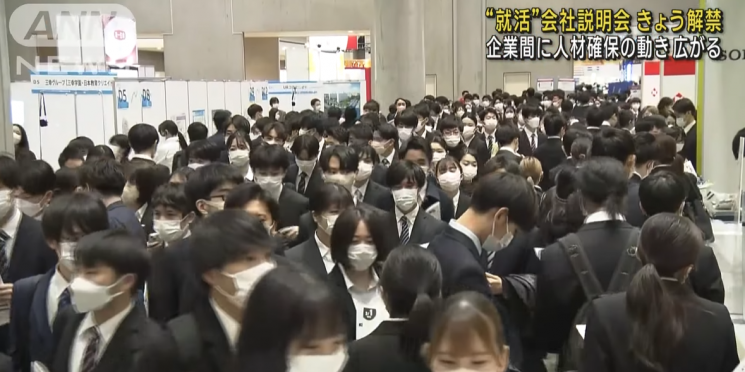
Nikkei analyzed that this is due to the worsening labor shortage caused by the continuous decline in the working-age population due to low birth rates. According to Japan's Ministry of Internal Affairs and Communications, the working-age population aged 15 to 64 was 74 million as of February this year, a 15% decrease compared to 1995, when low birth rates and aging peaked. It is projected to decrease to 52.75 million by 2050, a 39% decline compared to 1995. In reality, as the labor population itself decreases, the number of business closures, especially among local small and medium-sized enterprises, is increasing. The Ministry of Economy, Trade and Industry predicts that the loss in gross domestic product (GDP) will reach about 22 trillion yen (281 trillion won) by 2025.
In particular, as the COVID-19 pandemic subsides, labor shortages in the non-manufacturing sector, which did not hire during the pandemic, appear to have intensified. The hiring scale in the non-manufacturing sector for the first half of next year is expected to increase by 23.5% compared to this year. For example, All Nippon Airways (ANA) responded that it plans to increase its hiring scale by 2.1 times compared to the existing scale. An ANA official told Nikkei, “We need to secure talent to respond to the recovered air travel demand.” In the food service industry, the large food service company Zensho Group, which operates gyudon and sushi chains, plans to increase hiring by 86.5% in the first half of next year compared to this year, citing accelerated store openings as a reason.
In the manufacturing sector, companies plan to recruit talent in digital transformation, semiconductors, and decarbonization fields. Fujifilm Holdings plans to hire 820 people in the first half of next year, a 17.5% increase from this year, stating that it will strengthen talent to keep pace with digital transformation. Toshiba plans to expand hiring in the semiconductor field for use in electric vehicles and other areas.
Given Japan’s characteristic of rare experienced hires and a focus on new graduate recruitment, competition among companies to attract young talent is expected to accelerate further. Additionally, the characteristics of Japan’s MZ generation (Millennials + Generation Z) have further driven corporate changes. While companies face labor shortages, job seekers can choose companies that match their conditions. In Japan, job hunting is conducted during university, and students go through a process called “naitei,” where they receive job offers before graduation. Recently, the ratio of naitei to planned hires was only 88.9%, according to Nikkei. Among the companies surveyed, 35.1% said they failed to meet their hiring targets in the first half of this year and had to conduct additional recruitment.
Recently, among employees in their 20s and 30s, there has been a trend of active job changes due to treatment and other reasons. In response, companies plan to raise starting salaries significantly to attract talent. More than 70% of companies participating in the Nikkei survey said they plan to increase starting salaries.
© The Asia Business Daily(www.asiae.co.kr). All rights reserved.

















