4 out of 10 US Loans Handled by Small and Medium Banks
Reducing Loans Expected to Tighten Household and Corporate Credit
Goldman Sachs "Recession Probability in 12 Months Rises from 25% to 35%"
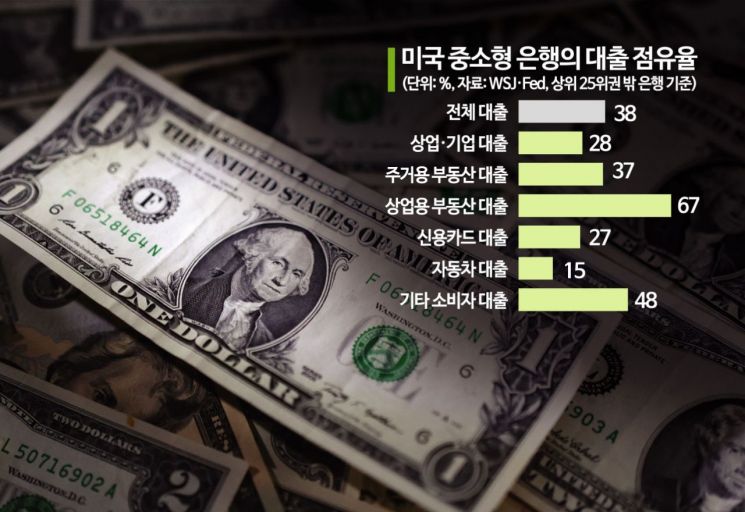
Concerns about a U.S. economic recession have resurfaced following the Silicon Valley Bank (SVB) bankruptcy crisis, which even raised the possibility of a 'no landing' scenario. There are forecasts that credit tightening for households and businesses could occur as small and medium-sized banks, responsible for 4 out of 10 loans nationwide, reduce lending to manage risks.
On the 19th (local time), The Wall Street Journal (WSJ) reported, citing experts, that recent turmoil in the financial sector centered on small and medium-sized banks is hindering economic growth and escalating the risk of a recession. This outlook is based on the fact that these banks play a driving role in the U.S. loan market and are a key force behind economic revitalization. The SVB crisis could cause lending by small and medium-sized banks, which function as the 'lifeblood' of the economy, to become severely restricted.
According to an analysis of U.S. Federal Reserve (Fed) data by WSJ, 38% of all U.S. loans are concentrated in small and medium-sized banks outside the top 25. By loan type, these banks accounted for 67% of all commercial real estate loans in the U.S. Next, they handled 37% of residential real estate loans, 28% of commercial and corporate loans, 27% of credit card loans, and 15% of auto loans.
Greg Daco, Chief Economist at global accounting and consulting group Ernst & Young, said, "The risk stemming from SVB is already a reality," adding, "Once stress occurs at a particular institution, similar institutions tend to become more cautious in lending." He further predicted, "We are likely to remain in this state for the long term."
As SVB failed to respond to tech companies' deposit withdrawals, investors began closely monitoring the bank's liquidity status. This led to a plunge in financial stocks due to fears of a bank run (massive deposit withdrawals). Torsten Slok, Chief Economist at private equity firm Apollo Global Management, explained, "Small and medium-sized banks are likely to respond by tightening lending standards and reducing loans to raise capital ratios," adding, "Through such moves, they will cope with fickle depositors who might withdraw deposits at any time and volatile capital raising costs."
If the reduction in lending by small and medium-sized banks accelerates, it could lead to a U.S. economic recession. Reduced household lending would decrease consumption, and companies would likely face financial difficulties. Slok, who had previously anticipated a no landing scenario before the SVB bankruptcy, warned, "Due to the lending cuts by small and medium-sized banks, we will enter a recession by mid-year," and expressed concern that "With added risks from these banks, we are heading toward a hard landing or a painful recession." The term 'no landing' is a neologism meaning the economy maintains a prolonged boom without falling into recession or stagnation.
U.S. investment bank Goldman Sachs had previously estimated a 25% chance of a recession within 12 months but raised this to 35% after the SVB bankruptcy. Chief Economist Daco predicted that without a financial collapse, credit and financial tightening would reduce U.S. gross domestic product (GDP) by 0.5% over the next 18 months. Mark Zandi, Chief Economist at Moody's Analytics, also warned, "U.S. economic growth could slow from 1-2% in Q1 to 0-1% in Q2 and Q3, and depending on circumstances, could turn negative."
According to Fed research, banks began reducing lending from the end of last year. This was due to difficulty finding high-credit borrowers amid interest rate hikes and weakened loan demand. Fedrek Gavey, Head of Research at ING Bank, said, "The SVB collapse will deepen (loan) tightening, a bad sign for the labor market, by slowing expansion and investment," adding, "There is a strong correlation between lending standards and unemployment rates."
© The Asia Business Daily(www.asiae.co.kr). All rights reserved.
![Clutching a Stolen Dior Bag, Saying "I Hate Being Poor but Real"... The Grotesque Con of a "Human Knockoff" [Slate]](https://cwcontent.asiae.co.kr/asiaresize/183/2026021902243444107_1771435474.jpg)
















