Inside and outside, emphasis on China's role as a 'war mediator'
Practical discussions on economic cooperation between the two countries are also expected
Chinese President Xi Jinping will make a three-day state visit to Russia starting on the 20th. While international attention is focused on Xi's role as a mediator in the war between Ukraine and Russia, it is also expected that the two countries will discuss joint responses to U.S. economic pressure and practical directions for economic cooperation.
According to the Chinese Ministry of Foreign Affairs on the 20th, President Xi will visit Russia on a state visit from the 20th to the 22nd at the invitation of Russian President Vladimir Putin. This marks Xi's first overseas trip since being re-elected as both the President and Chairman of the Central Military Commission, achieving a 'third term.' He will meet President Putin face-to-face for the first time in seven months since the Shanghai Cooperation Organization (SCO) summit held in Uzbekistan last September.
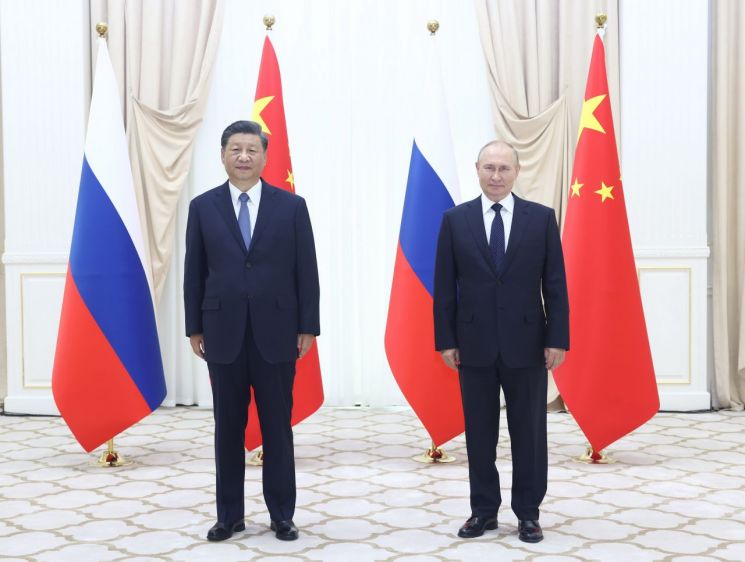
Regarding the purpose of this visit to Russia, China has emphasized mediation in the Ukraine war. Wang Wenbin, spokesperson for the Chinese Ministry of Foreign Affairs, stated at a regular briefing on the 17th, "President Xi's visit to Russia is a journey of friendship, cooperation, and peace," adding, "It will play a constructive role in encouraging reconciliation on the Ukraine issue and promoting dialogue." He further explained, "Safeguarding world peace and promoting common development are the goals of China's foreign policy," and "China will maintain an objective and fair stance and play a constructive role in resolving the crisis politically."
Through this summit, the two countries are also likely to strengthen economic cooperation under the pretext of joint responses to the United States. Chinese state media pointed out that the Western world views China's mediator role with suspicion and criticism. The Chinese state-run Global Times (GT) cited Alexander Lukin, head of the East Asia Center at the Moscow State Institute of International Relations, saying, "Russia definitely trusts China as a mediator, but the problem is that Ukraine and the West do not," and reported, "Therefore, China can hardly play a mediation role." Lukin emphasized, "In the early stages of the conflict, Russian and Ukrainian delegations met directly, but it was not due to the absence of a mediator; rather, Ukraine refused to engage in dialogue."
Russian local media, quoting Yuri Ushakov, Kremlin foreign affairs advisor, mentioned that the two leaders will sign bilateral documents including a declaration on entering a new era of relations and a development plan for key areas of Russia-China economic cooperation through 2030, referring to the expected outcomes of the summit.
Before visiting Russia, President Xi emphasized the long-standing friendly relations between the two countries in an article contributed to Russian local media. He particularly highlighted that Russia was his first overseas destination after becoming president ten years ago, stating, "Over the past several years, I have met President Putin 40 times at international events," and "We have drawn blueprints for bilateral relations and cooperation in various fields and communicated in a timely manner on major international and regional issues, sharing responsibility for the continuous and stable growth of China-Russia relations."
President Xi also directly addressed the importance of economic cooperation. He explained, "Last year, China-Russia trade exceeded $190 billion (approximately 248.52 trillion won), an increase of 116% compared to ten years ago," adding, "China has been Russia's largest trading partner for 13 consecutive years." He further noted, "Our bilateral investment continues to grow steadily, and cooperation on major projects in fields such as energy, aviation, space, and connectivity is steadily progressing."
Wang Yiwei, director of the Institute of International Studies at Renmin University, told GT, "President Xi's first visit to Russia since taking office fully demonstrates how much China values the new era of China-Russia relations," describing it as "a model for a new type of international relations." He added, "As permanent members of the UN Security Council, China and Russia have the responsibility to reject unilateral hegemony and advance the path of a multipolar world," emphasizing the need to strengthen strategic coordination with Russia.
© The Asia Business Daily(www.asiae.co.kr). All rights reserved.
![Clutching a Stolen Dior Bag, Saying "I Hate Being Poor but Real"... The Grotesque Con of a "Human Knockoff" [Slate]](https://cwcontent.asiae.co.kr/asiaresize/183/2026021902243444107_1771435474.jpg)











