One in Four of the Poorest Remains Silent on Rights Violations
Higher Income Leads to More Conversations with People Around Them
A study has revealed that the lower the income and education level, the more hesitant people are to voice their opinions in society and to talk with those around them.
It is analyzed that these individuals have a low sense of 'political efficacy,' which is the belief that their voice can influence politics.
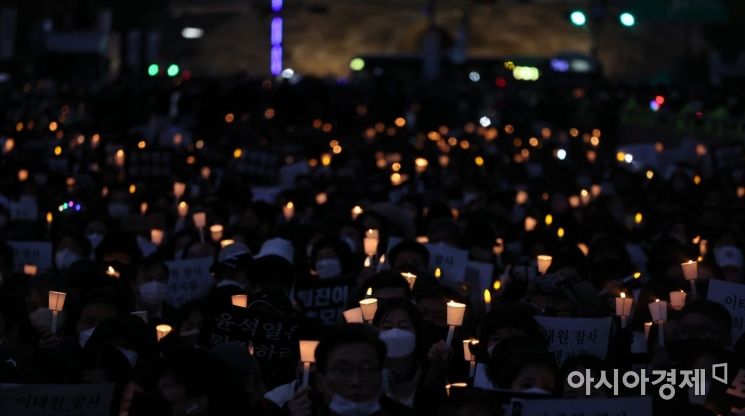
The problem is that this situation can distort the political process and lead to the adoption of policies that are not favorable to vulnerable groups.
On the 20th, the Korea Institute for Health and Social Affairs (KIHASA) published the results of the 'Polarization of Political and Social Participation' in the February issue of its monthly Health and Welfare Forum. The study was based on the 'Social Participation, Capital, and Perception Survey' conducted from August to October 2021 on 8,174 people aged 19 to 59.
A notable point in this survey was the 'silence' of those with a high school education or less, or those in the lowest income quintile (1st quintile).
One in four of these individuals did not talk to people around them even when their own or their family's interests were infringed upon.
High School or Less... Silence Even When Interests or Rights Are Violated
When asked whether they talk with people around them when their own or their family's interests or rights are violated, 77.63% of those with a high school education or less answered yes. In contrast, 85.79% of those with a college degree or less and 91.32% of those with graduate degrees said they talk with people around them.
Also, the response rate to this question increased with income. The response rate of the 1st income quintile was the lowest at 74.65%, followed by 83.36% in the 2nd quintile, 86.06% in the 3rd, and 88.78% in the 4th. The 5th quintile was slightly lower than the 4th at 87.99%.
Responses to 'When my or my family's interests or rights are violated, I convey my opinions to politicians or public officials' showed a similar pattern. The gap between those with graduate degrees (73.57%) and those with a high school education or less (52.10%), and between the 1st income quintile (49.44%) and the 5th quintile (67.33%) was 21.47 and 16.89 percentage points, respectively.
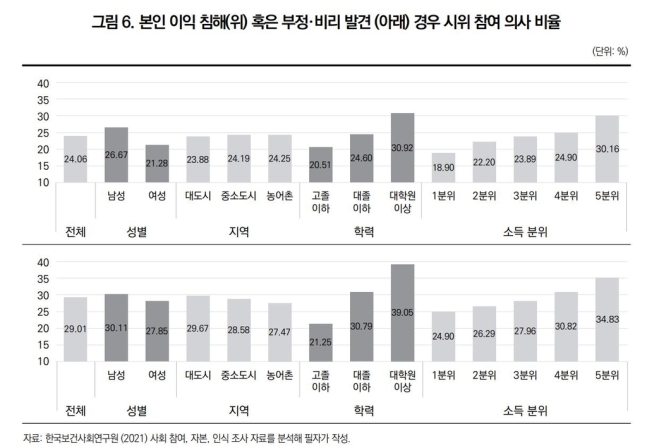
The willingness to participate in rallies or demonstrations, which can be seen as active self-assertion, was particularly higher among highly educated and high-income individuals.
There was about a 10 percentage point difference between those with a high school education or less (20.51%) and those with graduate degrees (30.92%). Notably, the response rate of the 1st income quintile (18.90%) was nearly half that of the 5th quintile (30.16%).
Political Efficacy Varies by Income and Education
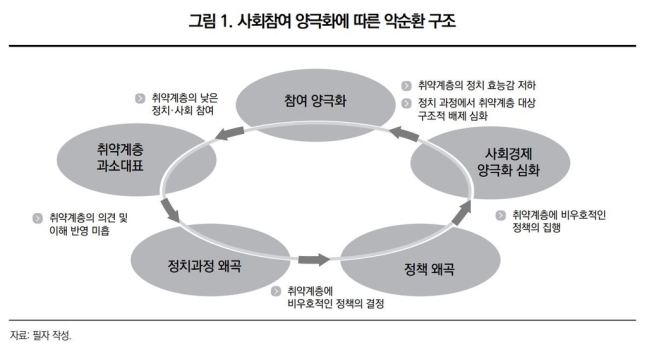
The research team viewed that the polarization of social and political participation was influenced by differences in 'political efficacy' according to income and education. Political efficacy refers to the belief in the government's likelihood and ability to accommodate citizens' demands.
Among those with a high school education or less, 20.71% responded that they 'do not agree at all' or 'do not really agree' with the statement, 'People like me cannot influence what the government does.'
This figure was 24.60% in the 1st income quintile, much lower than 37.53% for those with graduate degrees and 35.22% for the 5th income quintile.
The proportion of respondents who said they 'always participate in voting' showed a similar trend. It was higher among those with graduate degrees (70.21%) than those with a high school education or less (43.49%), and higher in the 5th income quintile (59.68%) than in the 1st (46.78%).
The participation rates in civic groups and political parties showed a 'U-shaped' pattern, with both low-education and high-education groups, as well as the 1st and 5th income quintiles, having higher rates.
The participation rate in civic groups was similarly high in the 1st income quintile (5.13%) and the 5th quintile (4.77%), with the lowest rate in the 3rd quintile (3.24%). Political party participation was higher among those with a high school education or less (5.39%) and those with graduate degrees (4.70%) than among those with a college degree or less (4.27%).
Researcher Kim Ki-tae pointed out, "The low political and social participation of vulnerable groups leads to the problem of 'underrepresentation of vulnerable groups,' which may result in insufficient reflection of their opinions and interests in political decision-making processes."
He added, "Policies tend to serve the interests of high-income and vested groups more, which could worsen income polarization and create a vicious cycle where the political efficacy of vulnerable groups declines."
© The Asia Business Daily(www.asiae.co.kr). All rights reserved.



















