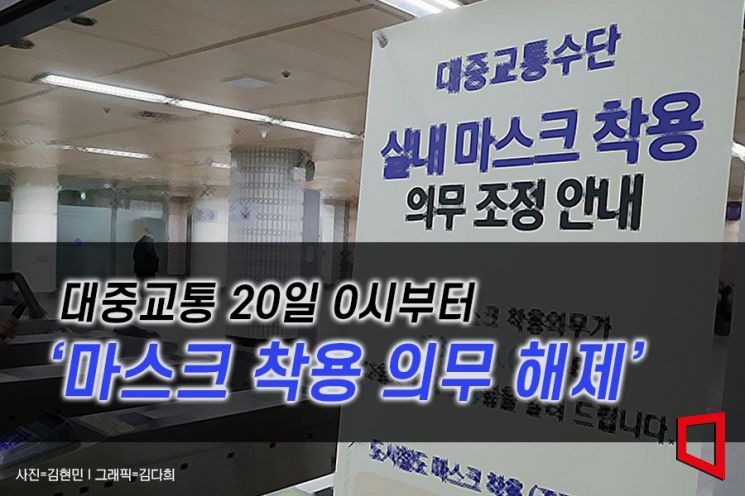
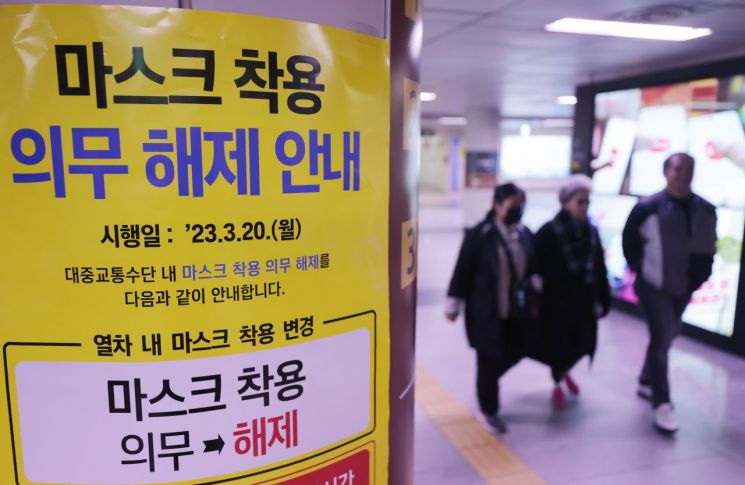
As of midnight on the 20th, the mandatory mask-wearing requirement on public transportation such as buses, subways, and taxis has been lifted. The so-called 'no mask' policy is now also possible on airplanes. This marks the end of the government-mandated mask-wearing that began in October 2020, after two years and five months.
The facilities where masks are no longer required now include large open-type pharmacies without walls or partitions inside large facilities such as marts, department stores, and stations. This is because it was inefficient to mandate mask-wearing given the difficulty in distinguishing between mask-free and mask-required areas and the fact that the same air is shared. Now, indoor mask mandates apply only to infection-vulnerable facilities severely impacted by COVID-19, such as hospitals, general pharmacies, long-term care hospitals, long-term care institutions, and welfare facilities for the disabled. Practically, this means that ordinary people will no longer experience discomfort from mandatory mask-wearing.
This measure follows the continued decline in COVID-19 cases since the first phase adjustment of indoor mask mandates on January 30, which applied to places like restaurants, cafes, and schools. The number of critically ill patients and deaths decreased by 68.5% and 56.0%, respectively, from the week of January 22-28 (463 critically ill, 25 deaths) to the week of March 5-11 (146 critically ill, 11 deaths).
However, health authorities recommend that masks continue to be worn in crowded situations such as rush hours or by workers in open-type pharmacies even after the mask mandate is lifted. Since mask-wearing remains the most basic preventive measure against respiratory infections like COVID-19, it is advisable to wear masks based on personal judgment when in 3Cs (closed spaces, crowded places, close-contact settings).
Although the mask mandate on public transportation has been lifted, citizens are expected to continue wearing masks for the time being. In a recent public opinion survey, 7 out of 10 people responded that they would continue wearing masks indoors even after the mandate is lifted. Jeong (age 30), who commutes every morning from Sillim Station in Seoul to his workplace in Gangnam, said, “I think I will keep wearing a mask during rush hours when the distance between my face and others’ is less than 10 cm.”
The remaining quarantine measures now include mask-wearing in medical institutions and a 7-day isolation requirement. The government plans to adjust these measures together when the World Health Organization (WHO) Emergency Committee scheduled for late April to early May lifts the Public Health Emergency of International Concern (PHEIC). Health authorities plan to prepare a ‘Recovery Roadmap’ by the end of this month in advance.
© The Asia Business Daily(www.asiae.co.kr). All rights reserved.


















