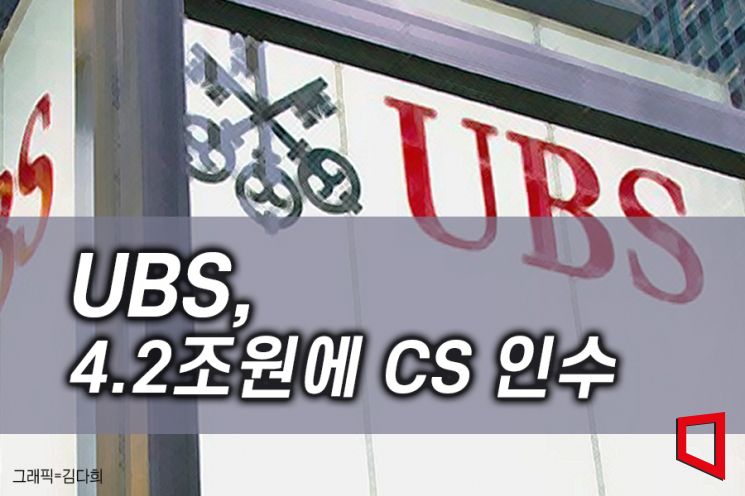
To prevent the global spread of financial risks, Switzerland's largest financial institution, UBS, has agreed to acquire Credit Suisse (CS), which is facing a liquidity crisis, for approximately 3 billion Swiss francs (about 4.24 trillion KRW). This comes just five days after CS's financial report revealed a 'material weakness,' which sharply escalated the liquidity crisis. Swiss financial authorities also stepped in with large-scale liquidity support measures to contain the financial market shock triggered by CS.
On the 19th (local time), UBS and CS announced at a press conference and in a statement held in Bern, Switzerland, that the two companies had signed a merger agreement with UBS as the surviving entity.

The acquisition price for CS by UBS is 0.75 Swiss francs per share, totaling 3 billion Swiss francs. All CS shareholders will receive 1 UBS share for every 22.48 CS shares. This offer exceeds the acquisition price of 0.25 Swiss francs per share, which was reported earlier that morning as having been rejected by CS. However, it is far below CS's market value based on the closing price of 1.86 Swiss francs per share on Friday the 17th.
This acquisition was requested by the Swiss government, the Swiss National Bank (SNB), and the Financial Market Supervisory Authority (FINMA) to restore the confidence necessary for the stability of the Swiss economy and banking system. CS, one of the world's major investment banks, had been pushed into a liquidity crisis following a series of investment failures and the fallout from the collapse of the U.S. Silicon Valley Bank (SVB). Swiss President Alain Berset explained at the press conference, "The liquidity outflows and market volatility confirmed last Friday showed that market confidence could no longer be restored, and a swift and stable solution was needed. This solution was UBS's acquisition of CS."
The SNB will provide up to 100 billion Swiss francs in liquidity support for this acquisition. The SNB confirmed, "By providing substantial liquidity, both banks will have access to the liquidity they need," and added, "We will work closely with the government and FINMA to ensure the stability of the financial system." The Swiss Finance Ministry also agreed to provide a guarantee of 9 billion Swiss francs, acting as a form of insurance that will take effect if certain losses occur.
Karin Keller-Sutter, Swiss Finance Minister, expressed regret that CS could not resolve the issues on its own but emphasized that a default by CS would have had severe consequences for the global financial system, and preventing such a scenario is Switzerland's responsibility. She described the measure as a "commercial solution, not a bailout," which is interpreted as a statement mindful of criticism from Wall Street experts that this acquisition is effectively a bailout.

Swiss authorities worked busily throughout the weekend to finalize the deal before the Asian financial markets opened on the 20th to prevent market disruption. Following the authorities' measures, the essential shareholder approval process was also waived. U.S. and European financial authorities, recognizing the significant impact the collapse of CS, with a market capitalization of 8 billion USD, would have on the global financial markets, cooperated with Switzerland to reach this agreement. It is reported that the Swiss government also considered fully or partially nationalizing CS if the negotiations failed.
Accordingly, UBS and CS expect to complete the merger process as early as this year. Unlike the shareholder approval process, which was waived, antitrust regulatory approvals from major countries remain pending. Once all approvals are completed, a giant bank with a market capitalization in the 70 billion USD range will be created. The CEO of the merged entity is expected to be Ralph Hamers, who currently leads UBS.
UBS confirmed on the same day that it plans to downsize CS's investment banking business. UBS Chairman Colm Kelleher stated, "We understand this will be a difficult time for CS employees and will do our best to reduce uncertainty." When asked about plans for layoffs, he replied that it was too early to comment. Regarding whether UBS has any option to withdraw from the deal, he added, "We are doing our best to successfully complete the transaction." Axel P. Lehmann, Chairman of the CS Board, said, "Considering the recent unprecedented situation, this merger is the best outcome."
Major financial authorities worldwide welcomed the move. The U.S. Treasury and the Federal Reserve issued a joint statement saying, "We welcome the announcement by Swiss authorities to support financial stability." They also explained, "The U.S. banking system's capital and liquidity positions are strong, and the U.S. banking system is resilient." The UK's Financial Conduct Authority and the Bank of England (BOE) also stated, "We have worked closely with international counterparts leading up to today's announcement and support it," adding, "The UK banking system is well-capitalized and funded, and is safe and sound."
© The Asia Business Daily(www.asiae.co.kr). All rights reserved.



















