From 6 a.m. to 9 p.m. on the 20th, the first day of mask removal on public transportation, a high-concentration fine dust emergency reduction measure will be implemented in the Seoul metropolitan area.
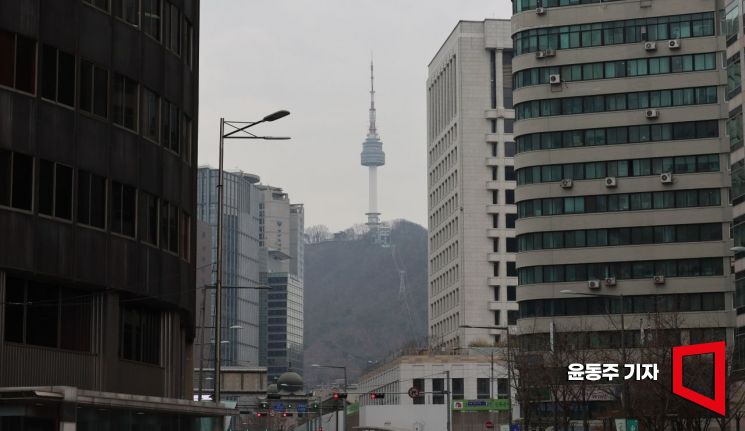 Seoul N Tower appeared hazy on the 7th, when fine dust levels were temporarily poor in the morning. Photo by Dongju Yoon doso7@
According to the Korea Environment Corporation on the 19th, when the emergency reduction measure is implemented, workplaces that emit a lot of fine dust, such as waste incineration plants, especially those operated by administrative and public institutions, must reduce operating hours and lower operating rates.
At construction sites, construction hours will be adjusted and measures such as using dust covers will be taken to prevent dust from spreading. According to ordinances of each city and province, operation of grade 5 diesel vehicles will also be restricted. However, in the Seoul metropolitan area, operation of grade 5 diesel vehicles has already been restricted since December last year under the fine dust seasonal management system.
The fine dust emergency reduction measure is issued when the daily average concentration of ultrafine dust (PM2.5) exceeds 50㎍/㎥ from midnight to 4 p.m., and the next day's daily average concentration is also expected to exceed 50㎍/㎥.
According to the National Institute of Environmental Research, as of 5 p.m. on that day, the daily average concentration of ultrafine dust in the Seoul metropolitan area is 54㎍/㎥ in Seoul, 64㎍/㎥ in Incheon, and 52㎍/㎥ in Gyeonggi. Fine dust levels are expected to be 'Bad' in the Seoul metropolitan area, Gangwon Yeongseo, Chungcheong, Gwangju, and Jeonbuk, while other regions are expected to be at 'Moderate' levels. In Incheon, fine dust will thicken to 'Very Bad' levels at night for a short time.
The Environmental Science Institute stated, "As fine dust is inflowing from abroad and the atmosphere is stagnant, fine dust generated domestically is accumulating, resulting in high fine dust concentrations in most central regions and some southern regions."
© The Asia Business Daily(www.asiae.co.kr). All rights reserved.
![Clutching a Stolen Dior Bag, Saying "I Hate Being Poor but Real"... The Grotesque Con of a "Human Knockoff" [Slate]](https://cwcontent.asiae.co.kr/asiaresize/183/2026021902243444107_1771435474.jpg)
















