Survey of 930 Workers, 74.4% Experienced Burnout
"Frequent Stress from Facing Violent Offenders"
"I suffer from verbal threats and loud yelling from the perpetrator, such as 'Who do you think you are coming here? Stay over there.'" (Worker at a domestic violence victim protection facility)
"I feel guilt and self-loathing, thinking whether it is even possible to help others when I can't even take care of myself." (Worker at a women’s violence victim support organization)
A result showed that 3 out of 4 workers at women’s violence victim support organizations experienced ‘burnout,’ a chronic stress response from their job, in the past year.

According to the Korea Women’s Human Rights Institute on the 19th, a recent study titled "Analysis of Burnout Status and Improvement Measures for Workers at Women’s Violence Victim Support Organizations," conducted by the Gyeongbuk Women’s Policy Development Institute (lead researcher Kim Mina), found that 74.4% (692 respondents) reported experiencing burnout in the past year.
The research team conducted an online survey from July 20 to August 31, 2022, targeting 930 workers from 672 women’s violence victim support organizations nationwide, including domestic violence counseling centers, Sunflower Centers, and Women’s Emergency Call 1366 Centers, asking if they had experienced burnout, a chronic stress response from their job.
Burnout is a phenomenon where a person who was enthusiastically engaged in work experiences extreme physical and mental fatigue and becomes lethargic. It is an emotional and behavioral stress response that appears when working long-term in jobs with high emotional and interpersonal demands.
High Burnout Experience Among Workers Supporting Victims of Sex Trafficking

In particular, the survey showed that workers at sex trafficking victim support organizations had the highest burnout experience rate in the past year at 83.0%. Additionally, those with 3 to less than 5 years of work experience (84.9%) and middle managers (85.6%) reported high rates of burnout in the past year.
The causes of burnout among these workers were analyzed as 'direct and indirect experiences of violence' and 'vicarious trauma' resulting from exposure to violence. The research team viewed their burnout as related to poor working conditions and vicarious trauma from exposure to direct and indirect violence during victim support processes. It was also revealed that users often resorted to verbal abuse and insults when their demands were not met or their behavior was restricted.
A, a second-year worker at a sex trafficking victim support facility who participated in an in-depth interview with the research team, said, "Even though rules were already set, when sanctions were imposed on behavior, I received direct verbal abuse, and in some cases, users insulted the families of workers."
Due to the nature of their work, workers sometimes faced threats from perpetrators when confronting them. They were exposed to risks of direct and indirect verbal, emotional, and physical violence from perpetrators.
There were also many cases where users threatened suicide or self-harm, causing workers to live with anxiety and worry, according to responses.
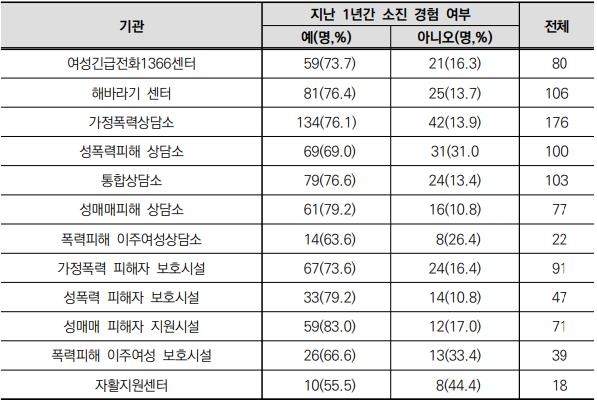 Experience of burnout in the past year by affiliated institution
[Photo by Gyeongbuk Women's Policy Development Institute]
The research team analyzed, "(Workers) reported physical symptoms such as fatigue, headaches, tension, and insomnia, as well as emotional symptoms like depression and anxiety due to these direct and indirect experiences of violence, and in severe cases, it led to suicidal thoughts."
They added, "Experiencing burnout increases turnover intentions and can result in a decline in service quality." This implies that workers’ burnout negatively affects support for women’s violence victims.
The research team emphasized, "Practical and policy support is required so that workers can actively respond in crisis situations."
The report suggested related measures including ▲establishing a system for burnout prevention programs for workers ▲providing break times and rest areas ▲adjusting workloads and reinforcing staffing ▲improving the salary system.
© The Asia Business Daily(www.asiae.co.kr). All rights reserved.



















