Ministry of Agriculture, Food and Rural Affairs to Implement 2023 Agricultural Workforce Supply and Demand Support Measures
The government has decided to expand the introduction of foreign labor by 73% compared to the previous year in preparation for the busy farming season starting in April.
The Ministry of Agriculture, Food and Rural Affairs announced on the 19th that it will implement a "labor supply support plan" containing these measures.
According to the Ministry, the demand for agricultural labor for major crops this year is expected to be similar to last year, with more than 70% of the annual demand concentrated during the busy farming season (April to June) and the harvest season (August to October), mainly for fruit trees and open-field vegetables.
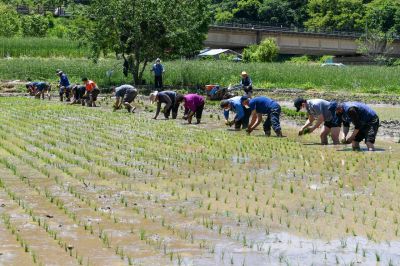
First, domestic labor supply will be expanded by 20%, from 2.93 million in 2022 to 3.52 million in 2023. To this end, the Rural Labor Brokerage Centers will be expanded from 154 centers (rural type) in 2022 to 170 centers in 2023 by adding 9 cities/counties that previously had no public labor brokerage centers.
Support will be provided to ensure smooth supply of labor to farms facing labor shortages during the busy farming season through the activation of urban job seeker recruitment, based on a memorandum of understanding signed in January this year between the Ministry of Agriculture, Food and Rural Affairs and the Ministry of Employment and Labor. This project is a pilot program linking the Ministry’s Rural Labor Brokerage Centers with the Employment Support Agencies of the Ministry of Employment and Labor, starting with 11 cities/counties in Jeonbuk and Gyeongbuk this year, with plans to expand nationwide next year.
Through the Rural-Urban Labor Brokerage Platform, which launched services on February 13 this year, customized job information provision and online matching between employers and job seekers will be strengthened. Additionally, the number of residential-type farming work teams linked with the NongHyup, which was piloted last year, will be expanded from 20 teams serving 20,000 people last year to 30 teams serving 30,000 people this year by recruiting job seekers from urban areas.
The number of foreign workers will be increased to an all-time high. The number will expand by 73%, from 22,000 in 2022 to 38,000 in 2023. Under the Employment Permit System, 14,000 foreign workers (E-9) have been allocated, and under the Seasonal Work System, 24,418 foreign workers (C-4·E-8) have been allocated to 121 cities/counties and are scheduled to enter the country sequentially.
In particular, through consultations with related ministries last year, the allocation of foreign workers for this year was completed by December of last year to enable early supply. As a result, a total of 4,681 foreign workers under the Employment Permit System and Seasonal Work System entered the country in January and February, a 487% increase compared to 797 during the same period last year.
In addition, to effectively respond to the demand from farms requiring short-term employment of less than one month, the public seasonal work program will be expanded from 5 sites with 190 people last year to 19 sites with 990 people. Furthermore, to reduce the administrative burden on local governments in introducing foreign seasonal workers, NongHyup will support tasks such as labor contract signing, visa issuance application, entry, and employment training for 19 public seasonal work sites and 13 local governments newly introducing foreign seasonal workers in 2023.
The Ministry of Agriculture, Food and Rural Affairs has selected 30 cities/counties as priority management areas centered on major crop production regions to intensively manage labor supply and demand during the busy farming season. The system has been improved to enable rapid monitoring by inputting and managing labor supply performance through the Rural-Urban Labor Brokerage Platform. A labor supply support task force situation room linking the Ministry, local governments, and NongHyup will be operated to establish a system that can respond promptly in case of labor shortages.
Park Su-jin, Director of Agricultural Policy at the Ministry of Agriculture, Food and Rural Affairs, said, "This measure is expected to alleviate the shortage of agricultural labor during the busy farming season and help stabilize wages for agricultural workers by expanding public sector labor supply. Ahead of the busy farming season, we will closely cooperate with related ministries, local governments, and NongHyup to ensure smooth supply of agricultural labor and explore all possible measures to prevent disruptions in agricultural production due to labor shortages."
© The Asia Business Daily(www.asiae.co.kr). All rights reserved.

















