Third Head of State After Sudan and Libya Dictators
Kremlin Calls It "Rude and Unacceptable Behavior"
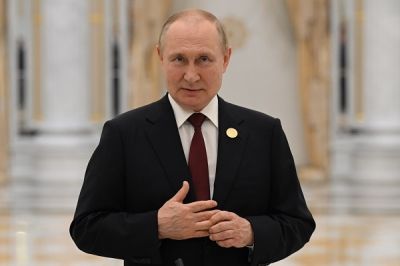
The International Criminal Court (ICC) has issued an arrest warrant for Russian President Vladimir Putin, who invaded Ukraine. This is the third case in history involving a head of state.
The ICC Pre-Trial Chamber announced on the 17th (local time) through a statement posted on its website that “based on the prosecutor's request on the 22nd of last month, there is reasonable grounds to believe that President Putin is responsible for war crimes involving the illegal transfer of children from occupied territories in Ukraine,” and thus issued the arrest warrant.
The chamber stated that such crimes began at least on the day of the invasion, February 24 of last year, and explained, “He is responsible for failing to properly control the civilian and military subordinates who committed these acts.” Additionally, an arrest warrant was also issued for Mariya Lvova-Belova, the Russian Presidential Commissioner for Children's Rights, on the same charges.
This is the first time the ICC has officially identified a top Russian official as a suspect since the outbreak of the Ukraine war. Furthermore, the issuance of an arrest warrant for a head of state marks the third case, following former Sudanese President Omar al-Bashir and Libyan dictator Muammar Gaddafi.
On the 13th, some foreign media outlets such as The New York Times (NYT) reported the possibility of an arrest warrant request, but the ICC refused to comment, stating, “We do not publicly discuss ongoing specific cases.”
In its statement, the chamber explained the reason for disclosure, saying, “The warrant was considered confidential to protect victims, witnesses, and the investigation. However, considering that the disclosure of the warrant could contribute to preventing further crimes, it was deemed in the interests of justice to authorize the ICC Registry to disclose the issuance of the warrant along with the suspect's name and charges.”
Karim Khan, ICC Prosecutor overseeing the investigation, said, “The cases we have confirmed include the abduction of at least hundreds of Ukrainian children from orphanages and child protection facilities, who were forcibly transferred to Russia,” adding, “Many of them are suspected to have been adopted in Russia.”
He continued, “Through legal amendments enacted by Putin’s presidential decree, Russian citizenship was swiftly granted to these children to facilitate their adoption,” emphasizing, “It is unacceptable for children to be treated as spoils of war.”
In response, Ukrainian President Volodymyr Zelensky described this as a “historic decision” and criticized, “The number of children forcibly transferred by Russia from occupied Ukrainian territories may be much higher than 16,000, and this is a state-led malicious policy originating from Putin, the top leader of Russia.”
On the other hand, Dmitry Peskov, spokesperson for the Russian Kremlin, condemned the ICC’s issuance of the warrant against President Putin as “rude and unacceptable,” asserting, “The ICC’s actions are invalid and have no legal effect on Russia.”
As the Kremlin claims, it is currently almost impossible to secure President Putin’s custody. When an ICC arrest warrant is issued, the involved countries are generally required to execute arrest and surrender requests according to ICC regulations and their domestic legal procedures. Since Russia withdrew from the ICC in 2016, cooperation is unlikely. CNN reported, “Because the ICC does not conduct trials in absentia, the timing of the trial against President Putin remains uncertain.”
However, since ICC member states are obligated to arrest and surrender suspects with issued warrants, even if they are foreign heads of government, it is expected that President Putin and Russia will continue to face diplomatic isolation.
© The Asia Business Daily(www.asiae.co.kr). All rights reserved.

![A Woman with 50 Million Won Debt Clutches a Stolen Dior Bag and Jumps... A Monster Is Born [Slate]](https://cwcontent.asiae.co.kr/asiaresize/183/2026021902243444107_1771435474.jpg)















