Jeonggae Special Committee Submits 'Kim Jin-pyo Proposal' to the Full Committee
National Assembly Full Committee, Debate Among 299 Members
The National Assembly is set to officially begin discussions on electoral district reform ahead of next year's general election. Based on a proposal prepared by Speaker Kim Jin-pyo, a plenary committee consisting of all 299 members of the National Assembly will hold intensive debates for two weeks starting from the 27th.
This is the first plenary committee meeting in 19 years since it was convened in 2003-2004 to discuss the dispatch of troops to Iraq. The discussions will focus on either increasing the number of lawmakers by 50 while keeping the size of electoral districts unchanged, or maintaining the current number of lawmakers but enlarging the size of the constituencies.
Increase proportional representation seats by 50, or elect 3 to 10 members per district in major cities
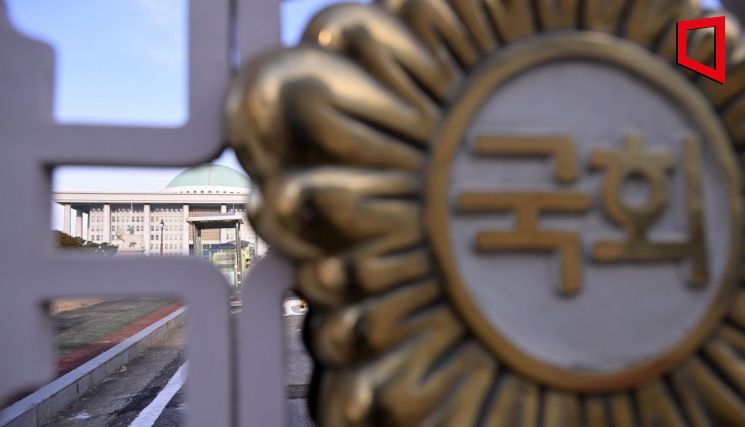 The ruling and opposition parties are sharply divided over the dismissal proposal of Minister Lee Sang-min, casting a red light on the approval of next year's budget. On the 12th, the National Assembly building was shrouded in silence. Photo by Yoon Dong-joo doso7@
The Special Committee on Political Reform of the National Assembly (Political Reform Special Committee) held a subcommittee meeting on the 17th and approved three electoral system reform proposals to be submitted to the plenary committee. The three approved reform plans largely resemble the proposal Speaker Kim submitted last month.
The first plan is a single-member district system combined with a regional and parallel proportional representation system. It maintains the current single-member district system (one member per electoral district) and elects proportional representatives based on party vote shares regardless of the results in the constituencies. The second plan is a single-member district system combined with a regional and semi-compensatory proportional representation system, where if a party fails to secure seats equivalent to its vote share in the constituencies, the proportional seats are allocated to compensate. Both the first and second plans increase the number of proportional representatives by 50, raising the total number of lawmakers to 350.
However, there is considerable public opposition to increasing the number of lawmakers. According to a survey conducted by the Political Reform Special Committee in January among 1,200 citizens aged 18 and over nationwide, 57.7% opposed expanding the number of National Assembly members. Especially for proportional representatives, which have been criticized as 'useless' in every general election and rated lower than constituency lawmakers, it remains uncertain whether public resistance to increasing proportional seats can be eased.
The third plan proposes a mixed urban-rural multi-member district system combined with a regional and parallel proportional representation system. It introduces a multi-member district system in major cities where 3 to 10 members are elected per district, while applying the single-member district system in rural and fishing villages. The total number of lawmakers remains unchanged. President Yoon Seok-yeol has also expressed the need to introduce a multi-member district system. In a New Year's interview with the Chosun Ilbo released in early January, President Yoon suggested "electing 2, 3, or 4 members depending on regional characteristics," which aligns with the features of the mixed urban-rural multi-member district system.
Unlike the existing single-member district system, the multi-member district system is evaluated as capable of mitigating the 'winner-takes-all' effect, but it also faces criticism for its drawbacks. Former People Power Party emergency committee chairman Jeong Jin-seok mentioned on social media that "the problems of the multi-member district system are not well known to us," citing Japan's example where factional politics intensified after implementing the multi-member district system.
Daegu Mayor Hong Joon-pyo also recently stated on social media that "the multi-member district system might be possible under a parliamentary system with multi-party and coalition governments, but it is not an appropriate system under a presidential responsibility system."
Intensive debates broadcast live for the first time in 19 years since 'Iraq dispatch'?will it sway public opinion?
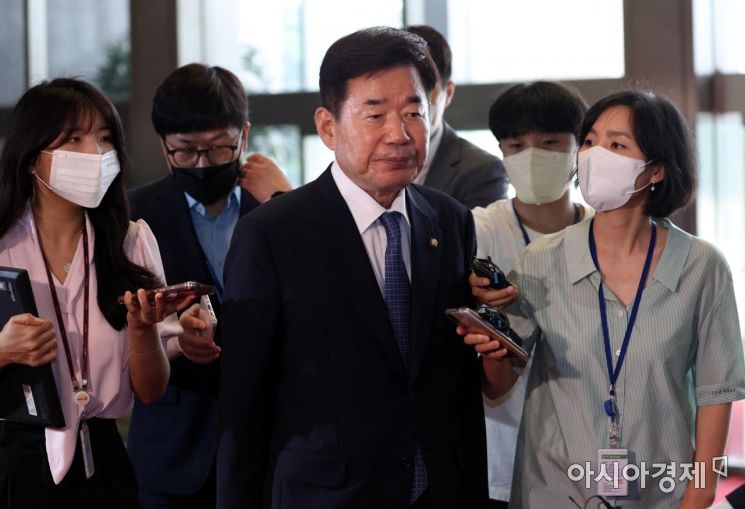 Kim Jin-pyo, the newly appointed Speaker of the National Assembly, is arriving at the National Assembly building on the 5th. Photo by Yoon Dong-joo doso7@
The method of discussing electoral district reform is also drawing attention. The plenary committee, which was last convened 19 years ago to discuss the Iraq dispatch consent, has been revived. The plenary committee is a system where all members of the National Assembly participate in reviewing bills to supplement the formalized deliberations in the standing committees and plenary sessions. It was held in March 2003 and December 2004 for the Iraq dispatch consent and dispatch extension consent, respectively. The National Assembly plans to broadcast the plenary committee debates live on the National Assembly Broadcasting System to build public consensus on electoral reform and to encourage public participation through nationwide opinion surveys.
Although both ruling and opposition parties have expressed their intention to participate in the plenary committee, neither side has finalized their party stance on electoral reform. On the morning of the 17th, People Power Party floor leader Joo Ho-young told reporters, "It is extremely difficult to establish a party stance on the electoral system." Unlike the Iraq dispatch 19 years ago, where political positions between parties were sharply divided and party stances were easier to determine, electoral reform involves conflicting interests among lawmakers even within the same party depending on the reform plan, making consensus difficult.
There are also calls for the ruling and opposition parties to clarify their positions on the electoral system before participating in the plenary committee. The Citizens' Coalition for Economic Justice (CCEJ) stated, "Even if the plenary committee is formed without the parties clearly stating their principles and positions on electoral reform, meaningful discussions will be difficult," urging, "It is time for the parties to transparently present their electoral reform proposals and conduct public opinion surveys and civil society consultations."
The legal deadline for redistricting is the 10th of next month, one year before the election. Since redistricting presupposes electoral system reform, discussions on reform must be concluded within this month to meet the legal deadline. Speaker Kim urged at the opening ceremony of the extraordinary session last month, "No matter what, let's complete the revision of the election law by the end of March to comply with the legal deadline." However, this remains a challenging task in reality. In the last general election, the redistricting bill was passed with only 39 days left before the election day.
© The Asia Business Daily(www.asiae.co.kr). All rights reserved.


















