No Major Changes in CDS Premiums of Korean Domestic Banks
US CDS Soars Amid Growing Anxiety Over SVB Bankruptcy
Won-Dollar Exchange Rate Opens Lower... Fear Slightly Eases
However, Uncertainty Remains... Financial Authorities Closely Monitoring
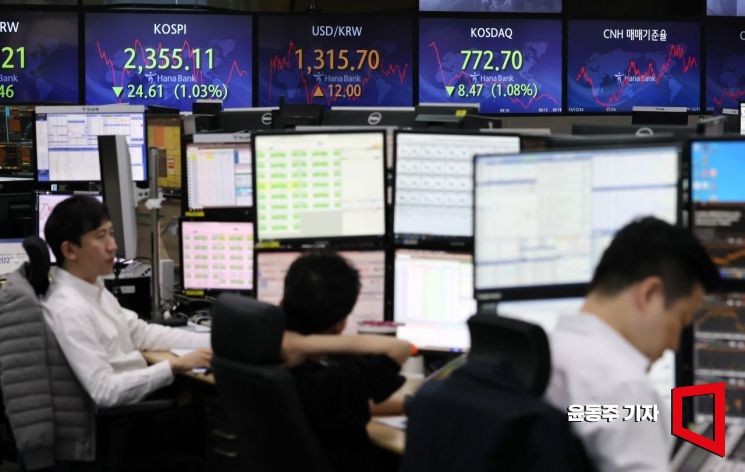 On the 16th, dealers are busily moving in the Hana Bank dealing room in Jung-gu, Seoul. Photo by Dongju Yoon doso7@
The shock of the bankruptcy of the U.S. Silicon Valley Bank (SVB) has spread to Credit Suisse (CS), a world-renowned Swiss investment bank (IB), increasing global financial market uncertainty. However, it appears that South Korea and domestic banks' external credit ratings remain stable. Unlike the bankrupt SVB, domestic banks have a low proportion of securities that are heavily impacted during interest rate hikes, and structurally, the possibility of a 'bank run' (massive withdrawal of deposits) is also low. Nevertheless, as the global liquidity crisis could further spread and affect the domestic financial market, the government and the Bank of Korea are closely monitoring both domestic and international market conditions.
According to the financial investment industry on the 17th, the credit default swap (CDS) premium for the 5-year foreign exchange stabilization fund bonds issued by the Korean government was 42.58 basis points (bp) as of the previous day, down 0.51 bp in one day (1 bp = 0.01 percentage point). CDS is a type of financial derivative product that acts like insurance, compensating for losses if the issuing country or company defaults. When economic risks increase, premiums typically rise, reflecting the default risk and external creditworthiness of countries and companies. South Korea's CDS premium has slightly increased compared to 41.15 bp on the 7th, just before the SVB bankruptcy, but remains low compared to the 74.98 bp reached in November last year amid fears of U.S. tightening.
In contrast, the U.S. CDS premium surged to 42.52 bp the previous day, continuing its sharp rise. It was only around 13 bp in March last year but steadily increased following the Federal Reserve's (Fed) aggressive tightening monetary policy, with the SVB bankruptcy causing an even steeper rise. CDS premiums for major U.S. banks such as JP Morgan soared to their highest levels since October last year, and the CS Group, which was engulfed in crisis rumors, rose to 1366.99 bp on the 15th before dropping to 1041.77 bp after the Swiss National Bank's decision to provide funding, showing a very unstable situation.
In comparison, domestic banks show little change in external credit ratings. The CDS premiums for KB Kookmin Bank, Shinhan Bank, Woori Bank, and Hana Bank are 42.34 bp, 52.36 bp, 45.18 bp, and 50.49 bp respectively, similar to levels earlier this month. Compared to November last year, they are about 20 bp lower. Yuanta Securities explained, "While CDS premiums in the U.S. are steadily rising, Korea's premiums surged due to the Legoland incident last year but are currently stabilizing," adding, "This means the Korean financial market is relatively distant from the SVB bankruptcy incident."
It is analyzed that domestic banks suffered less damage from interest rate hikes because the increased liquidity was mainly used for loans rather than investing in high-risk products such as securities. SVB invested the deposits increased during the COVID-19 period in U.S. Treasury bonds and mortgage-backed securities, but bond prices plummeted due to interest rate hikes, causing losses and ultimately bankruptcy due to a bank run triggered by these losses. Although concerns about bank runs have emerged in the domestic financial sector, such as in savings banks, most deposits are under 50 million won, which are protected by deposit insurance, making the possibility low. A Bank of Korea official explained, "Structurally, the likelihood of a bank run occurring here is very low."
The won-dollar exchange rate also opened at 1,301 won, down 12 won from the previous trading day, showing a downward trend. It had risen to 1,316.9 won the previous day due to the SVB bankruptcy and CS crisis rumors, but financial market instability eased as major banks decided to supply large-scale liquidity to First Republic, dubbed the second SVB, and the CS crisis rumors somewhat subsided. The swift intervention by countries such as the U.S. and Switzerland whenever individual crises occur has led to expectations that the situation will not escalate into a global liquidity crisis.
However, the high interest rate stance in the U.S. and Europe and the resulting economic uncertainties remain, so the risk to South Korea's financial and foreign exchange markets cannot be ruled out. If international financial market instability increases, risk-averse sentiment spreads, and foreign capital continues to exit the domestic stock market, the won-dollar exchange rate could rebound, and a liquidity crisis could recur. Financial authorities such as the Ministry of Economy and Finance and the Bank of Korea have strengthened market monitoring in preparation for any eventuality. Lim Hye-yoon, a researcher at Hanwha Investment & Securities, said, "Although the SVB incident has calmed down for now, the embers remain," adding, "If financial instability such as liquidity tightening or loan asset deterioration occurs, it is highly likely to spill over into the real economy through companies with insufficient funding capabilities."
© The Asia Business Daily(www.asiae.co.kr). All rights reserved.
!["The Woman Who Threw Herself into the Water Clutching a Stolen Dior Bag"...A Grotesque Success Story That Shakes the Korean Psyche [Slate]](https://cwcontent.asiae.co.kr/asiaresize/183/2026021902243444107_1771435474.jpg)

















