Yoon Sang-hyun, a member of the People Power Party and former chairman of the National Assembly's Foreign Affairs and Unification Committee, evaluated the recent Korea-Japan summit as "the first step toward a future-oriented Korea-Japan relationship," citing the normalization of GSOMIA (General Security of Military Information Agreement) as one of the major achievements.
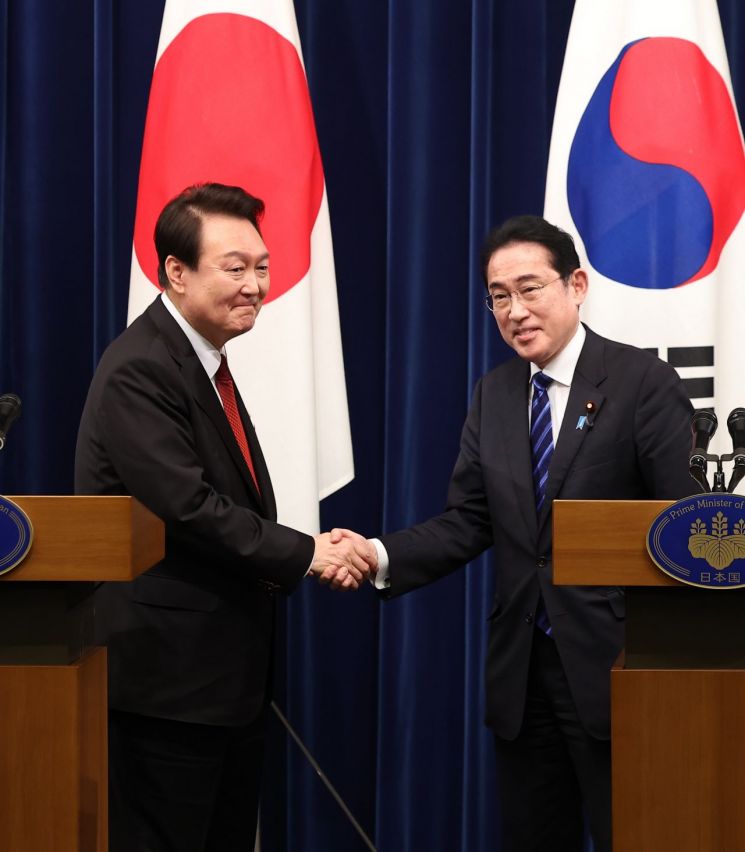
On the 17th, Yoon said on SBS's 'Kim Tae-hyun's Political Show,' "The Moon Jae-in administration made no effort whatsoever to resolve the forced labor issue, which was the biggest conflict and obstacle in Korea-Japan relations, but this issue has now been temporarily settled."
He pointed to the restoration of GSOMIA as the greatest gain. He explained, "The most difficult issue we currently face is the severe international situation. The Korea-Japan information-sharing agreement, GSOMIA, had been conditionally suspended, but it has now been fully normalized. Korea and Japan can hold strategic dialogues at the vice-ministerial level, defense and foreign affairs director-level talks, and newly established economic security dialogues at the National Security Council (NSC) level."
He also cited the lifting of export restrictions on semiconductor core materials such as hydrogen fluoride and photoresists, as well as the establishment of a future partnership fund, as achievements. However, regarding the restoration of GSOMIA, the Democratic Party has criticized it as legitimizing Japan's militarization. In response, Yoon said, "The Korea-Japan military information-sharing agreement is indispensable at a time when North Korea continues to advance its nuclear and missile capabilities," adding, "We do not have any military reconnaissance satellites, but Japan operates seven military reconnaissance satellites."
He stated, "To track North Korean missile trajectories, Japan's assistance is absolutely essential," and "Because there are things we cannot detect, we must receive technical information from Japan regarding missile falls. This (GSOMIA) is essential."
Regarding the Democratic Party's criticism of the summit as 'diplomatic submission,' he said, "They have nothing to say even if they had ten mouths," and criticized, "Since the Supreme Court's final ruling in October 2018, the Democratic Party government has done nothing."
Yoon added, "During the Moon Jae-in administration, then-Prime Minister Lee Nak-yeon formed a task force (TF) under the Prime Minister's office to address this issue, and then-National Assembly Speaker Moon Hee-sang also tried to implement a '2 (companies) + 2 (government) + alpha (voluntary public donations)' plan, but it failed. The main reason was the Moon Jae-in Blue House," and said, "The biggest problem was that the president did not propose any political solution beyond the legal resolution of this issue."
© The Asia Business Daily(www.asiae.co.kr). All rights reserved.
![Clutching a Stolen Dior Bag, Saying "I Hate Being Poor but Real"... The Grotesque Con of a "Human Knockoff" [Slate]](https://cwcontent.asiae.co.kr/asiaresize/183/2026021902243444107_1771435474.jpg)
















