Focus on Inflation Control Over Financial Stability
US Fed's Rate Hike Size on June 21-22 in Spotlight
The European Central Bank (ECB) carried out the previously announced 'big step' (a 0.5 percentage point increase in the benchmark interest rate) on the 16th (local time). Despite the collapse of the U.S. Silicon Valley Bank (SVB) and the emergence of Credit Suisse (CS) crisis rumors in Europe, the ECB placed more emphasis on the fight against inflation rather than the stability of the financial system.
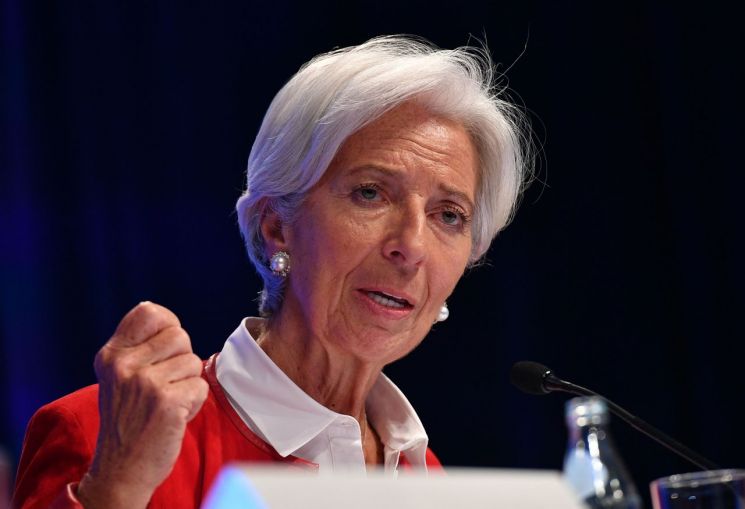
On the day, the ECB held a monetary policy meeting and announced that it would raise the benchmark interest rate by 0.5 percentage points to 3.5%. Thus, the ECB, which had maintained the rate at 0%, began raising the benchmark interest rate six times since the first 0.5% increase in July last year.
The market was on high alert regarding the ECB's benchmark interest rate decision. Starting with the bankruptcy of the U.S. SVB on the 10th amid a liquidity crisis, followed by the bankruptcy of Signature Bank on the 12th, and the spread of CS crisis rumors on the 14th, fears about instability in the global financial system intensified. In response, Swiss financial authorities decided to inject up to 70 trillion won in emergency funds into CS. Since the sharp interest rate hikes triggered by the U.S. Federal Reserve (Fed) worsened banks' funding difficulties, attention was focused on whether central banks around the world would halt their rate hike momentum. The market largely expected the ECB to raise the benchmark interest rate by 0.25 percentage points on this day.
In particular, the ECB's decision was closely watched as a gauge for the direction of the U.S. Federal Open Market Committee (FOMC) interest rate decision scheduled for the 21st-22nd.
However, as ECB President Christine Lagarde had mentioned several times before, the ECB ultimately took the big step. This is interpreted as recognizing the fight against inflation as a more urgent task than calming financial system instability. Looking at Eurozone prices, the core Consumer Price Index (CPI), excluding food and energy, rose 5.6% in February, increasing from 5.3% the previous month. Although the overall CPI inflation rate slowed to 8.5%, it still exceeded market expectations. The inflation fire remains uncontrolled.
However, the ECB also faces the difficult task of mitigating financial system instability and concerns about a financial crisis caused by the interest rate hike.
Regarding the 0.5 percentage point increase in the benchmark interest rate, the ECB explained, "As uncertainty has heightened, it has become even more important to take a data-driven approach when deciding the benchmark interest rate," adding, "We are closely monitoring current market tensions and are prepared to take necessary measures to maintain price stability and financial stability." It also emphasized, "The ECB is fully prepared to provide liquidity support to the Eurozone financial system if necessary."
The ECB's big step on this day is expected to further complicate the Fed's calculations regarding the future interest rate path. The Wall Street Journal (WSJ) diagnosed, "Central banks still prioritize curbing high and sticky inflation," and "The ECB's decision shows how major central banks, including the U.S. Fed, will respond to market crisis signals triggered by the bankruptcy of two U.S. banks."
Some investors see the recent market turmoil as a turning point in major central banks' benchmark interest rate decisions. Immediately after the ECB's rate decision, investors bought government bonds, causing the yield on the 10-year German government bond to fall from 2.193% before the rate announcement to 2.145%.
Experts noted that the ECB did not specifically mention the pace of future rate hikes, suggesting that central banks may slow the pace of tightening. Rohan Kanna, interest rate strategist at Swiss investment bank UBS, said, "They are in a difficult situation balancing monetary policy and financial stability," adding, "Despite rising core inflation, the ECB appears not to have mentioned the pace of future rate hikes due to financial system instability." He further analyzed, "Some will interpret this as a signal that the Fed may be less 'hawkish' at next week's meeting."
© The Asia Business Daily(www.asiae.co.kr). All rights reserved.

















