Seoul City Plans Uicheon Riverside Specialized Residential Complex
The area around 724 Ssangmun-dong, Dobong-gu, Seoul, will be transformed into a waterfront-specialized residential complex with approximately 300 households through redevelopment.
On the 16th, the Seoul Metropolitan Government announced that it had finalized the rapid integrated planning proposal for the redevelopment candidate site in 724 Ssangmun-dong.
This area is a representative aging low-rise residential district surrounded by Uicheon-ro, including the Baekjo Apartments, which are over 40 years old. Although improving the residential environment was urgently needed, the redevelopment project stalled due to ups and downs during the promotion process. In particular, concerns were raised about the small area leading to weak locational competitiveness. However, Seoul City focused on the area's unique characteristics, such as being adjacent to Uicheon Stream and offering views of Bukhansan Mountain, and put the development project back on track.
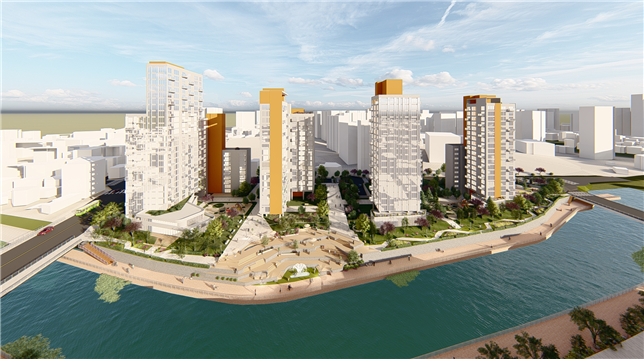
According to the finalized rapid integrated planning proposal, the boundary with Uicheon Stream, which flows along the southern edge of the site, will be removed, and the area will be transformed into a waterfront-specialized residential complex of up to 25 stories with 300 households, featuring eco-friendly leisure spaces by the water that everyone can enjoy.
Professor Kim Jeong-gon of Konkuk University, who participated as the Master Planner (MP) for the project, said, “This area has sufficient regional potential to become a representative ‘Seoul-style waterfront-sensibility city.’ By actively utilizing the emotional element of water in the otherwise quiet residential environment, residents will be able to experience significant changes in their daily lives.”
To achieve this, Seoul City incorporated four planning principles under the goal of creating an “attractive residential complex embracing Uicheon Stream.” First, to improve accessibility to Uicheon Stream and create waterfront spaces, the currently vehicle-centered southern road will be converted into a park, allowing residents to walk from the complex to the waterfront via a promenade. The imposing 3-meter-high artificial retaining wall along Uicheon Stream will be redesigned into a stepped resting area.
Second, around the waterfront space, various resident convenience facilities such as a multi-caf?, playground, and community plaza will be arranged and connected by pedestrian pathways, fostering an open community where diverse meetings and leisure activities can take place.
Third, considering the characteristics of the wide land facing Uicheon Stream, the plan avoids barrier-like building arrangements and creates external courtyards connected to the waterfront to secure open sightlines toward the water. Additionally, a phased height plan was established to form a natural skyline from the northern residential area.
Fourth, the plan includes improvements to Ssanghan Bridge, located between Gangbuk-gu and Dobong-gu, which has caused inconvenience to many residents due to an inefficient traffic and pedestrian system. Through this redevelopment, a three-way intersection will be formed to directly connect Ssanghan Bridge (Gangbuk-gu) and Uicheon-ro (Dobong-gu), enabling convenient movement for local residents. The bridge, previously accessible only by vehicles, will be redesigned to include sidewalks so that students commuting to and from Gangbuk Middle School can use it as a pedestrian route.
A Seoul city official emphasized, “What is particularly noteworthy in this plan is that Seoul City actively provided administrative support to enhance the feasibility of the Uicheon waterfront space creation plan, which residents found difficult to realize on their own, by holding multiple joint meetings among related departments and consulting experts in urban planning, architecture, transportation, and water resources.”
With the rapid integrated planning proposal for 724 Ssangmun-dong finalized, the city expects the maintenance plan decision to be completed within the year. Due to the streamlined procedures of rapid integrated planning, the project period is expected to be significantly shortened by integrating reviews from the Urban Planning Committee’s delegated subcommittee and related reviews during the project implementation plan stage.
Jo Nam-jun, Director of the Seoul Metropolitan Government’s Urban Planning Bureau, said, “This planning proposal aligns with the ‘Great Han River Project,’ which aims to extend the changes and vitality of the Han River to its four major tributaries and small streams. We hope that the relationship with tributaries, which coexist in citizens’ daily lives, will lead to the revitalization of the waterfront and, consequently, the local community.”
© The Asia Business Daily(www.asiae.co.kr). All rights reserved.
![Clutching a Stolen Dior Bag, Saying "I Hate Being Poor but Real"... The Grotesque Con of a "Human Knockoff" [Slate]](https://cwcontent.asiae.co.kr/asiaresize/183/2026021902243444107_1771435474.jpg)
















