Tax Subcommittee Delayed Over 1 Hour 30 Minutes
Democratic Party's Special Tax Law Amendment Bill Faces Difficulties
Decided Not to Discuss in This Subcommittee
The so-called 'K-Chips Act (Amendment to the Restriction of Special Taxation Act),' which increases tax benefits for facility investments in national advanced strategic technology industries such as semiconductors, was submitted to the National Assembly's Planning and Finance Committee's Tax Subcommittee on the 16th. If it passes the subcommittee that day, the bill is more likely to clear the March plenary session hurdle, but it is facing difficulties from the start.
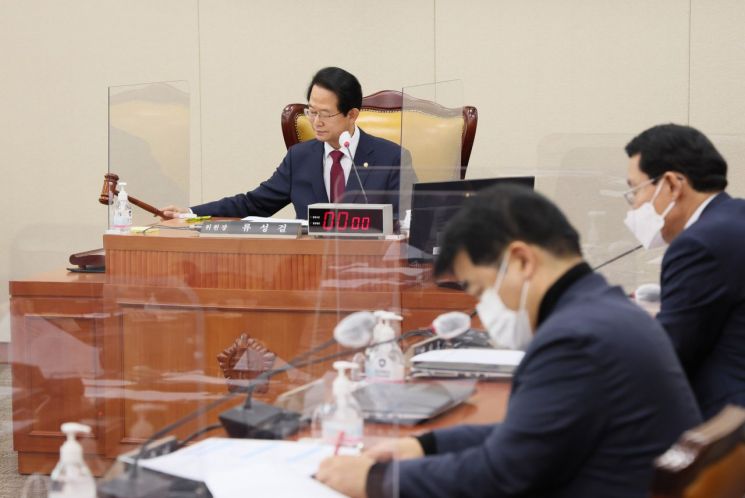
The National Assembly's Planning and Finance Committee Tax Subcommittee was scheduled to convene at 10 a.m. that day but was delayed by over an hour. This was because the ruling and opposition party floor leaders needed to agree on whether to conduct a joint review of the amendment to the Restriction of Special Taxation Act proposed by the opposition party floor leader, Shin Dong-geun, the day before. However, the bill did not meet the required deliberation period and thus was not included in the subcommittee agenda that day. Ryu Seong-geol, the ruling party floor leader of the Planning and Finance Committee, stated just before the meeting, "There is no agreement on new agenda items," adding, "Only seven partial amendments to the Restriction of Special Taxation Act from Article 1 to Article 7 will be collectively submitted." The Planning and Finance Committee decided to reconvene the subcommittee at 4 p.m. to continue discussions.
The reason the amendment was not included in the agenda is that it contained provisions to expand the national strategic technology industry sector and designate it by law. Earlier, in January, the government proposed an amendment to the Restriction of Special Taxation Act to increase the tax credit rate for investments in facilities in national strategic technology industries such as semiconductors from the current 8% to 15% for large and medium-sized enterprises and from 16% to 25% for small and medium-sized enterprises. The Democratic Party had consistently opposed the government’s proposal but began to support the increase in the tax credit rate, leading to more active discussions. However, while aligning the tax rates with the government’s proposal, the Democratic Party added provisions to further expand strategic technology fields such as renewable energy, green hydrogen, and future cars (electric vehicles), and to establish these in law rather than in enforcement ordinances.
The ruling party and the government have expressed a cautious stance on these additions. It is reported that the ruling party finds it difficult to reach a conclusion without a review report on issues such as the potential decrease in tax revenue due to the expansion of advanced technology industry sectors.
Since the bill was not included in the agenda, only the previously proposed amendments to the Restriction of Special Taxation Act, including the government’s proposal, will be discussed that day. If the majority Democratic Party opposes it, the bill may fail to pass. If a conclusion is reached in the tax subcommittee, the amendment will proceed to the full Planning and Finance Committee meeting on the 22nd and could be processed at the March plenary session scheduled for the 30th.
© The Asia Business Daily(www.asiae.co.kr). All rights reserved.
!["The Woman Who Threw Herself into the Water Clutching a Stolen Dior Bag"...A Grotesque Success Story That Shakes the Korean Psyche [Slate]](https://cwcontent.asiae.co.kr/asiaresize/183/2026021902243444107_1771435474.jpg)
















