Presidential Office Messages for Third Day... This Time, Senior Secretary Ahn Sang-hoon Emergency Briefing
President Yoon "Regret Over No Cap on Working Hours"… Ordered Supplementary Measures
President Yoon Suk-yeol recently instructed the preparation of supplementary measures regarding the controversial flexible working hours policy, stating that "even with extended working hours, working more than 60 hours per week is excessive." This is effectively a complete withdrawal of the '69-hour workweek' system, a response to ongoing criticism of the Ministry of Employment and Labor's proposed working hours reform plan based on this policy. The Presidential Office has been working to manage the situation for three consecutive days.
On the morning of the 16th, Ahn Sang-hoon, Senior Secretary for Social Affairs at the Presidential Office, held a briefing at the Yongsan Presidential Office and said regarding the Ministry of Labor's legislative notice of the maximum 69-hour workweek reform plan, "The President believes that even with extended working hours, working more than 60 hours per week is excessive," adding, "He regrets that the government proposal did not set an appropriate upper cap and has instructed for its supplementation."
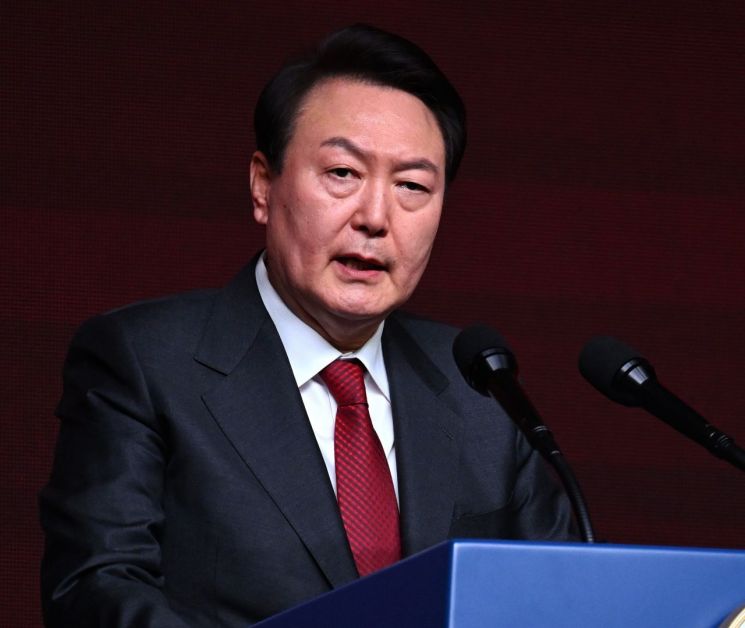
In particular, Senior Secretary Ahn explained, "(The government plan) aims to guarantee the right to choose working hours, health rights, and rest rights based on labor-management agreements, but concerns have been raised that it might encourage long working hours," and added, "The government will carefully listen to diverse opinions from the field, including MZ workers, non-unionized workers, and small and medium-sized enterprise workers, and prepare supplementary measures."
Kim Eun-hye, Senior Secretary for Public Relations, unexpectedly appeared at a briefing the previous day and said, "The core of President Yoon Suk-yeol's labor market policy is the protection of the rights and interests of vulnerable workers such as MZ workers, non-unionized workers, and small and medium-sized enterprise workers," adding, "We will set the direction after more detailed listening to the opinions of vulnerable workers." She also issued an additional statement in the afternoon. The Presidential Office explained, "Until now, the 69-hour workweek was perceived as being pushed forward without workers' consent, and discussions were limited to the number '69,'" further clarifying, "We want to conduct public opinion surveys and focus group interviews to determine how much it is reasonable to increase from 52 hours and what is most suitable for the rights and interests of vulnerable workers."
President Yoon's sudden instruction to review and supplement the working hours reform plan appears to have been influenced by negative public opinion. President Yoon's approval rating, which had been in the 40% range, has dropped to the 30% range within four weeks. The additional statement issued by the Presidential Office as President Yoon departed for Japan for the Korea-Japan summit was for the same reason. A Presidential Office official said, "The priority is to listen to and coordinate the voices of all sectors," adding, "We will also address the lack of government explanation and communication."
The Presidential Office's position, continuing for three days, is interpreted as acknowledging misunderstandings about the working hours reform plan and planning to devise supplementary measures after sufficient opinion gathering. However, given the high level of negative public opinion, there is also a possibility that the reform plan will be completely revised. Labor unions' opposition, calling it a "deterioration that encourages long working hours," is intensifying, and contrary to the government's claim that the youth favor it, even the MZ labor union opposes the reform plan.
The MZ labor union, Saerogochim Workers' Council, publicly opposed the plan, stating, "'Expansion of the extended working hours management unit' is an element that reverses the efforts and historical progress of the international community to raise the minimum standards of working conditions." They also pointed out, "Despite South Korea having relatively many public holidays, the average working hours are longer compared to major advanced countries because the upper limit on extended working hours is high and extended working hours frequently occur in industrial sites," adding, "The intended stabilization expected from the 52-hour workweek system has not been achieved."
Some expect that the government and ruling party, centered on the Presidential Office, will set the maximum working hours between the current 52 hours and 60 hours through public opinion gathering. Additional measures to guarantee long-term leave due to extended working hours, as indicated by the Presidential Office, may also be introduced. However, even if the situation is resolved, there may be ongoing accountability discussions regarding the policy discord between the Presidential Office and government ministries. On this day, the Presidential Office stated, "Realistically, we do not think the 69-hour system will be implemented based on labor-management agreements," but also added, "The Ministry of Labor did not clearly report that time during the briefing," drawing a line on responsibility.
© The Asia Business Daily(www.asiae.co.kr). All rights reserved.

















