KCCI Marks 50th Anniversary of Commerce and Industry Day with Research Presentation
Corporate Investment Growth Contribution Higher than US, Japan, and Germany
Challenges: Regulatory Framework Shift, New Industry Transition, Export Diversification, and Innovation Investment
The scale of the South Korean economy has increased by 85 times in gross domestic product (GDP) and 153 times in export volume over the past 50 years.
On the 15th, the Korea Chamber of Commerce and Industry (KCCI) released a research report titled "50 Years of Change and Future Preparation of the Korean Economy and Our Companies" to commemorate the 50th anniversary week of Commerce Day.
This study analyzed domestic and international economic data from sources such as the Bank of Korea, Statistics Korea, and the Organisation for Economic Co-operation and Development (OECD) to compare and analyze the changes in the Korean economy between 1974, when the first Commerce Day was held, and the present. The 1970s marked the beginning of industrialization, with representative companies such as Samsung Electronics (established in 1969), Hyundai Motor Company (established in 1967), and POSCO (established in 1968) beginning to grow significantly.
The KCCI categorized the analysis results into four areas: national economic growth, industrial structure advancement, exports and trade, and investment and job creation.
GDP Increased 85.2 Times... Contribution of Corporate Investment to Growth Higher than Major Countries
The scale of the South Korean economy has achieved remarkable growth compared to 50 years ago. The GDP grew from $19.5 billion in 1974 to $1.6643 trillion in 2022, an 85-fold increase. Per capita GDP also rose 56 times, from $563 to $32,237 during the same period. South Korea's global GDP ranking improved from 30th to 10th. In 1974, South Korea's GDP ranking was lower than Venezuela (25th), Indonesia (26th), and Nigeria (29th).
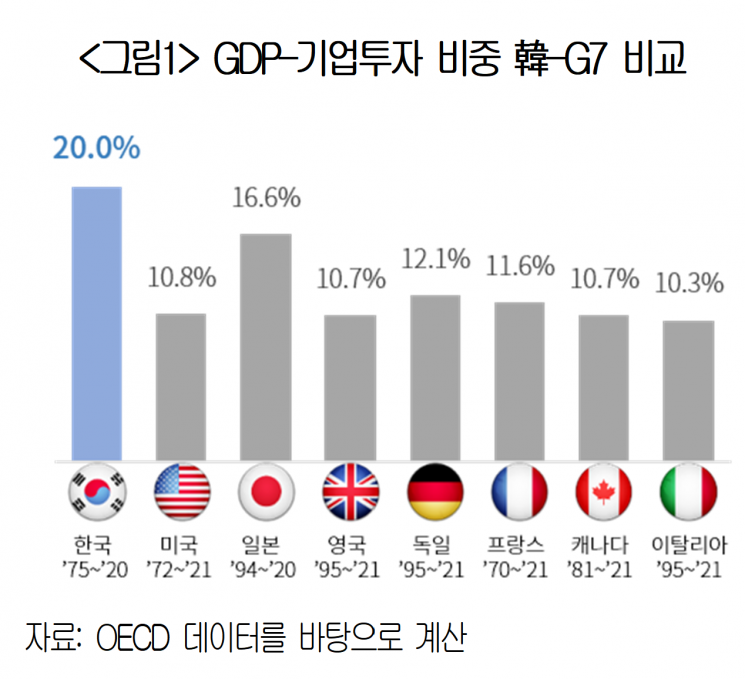
The KCCI analyzed that the growth was driven by the dedicated efforts of companies. According to OECD data, over the past 50 years, the average contribution of corporate investment to the national economy (GDP) in South Korea was 20.0%. This is significantly higher than major countries (G7) such as the United States (10.8%), Japan (16.6%), the United Kingdom (10.7%), Germany (12.1%), France (11.6%), Canada (10.7%), and Italy (10.3%).
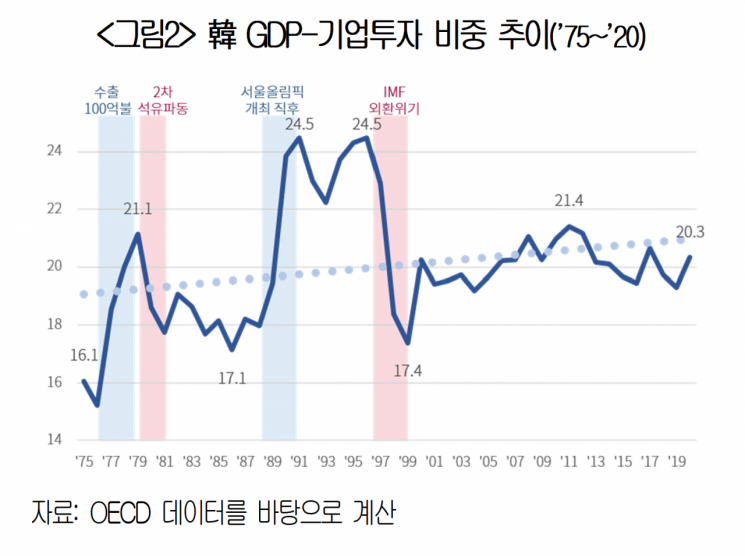
Looking at the time series, the proportion of corporate investment contributing to growth (GDP) showed an overall upward trend. It rose from 16.1% in 1975 to 20.3% in 2020, with significant increases during the period when exports surpassed $10 billion in 1977-1978 and immediately after the Seoul Olympics in 1989-1990. Although it slowed somewhat during economic crises such as the second oil shock (1979) and the IMF financial crisis (1997-1999), it quickly recovered.
Cho Dong-chul, President of the Korea Development Institute, said, "Although the Korean economy is expected to grow at a rate of around 1% this year and the situation is challenging, companies should continue to develop technologies and make efficient investments to create new growth engines." He added, "The government should revise outdated laws and systems created during the development era and provide an environment that can flexibly respond to rapidly changing international circumstances."
Industrial Structure Advancement... From Agriculture, Trading, and Textiles to IT, Electronics, and Finance
The industrial structure of the Korean economy has shifted from agriculture, forestry, and fisheries to manufacturing, and within manufacturing, from light industry to semiconductors, finance, and services.
Analyzing growth contribution rates by economic activity from Statistics Korea, the main industries in the early industrialization period of the early 1970s (1971-1975) were agriculture, forestry, and fisheries (13.8%), wholesale and retail trade including general trading companies (13.6%), textiles (11.6%), and white goods (4.2%). In the recent five years (2017-2021), the industrial structure shifted to semiconductors, mobile phones, and other computer electronics industries (23.9%), finance and insurance (13.7%), and information and communication and business services (8.5%).
Professor Cho Sung-hoon of Yonsei University said, "The process of industrial upgrading in South Korea, from labor-intensive low value-added industries to high value-added industries such as semiconductors and automobiles, is an excellent case rarely found worldwide," but added, "To truly enter an advanced economy, a paradigm shift is urgently needed where private companies lead the economy, focusing on eco-friendly and advanced industries."
Exports Increased 153 Times... Global Market Share from 39th to 7th
The KCCI report confirmed with data that "South Korea is an export-oriented country." The process of South Korea becoming a strong export nation was dynamic.
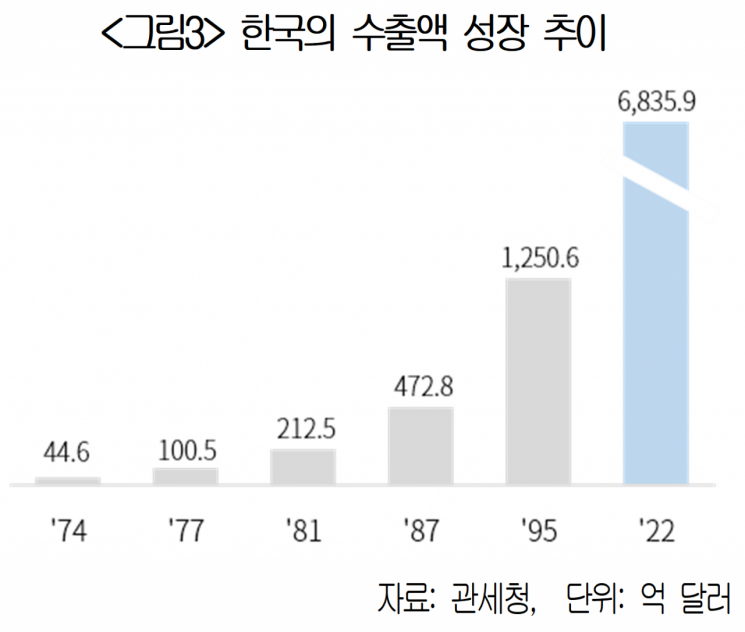
At the time of the first Commerce Day in 1974, South Korea's total exports were only $4.46 billion, but exports reached $10 billion in just three years in 1977, and $20 billion four years later in 1981. Six years later, in 1987, exports doubled to $40 billion, and in 1995, they surpassed $100 billion. Last year, total exports reached $683.58 billion, a 153.3-fold increase compared to 50 years ago.
South Korea's global market share also increased significantly from 0.53% (39th in the world) in 1974 to 2.89% (7th) in 2021. Leading export industries such as semiconductors (9.8%, 4th), shipbuilding (17.7%, 2nd), automobiles (5.3%, 5th), petrochemicals (9.9%, 2nd), displays (8.8%, 3rd), and steel (4.7%, 4th) performed well on the global stage.
Over the past 50 years, major export destinations and export products have changed significantly. In 1974, major export destinations were concentrated among Cold War allies such as the United States (33.4%), Japan (30.9%), and Germany (5.4%), but by 2022, they diversified to China (22.8%), the United States (16.1%), and Vietnam (8.9%). Major export products also advanced from textiles (36%), home appliances (10%), and steel (5%) to semiconductors (13%), automobiles (11%), and petroleum (9%).
Creating 340,000 Jobs Annually... Innovation Investment Increased 474 Times in Private Sector While National Investment Increased 26.7 Times
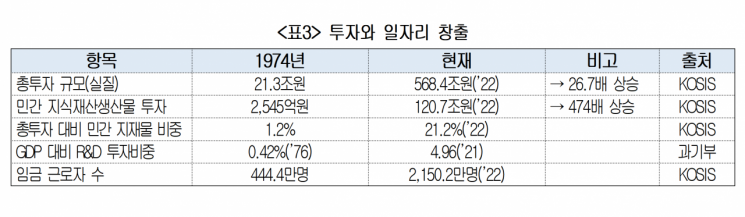
Over the past 50 years, Korean companies have also achieved results in investment and job creation, which are considered their core roles. First, innovation investment has increased significantly. Total national investment rose 26.7 times from 21.3 trillion won in 1974 to 568.4 trillion won in 2022. During the same period, private sector investment in intellectual property products increased 474 times from 254.5 billion won to 120.7 trillion won. The proportion of private intellectual property investment relative to total investment was only 1.2% 50 years ago but now accounts for 21.2%.
The R&D investment ratio to GDP increased from 0.42% (1976) to 4.96% (2021), ranking second in the world after Israel. Of the 102.1 trillion won invested in R&D in 2021, 76.4% (78 trillion won) was invested by the private sector. This indicates that research and development investment is led by the private sector, including companies. Companies also contributed significantly to job creation. The number of wage workers was 4.444 million in 1974 but increased to 21.502 million last year. Simply calculated, companies created 17.06 million new jobs over the past 50 years, averaging 340,000 new jobs annually.
Professor Shin Kwan-ho of Korea University emphasized, "As major countries recently provide astronomical funds to domestic companies producing strategically important goods such as semiconductors and focus on developing new industry technologies, we also need to strengthen the government's role in developing innovative industries." He added, "Since companies employ 74% of the total economically active population as wage workers, they must continue to devote great effort to advancing corporate culture and creating quality jobs."
Woo Tae-hee, Executive Vice Chairman of the KCCI, said, "The role expected of companies by the public has changed over the past 50 years," adding, "The public hopes that companies not only pay taxes well and create many jobs but also use their capabilities to solve social problems. Therefore, our businesspeople must demonstrate a new entrepreneurial spirit to open the next 100 years."
© The Asia Business Daily(www.asiae.co.kr). All rights reserved.



















