Heritage Foundation Announces '2023 Economic Freedom Index' Report
South Korea's Labor Market Rated 'Unfree'... "Due to Rigid Labor Market Regulations"
The U.S. has pointed out that South Korea's labor market has low flexibility due to rigid working hours and regulations on hiring and firing.
The Heritage Foundation, a U.S. think tank, recently released the "2023 Index of Economic Freedom" report. This annual report analyzes the level of economic freedom for businesses and individuals. It assigns scores (out of 100) and corresponding grades across 12 items in four categories: the rule of law, regulatory efficiency, government size, and market openness. Scores of 80 and above are rated "Free," 70?79.9 as "Mostly Free," 60?69.9 as "Moderately Free," 50?59.9 as "Mostly Unfree," and 0?49.9 as "Repressed."
According to the report, South Korea ranked 15th out of 184 countries evaluated, rising 4 places from the previous year. It received an overall score of 73.7, earning a "Mostly Free" rating.
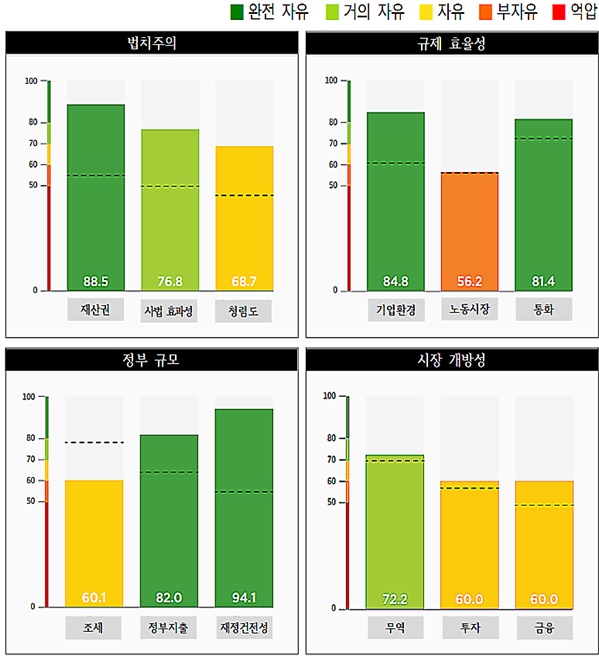 Scores by 12 items in 4 sectors of Korea in the '2023 Economic Freedom Index Report'. Source=Korea Employers Federation
However, the labor market scored 56.2 points, the only category rated as "Mostly Unfree." The Heritage Foundation analyzed that "rigid labor market regulations and strong union activities are increasing costs for companies." Additionally, it emphasized the need to address challenges such as aging population, low labor productivity, high export dependence, and expansionary fiscal policies.
Other low scores included taxation (60.1 points) and investment and finance (60.0 points). In taxation, higher top rates on income and corporate taxes and a higher national burden rate result in lower scores. As of last June, South Korea's top income tax and corporate tax rates were 49.5% and 27.5%, respectively. The national burden rate (taxes and social security contributions as a percentage of GDP) was 28.0%. Regarding investment and finance, the financial sector related to foreign direct investment was rated as competitive. However, difficulties in capital raising for startups and other companies were noted.
Hwang Yong-yeon, head of the Labor Policy Division at the Korea Employers Federation, stated, "This report reaffirmed that South Korea's rigid labor market regulations and strong union activities are restricting companies' economic activities. The recent government efforts to improve working hour regulations are the first step toward labor reform to ease labor market rigidity."
Meanwhile, Singapore ranked first globally in this report. Switzerland, Ireland, and Taiwan were also evaluated as having "Free" levels of economic activity, making a total of four countries in this category. Due to high government intervention, the U.S. and Japan ranked 25th and 31st, respectively. China was ranked 154th.
© The Asia Business Daily(www.asiae.co.kr). All rights reserved.

















