[Advanced Industry Promotion] Future Car Sector Mentioned but
Government Does Not Present Concrete Implementation Plan
Contrasted with US, China, and Europe
Competing to Attract Electric Vehicle Factories with Bold Incentives
Although the government has identified future vehicles as one of the key industries under the banner of fostering advanced industries, reactions from inside and outside the completed car industry fall short of expectations. This is because there is a lack of incentives that companies can tangibly feel. This contrasts with advanced markets like the U.S. and Europe, which aggressively attract future vehicle production facilities by offering substantial deductions on investment amounts.
At the Emergency Economic and Livelihood Meeting chaired by President Yoon Suk-yeol on the 15th, regarding the future vehicle industry, there were plans to increase electric vehicle production capacity fivefold and to enact a Special Act on Future Vehicle Transition (tentative name) within this year. The plan also includes helping secure sites in cooperation with local governments and investing 95 trillion won by 2026.
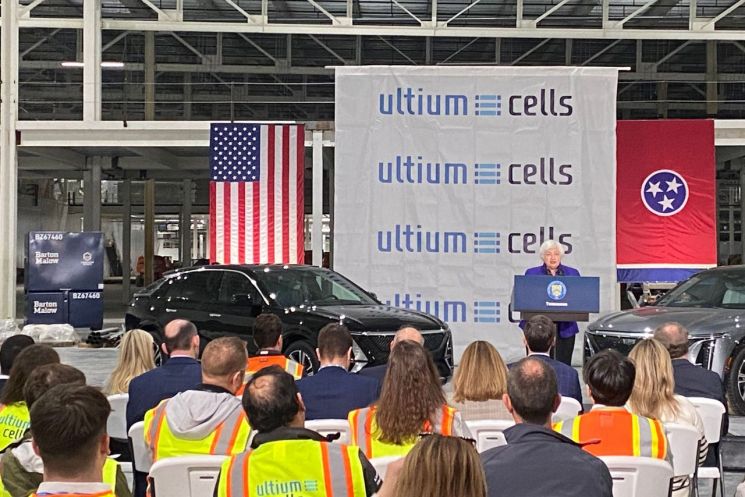 U.S. Treasury Secretary Janet Yellen is giving a speech on the 8th (local time) at the Ultium Cells battery plant, a joint venture between General Motors (GM) in the U.S. and South Korea's LG Energy Solution, located in Spring Hill, Tennessee. Secretary Yellen stated that this plant is an example demonstrating the success of the Biden administration's policies, including the Inflation Reduction Act (IRA), in attracting historic-scale investments in clean energy manufacturing and battery production within the United States.
 There is no specific implementation plan to realize this. An anonymous official from the completed car industry said, "The U.S. offers up to a 30% deduction on investment in electric vehicle production facilities through the Inflation Reduction Act (IRA), and Europe is also making every effort to attract eco-friendly vehicle industries through laws such as the Critical Raw Materials Act and the Carbon Neutral Industry Act," adding, "In contrast, in Korea, the investment tax credit is only 1% (for large corporations), so the investment merit is significantly low, and there is no sign of efforts to compensate for this."
The proposal to create a special law to enable budgetary or administrative support has also been at a standstill for several years. Four bills (one from the ruling party and three from the opposition) on the Special Act on Future Vehicle Transition have been submitted but have not even been discussed. The bill led by Representative Yang Hyang-ja was submitted in June 2021 and was only recently submitted to the standing committee last month. The ruling party member’s bill, which somewhat aligns with the government, focuses on research and development for parts manufacturers and small and medium-sized cooperative companies. Since assembly plants at the top of the completed car value chain must be operated by large corporations, the bill’s chances of passing are low, and even then, there are criticisms that it lacks effectiveness.
 President Yoon Suk-yeol salutes the national flag at the 14th Emergency Economic and Livelihood Meeting held at the Blue House's State Guest House on the 15th.
 The completed car industry believes that future vehicle sectors such as electric and hydrogen vehicles should also be designated as national strategic technologies, similar to advanced industries like semiconductors and displays, which qualify for large-scale tax credits. Considering the characteristics of electric vehicles, such as battery supply and market demand, Korea’s investment environment is not favorable, so full support at the administrative and institutional levels is necessary.
Foreign completed car companies like Korea GM and Renault Korea Motors are also lukewarm about producing electric vehicles at their Korean plants for similar reasons. When foreign companies invest in new facilities in Korea, they consider whether the target technology qualifies and whether there will be new installations or job creation to receive support. Currently, electric vehicle facilities do not qualify. Therefore, there is little incentive for GM or Renault headquarters to invest heavily in facilities at their Korean plants.
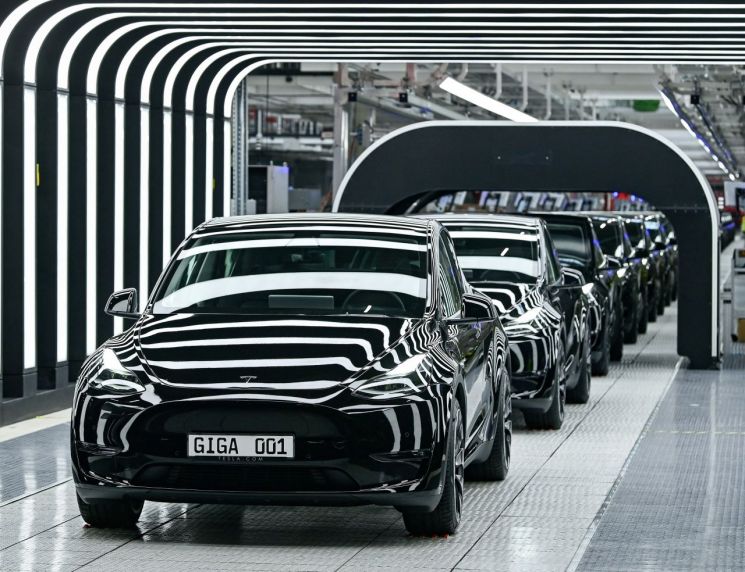
These conditions significantly influence companies’ investment strategies and decisions. Tesla, the world’s largest electric vehicle company, moved its headquarters from California to Texas largely to reduce corporate and income tax burdens. The concentration of electric vehicle and battery companies in Hungary is also influenced by the lower corporate tax compared to neighboring countries. Hyundai Motor Group received a promise of about 2 trillion won in support from the state government, separate from tax credits, when building an electric vehicle-only plant in Georgia, USA.
© The Asia Business Daily(www.asiae.co.kr). All rights reserved.
![Clutching a Stolen Dior Bag, Saying "I Hate Being Poor but Real"... The Grotesque Con of a "Human Knockoff" [Slate]](https://cwcontent.asiae.co.kr/asiaresize/183/2026021902243444107_1771435474.jpg)


















