Increase in Tourist Numbers Expected with Expanded Exchanges Between the Two Countries
Tokyo Shinjuku Korean Town Bustling with Japanese Visitors
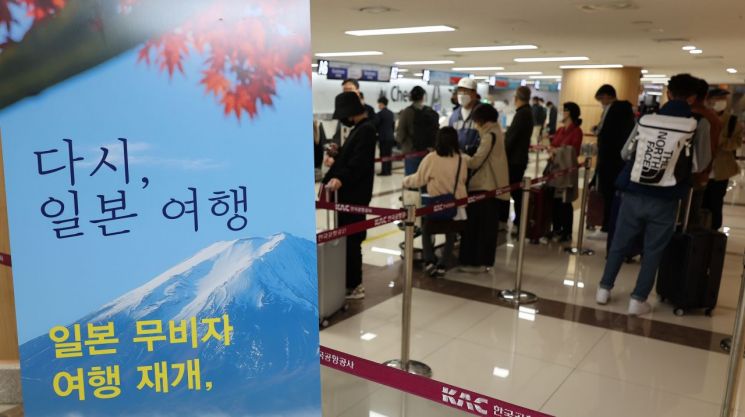 Passengers are waiting to check in for the Gimpo-Haneda flight at the Asiana Airlines international counter at Gimpo International Airport.
 [Photo by Yonhap News]
With President Yoon Suk-yeol and Prime Minister Kishida Fumio scheduled to hold a summit on the 16th, the Yomiuri Shimbun reported on the 15th that expectations are growing within the Japanese business community that the business environment will improve due to a recovery in sales in South Korea.
Yomiuri conveyed that among Japanese companies operating in or related to South Korea, there is a growing outlook that the negative impacts on business caused by the deterioration of Korea-Japan relations will be resolved.
A representative from Fast Retailing, the parent company of Uniqlo which was hit by the boycott of Japanese products, told Yomiuri on the same day, "We want to continue supporting the lives of Korean consumers going forward." Until 2019, Fast Retailing had as many as 188 stores, but due to the worsening Korea-Japan relations, the number of stores has decreased by two-thirds. The sister brand 'GU' opened its first store in Seoul in 2018, but all three stores closed in 2020.
Asahi Group Holdings, which saw a decline in sales due to the boycott of Japanese beer, also expressed optimism about the improvement in Korea-Japan relations. A representative from Asahi Group Holdings told Yomiuri, "Korea is a market we want to focus on in the future," adding, "We want to regain market share by targeting the premium beer market with our flagship beer 'Super Dry.'"
The tourism industry also anticipates that exchanges between the two countries will be revitalized and that the number of tourists will increase significantly. Yomiuri reported that recently, Shin-Okubo, a Korean town located in Shinjuku Ward, Tokyo, has been bustling with Japanese people seeking Korean food and Korean goods. In addition to the spread of the Korean Wave, the improvement in Korea-Japan relations has increased favorable feelings toward Korea, leading to more Japanese enjoying Korean culture.
According to the Japan National Tourism Organization, among the 1,497,000 foreigners who visited Japan last year, Koreans accounted for 37.7% (565,200 people). Taiwan, ranked second, accounted for only 17.3% of the total number of tourists. The travel reservation site 'KKday,' which has over 7 million members in Asian countries, also announced that the number of Japan tour reservations in February increased about 2.5 times compared to the same period in 2019 before the spread of COVID-19.
A representative from the Japanese tourism industry said, "It seems that a virtuous cycle will continue where it becomes easier to develop travel products for Japan and travel demand arises."
© The Asia Business Daily(www.asiae.co.kr). All rights reserved.

















