"Investigation Situation, Whistleblower Identity Leaked"
Secrecy and Promptness Undermined
Court Predicts Intensified Conflict Between Investigation Agencies
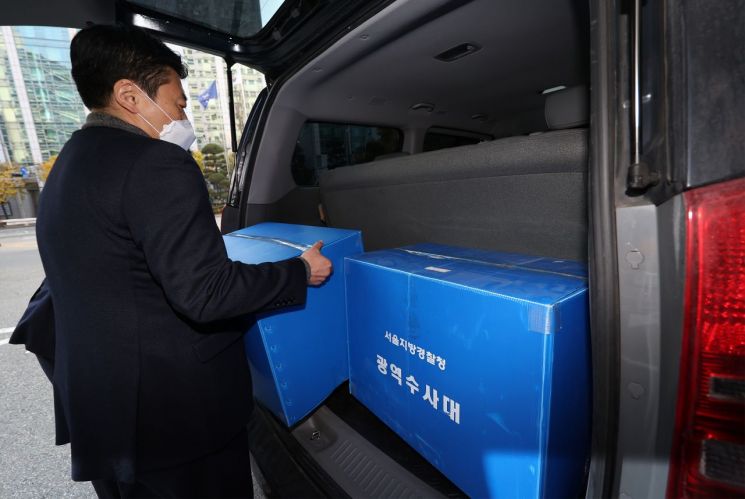
The Supreme Court's ongoing initiative for 'pre-hearing before search and seizure' has faced unified criticism from the prosecution, the Corruption Investigation Office for High-ranking Officials (CIO), and the Korean Bar Association, with the police also expressing opposition. Consequently, it is expected that conflicts between the judiciary and other legal and investigative bodies will intensify during the forthcoming legislative process.
The amendment to the Criminal Procedure Rules, announced for legislative notice by the Court Administration Office on the 3rd of last month, centers on introducing face-to-face hearings and a pre-hearing system during the issuance of search and seizure warrants. It stipulates that before issuing a warrant, a judge will question investigative agencies or defense attorneys who possess necessary information. There is also a provision requiring the inclusion of specific search terms designating the seizure targets in the warrant application. However, due to strong opposition from investigative agencies, the Supreme Court is considering limiting the pre-hearing subjects to investigative agencies only.
Meanwhile, the police, representing investigative agencies, have also voiced opposition. A senior police official stated on the 15th, "If face-to-face hearings are implemented, securing evidence through search and seizure will become difficult, and the confidentiality and speed of investigations will be compromised due to potential leaks of investigation details or exposure of whistleblowers' identities."
Regarding the backlash from investigative agencies, a Supreme Court official explained, "The purpose of this amendment to the Criminal Procedure Rules is to enable face-to-face hearings when necessary, supplementing the current written review process, to more thoroughly examine the facts required for search and seizure." This is because the prosecution tends to request search and seizure warrants too broadly, making it difficult to ascertain the actual scope of the search and raising concerns about human rights violations.
Currently, the Supreme Court is reportedly considering clearly specifying that face-to-face hearings will be limited to investigative agencies such as the prosecution and police, and third parties designated by investigative agencies, in response to criticisms that "face-to-face hearings restrict investigations through search and seizure." It has also hinted at possible adjustments to the wording related to face-to-face hearings and the timing of the legislative notice implementation. A Supreme Court official stated, "Cases involving face-to-face hearings will be extremely rare," adding, "The subjects of face-to-face hearings are likely to be limited to the police and prosecution, and among them, most probably the prosecutor who requested the warrant."
However, prior to the police, the prosecution, CIO, and the Korean Bar Association have already strongly opposed this amendment.
The prosecution argues that if the fact and content of search and seizure warrant applications, which are requested at the initial stage of criminal investigations, are disclosed in advance and questioning procedures involving related parties are conducted, it will harm the confidentiality of investigations and lead to evidence tampering. They also claim that the face-to-face hearing system is unprecedented and that investigation details will be exposed to suspects in real time. Furthermore, they point out that introducing this system through Supreme Court rules rather than the Criminal Procedure Act, which is a statute, is unconstitutional.
The Korean Bar Association opposes the amendment, stating that allowing suspects to prepare in advance for the execution of future search and seizure warrants could undermine the confidentiality of investigations and hinder the discovery of substantive truth. The CIO also expressed a negative opinion, arguing that questioning individuals who possess information necessary for reviewing search and seizure requirements runs counter to victim protection.
Experts have also pointed out that the Supreme Court's amendment could damage the 'confidentiality of investigations.'
Cha Da-eun, a lawyer at the Hanjoong Law Firm, said, "If a search and seizure warrant is issued after a face-to-face hearing, there is a risk of delay leading to evidence destruction," adding, "Also, if specific search terms must be designated in documents as seizure targets, it will be difficult to clearly delineate the scope of the search."
Lee Chang-hyun, a professor at Hankuk University of Foreign Studies Law School, stated, "Confidentiality must be guaranteed early in the investigation to achieve successful search and seizure results," and warned, "Introducing a face-to-face hearing system without considering the realities of investigations could cause side effects."
© The Asia Business Daily(www.asiae.co.kr). All rights reserved.
![Clutching a Stolen Dior Bag, Saying "I Hate Being Poor but Real"... The Grotesque Con of a "Human Knockoff" [Slate]](https://cwcontent.asiae.co.kr/asiaresize/183/2026021902243444107_1771435474.jpg)
















