Last month, the US Consumer Price Index (CPI) inflation rate eased slightly as expected. The recent surge in expectations for the Federal Reserve's (Fed) easing of tightening, following the collapse of Silicon Valley Bank (SVB), also appears to be continuing. However, underlying inflationary pressures have actually intensified, suggesting that the Fed's dilemma ahead of the March Federal Open Market Committee (FOMC) meeting will deepen. The market is increasingly weighing in favor of a so-called 'baby step'?a 0.25 percentage point increase in the benchmark interest rate.
◆ US February CPI Inflation Rate Slows to 6.0%... Core Inflation Pressure Increases
According to the US Department of Labor on the 14th (local time), the February CPI rose 6.0% year-on-year, marking the smallest increase since September 2021. The CPI inflation rate, which peaked at 9.1% in June last year, has slowed to 6%. This figure not only fell below January's increase of 6.4% but also matched or slightly underperformed expert forecasts of 6.0?6.1% compiled by Dow Jones and The Wall Street Journal (WSJ). The month-on-month CPI also rose 0.4%, slowing from January's 0.5% increase, which was in line with expectations (0.4%).
However, despite this inflation slowdown, underlying inflationary pressures have slightly strengthened. The core CPI, which excludes volatile energy and food prices, rose 5.5% year-on-year and 0.5% month-on-month. Notably, as the market feared, the month-on-month increase was larger than January's 0.4%. The WSJ noted, "Inflation has not yet returned to cooling mode," adding, "While the CPI increase has slowed, the core CPI that the Fed watches indicates it is not yet time to pop the champagne." The core CPI, closely monitored by the Fed before rate decisions, is considered a key indicator for predicting future inflation trends.
The main driver of the core inflation increase in February was housing costs, including rents. Housing costs surged 0.8% month-on-month and 8.1% year-on-year, accounting for more than 60% of the core CPI increase. Core services excluding housing also accelerated in February. This confirmed the Fed's earlier warnings about sticky service prices. Conversely, energy prices fell 0.6% month-on-month, dragged down by an 8.0% drop in natural gas prices and a 7.9% decline in fuel oil prices. Used car prices also fell 2.8% over the month.
Meanwhile, wages, which have fueled concerns about prolonged high inflation, declined for the second consecutive month. The average real hourly wage in February fell 0.1% month-on-month and was down 1.3% year-on-year.
The market breathed a sigh of relief at the CPI results that met expectations. Currently, the Fed faces two challenges following the SVB crisis: stabilizing inflation and protecting the financial system. Had the February CPI exceeded expectations as it did in January, the Fed's dilemma of needing to lower inflation amid a financial system crisis triggered by SVB would have deepened. Peter Cardillo, chief market economist at Spartan Capital Securities, described the CPI as "not worse than expected." Angelo Courkapas, investment strategist at Edward Jones, said, "It largely matches expectations, but service inflation remains sticky, indicating the Fed still has work to do."
◆ Fed's Dilemma Deepens... Weight on 'Baby Step'
The market is increasingly confident in a March 'baby step.' According to the Chicago Mercantile Exchange (CME) FedWatch tool, as of the morning of this day, federal funds (FF) futures priced in nearly an 85% probability that the Fed will opt for the usual 0.25 percentage point rate hike at the March FOMC meeting. The baby step outlook rose from the previous day's 65% after the CPI confirmed both inflation easing and core inflation concerns simultaneously.
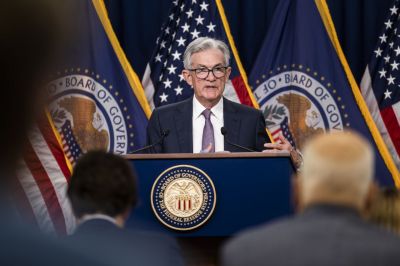
The probability of a rate hold, which was 0% a week ago and 35% the day before, stood at 15.1%. Although the hold outlook has slightly diminished compared to the previous day, expectations for a loosening of the tightening stance itself continue. Conversely, the possibility of a 'big step' (a 0.5 percentage point rate hike), which was dominant just a week ago, has dropped to 0%. Initially, the market expected the Fed to take a big step at the March 21?22 FOMC meeting, and Fed Chair Jerome Powell hinted at this possibility. However, following the SVB collapse on the 10th, the big step option has disappeared from the table.
Robert Pavlic, chief portfolio manager at Dakota Wealth, said, "The CPI released today indicates the Fed may pause rate hikes or raise by the minimum 0.25 percentage points," adding, "If the Fed is more concerned about credibility, it will raise by 0.25 percentage points, which it believes is the right thing to do." Cindy Boryu, a member of the investment policy committee at asset management firm Corning, supported the baby step, saying, "The Fed will raise rates by 0.25 percentage points if no further banking issues arise," and warned, "If rates are not raised, it could raise questions about whether the banking situation is so bad that inflation cannot be addressed."
While the baby step outlook is dominant, voices cautioning against ruling out a rate hold are also emerging. Cardillo, the chief market economist, said, "I don't think the Fed will raise rates at the March FOMC," but added, "Even if they do, it will be limited to 0.25 percentage points."
Final rate forecasts have also been lowered. As one of the main causes of the SVB crisis was pointed out to be the Fed's rapid rate hikes, more investors are betting that the terminal rate will stay below 5%. Currently, rate futures markets are betting that the US benchmark rate will peak around 4.95% (median) in May and then be cut within the year. This is a much more dovish outlook compared to a week ago, when the terminal rate was expected to reach 5.65% (median) by October.
Courkapas, the investment strategist, said, "The pace of inflation is important, but the Fed must also consider increasing risks to financial stability," and predicted, "They may stop rate hikes sooner." Joshua Chestnut, chief investment strategist at Guidestone Fund, said, "The Fed is caught between a rock and a hard place due to the financial market and inflation situation," adding, "If the regional banking system starts to experience stress, the Fed will struggle to continue raising rates."
Nancy Davis of Quadratic Capital Management pointed out, "The Fed has run out of good options," noting, "Higher rates are needed to fight inflation, but high rates could continue to cause problems in the banking sector."
© The Asia Business Daily(www.asiae.co.kr). All rights reserved.
![Clutching a Stolen Dior Bag, Saying "I Hate Being Poor but Real"... The Grotesque Con of a "Human Knockoff" [Slate]](https://cwcontent.asiae.co.kr/asiaresize/183/2026021902243444107_1771435474.jpg)











