5·18 Injured Veterans Association and Meritorious Persons Association Hold On-site Testimony Event Inviting Martial Law Troops
Kim Gwisam, Former 3rd Airborne Division Member, Explains Situations at Gwangju Station in 1980
In May 1980, the martial law troops who had oppressed the citizens of Gwangju with guns and knives and had been tormented by guilt met directly with the victims, apologized, asked for forgiveness, and testified about the situation.
On the afternoon of the 14th, at the Daedong Hall of the 5·18 Memorial Culture Center in Seo-gu, Gwangju Metropolitan City, an event titled "Today's Testimony is the First Step in Uncovering the Truth of 5·18," organized by the 5·18 Democratic Movement Injured Veterans Association, the Meritorious Persons Association, and the Special Forces Comrades Association, was held.
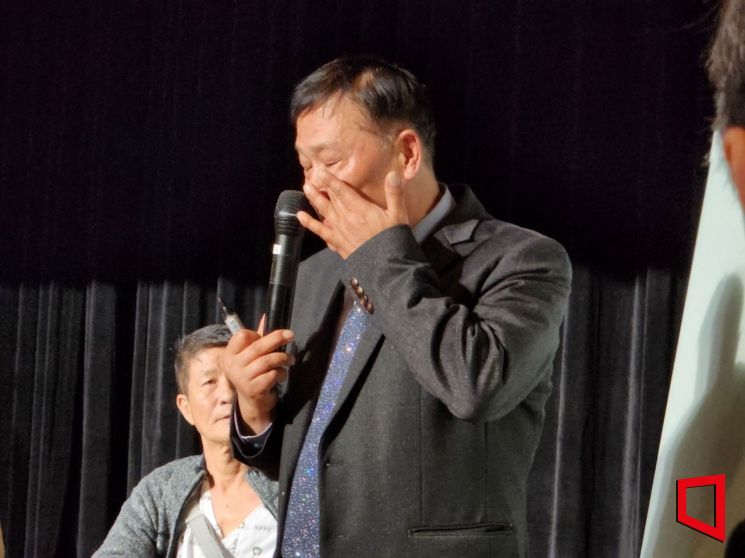 Mr. Kim Gwisam, who was a martial law soldier during the May 18 Democratic Uprising, is wiping away tears while explaining the situation at the event "Today's Testimony is the First Step in Uncovering the Truth of May 18."
 [Photo by Min Hyunki]
The event was attended by Kim Gwisam (68), a former sergeant of the 3rd Battalion, 3rd Airborne Brigade, who was deployed as a suppression force in Gwangju in May 1980, and Kim Taesu (68), a civilian soldier who was shot in front of Gwangju Prison.
Kim Gwisam, who introduced himself as a native of Gwangju, explained the situation when he arrived in Gwangju on May 20, 1980, and was deployed in the suppression operation, as well as the situation 43 years ago when he was on guard duty at Gwangju Prison.
Kim testified that during the confrontation with civilian soldiers in the alley in front of Gwangju Station, a crowd of citizens surged in, leading to clashes with the martial law troops attempting forced dispersal, resulting in numerous injuries. He also described how the martial law troops tied captured citizens with ropes and severely beat those who resisted to prevent escape.
He went on to say that upon hearing that his brothers had participated as civilian soldiers in the protests, he tried to check among the prisoners captured in front of Gwangju Station if any had brothers or friends. While telling his unit members "Don't hit them, don't hit them," he confessed that due to the circumstances, he had no choice but to bayonet the thigh of one civilian soldier.
According to Kim, his brothers Kim Gwiseong, Kim Gwijeong, and Kim Gwisik were active as 5·18 civilian soldiers when he was deployed as a martial law troop in Gwangju.
Afterward, Kim returned to his hometown after completing his military service, but he lived away from home, remembered not as an honorably discharged soldier but as "the one who killed his brothers."
Kim said, "I have not been able to visit the National 5·18 Democratic Cemetery out of shame," adding, "I feel guilty that many people, including students, died from the bullets we fired."
After the event, Kim visited the National 5·18 Democratic Cemetery to pay his respects. He plans to visit the May organizations and Gwangju Prison to provide detailed testimony in the future.
The 5·18 Meritorious Persons Association and Injured Veterans Association are expected to continue holding events where martial law troops from the 7th Airborne Battalion on the 21st and the 11th Airborne Battalion on the 28th will testify at the sites.
© The Asia Business Daily(www.asiae.co.kr). All rights reserved.

















