KIST Research Team
Domestic researchers have developed an ultra-small lithium-ion battery that can be freely printed in various shapes using a 3D printer. It is attracting attention as it can be used to supply power to ultra-small electronic devices such as Internet of Things (IoT) devices, bio-robots, and implantable medical device technologies.
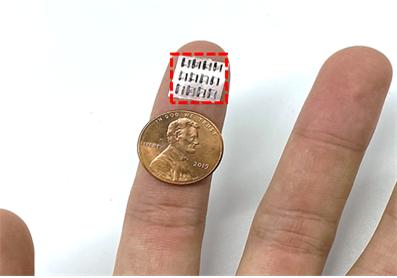 3D printed ultra-small lithium-ion battery with freely customizable shapes developed by the KIST research team. Photo by KIST
The Korea Institute of Science and Technology (KIST) announced on the 14th that Dr. Seungjun Jeong's team at the Soft Convergence Materials Research Center, in collaboration with Professor Jongwoo Lim of the Department of Chemistry at Seoul National University, developed a free-form lithium-ion battery that is lightweight, highly design-flexible, and can be introduced into personalized small devices.
Currently, lithium-ion batteries with very standardized designs such as cylindrical or rectangular shapes are used in portable devices and electric vehicles. Existing lithium-ion batteries have limitations such as using metal current collectors that are very heavy and employing flammable liquid electrolytes. To efficiently use space when designing user-customized ultra-small devices, technology that allows the battery shape to be freely manufactured is necessary.
The research team fabricated lithium-ion batteries by freely printing all battery materials from the current collector to packaging using 3D printing technology. For this, the development of battery material inks capable of forming stable patterns with high resolution was essential. Previous studies on liquid electrolytes or semi-solid gel electrolytes faced difficulties in controlling the rheological properties of the ink, preventing the formation of high-resolution patterns. The team succeeded in developing a semi-solid gel electrolyte that simultaneously satisfies high-resolution pattern formation below millimeter (mm) scale and high ionic conductivity by adjusting the ratio of two polymers. The heavy metal current collector was replaced with lightweight, electrically conductive metal nanoparticle ink and polymer ink to implement the current collector.
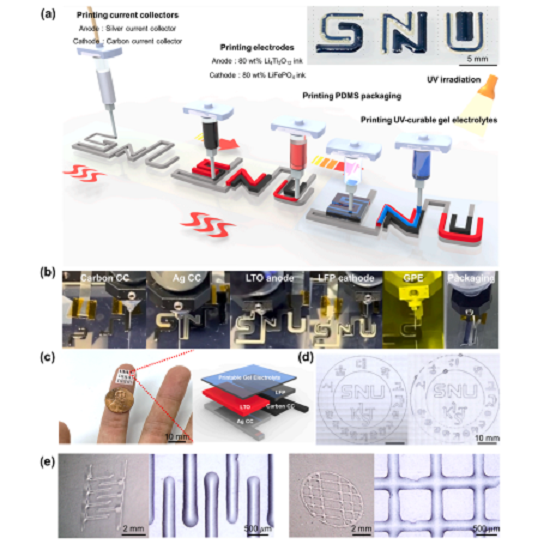
As a result, all materials required for the battery could be printed using 3D printing, and it was demonstrated that the battery could be integrated into devices without shape constraints in spaces where conventional batteries could not be applied, supplying power. The developed printed battery achieved capacities of several mAh required for IoT, sensors, and implantable medical devices.
Dr. Jeong stated, "It is expected to be used as an energy source in areas such as free-form 3D-shaped devices where conventional batteries are difficult to apply, implantable medical devices, and small robots."
This research result was published in the international journal 'Energy Storage Materials' (IF 20.831, JCR top 4.203%).
© The Asia Business Daily(www.asiae.co.kr). All rights reserved.
![Clutching a Stolen Dior Bag, Saying "I Hate Being Poor but Real"... The Grotesque Con of a "Human Knockoff" [Slate]](https://cwcontent.asiae.co.kr/asiaresize/183/2026021902243444107_1771435474.jpg)

















