At around 3 p.m. on the 13th, at a jokbal (pig's trotters) restaurant in Myeongdong, Jung-gu, Seoul, three Chinese customers entered amid preparations for the evening service. An employee who was tidying up the tables initially tried to communicate using body language but soon started responding through a translation application (app) on their smartphone. The store manager, Mr. Hwang (65), said, “The number of Chinese customers has been increasing, and recently the ratio of Korean to Chinese customers is about 5:5. We expect more Chinese customers, so we have instructed Korean staff to install translation apps and are continuously posting job ads to hire more employees who can speak Chinese.”
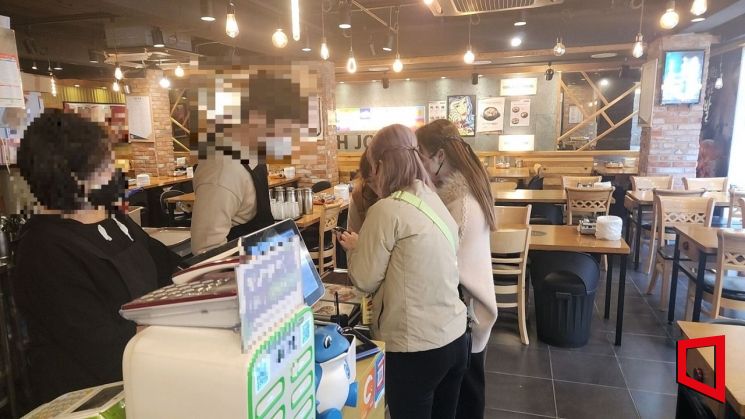 Around 3 p.m. on the 13th, at a jokbal restaurant in Myeongdong, Jung-gu, Seoul. Staff and Chinese customers are communicating through a translation application (app) on their mobile phones.
 Photo by Taewon Choi skking@
Small business owners such as restaurants and cafes, frequently visited by foreign tourists, are preparing to welcome the returning Yukeo (Chinese travelers) as the COVID-19 situation eases.
Along with this movement, small business owners hope that the return of Yukeo will help their livelihoods, which have been strained by rising prices and economic downturn. Yukeo tend to have a high average spending per customer and, since they visit Korea for tourism, they do not stay long, resulting in a high table turnover rate. According to the Bank of Korea, the average spending per Chinese visitor to Korea was $1,689 (based on 2019), which is higher than that of Americans ($1,106) and Japanese ($675).
Mr. Hwang said, “Chinese tourists not only order a lot of food but also tend to leave quickly after eating, probably because they are here for sightseeing, which leads to a good turnover rate and significantly helps sales.” Mr. Kim (55), a cafe owner in Yeonnam-dong, Mapo-gu, Seoul, also said, “Especially Chinese tourists on package tours, who come in groups of dozens, order many menu items in a short time and are the best customers.”
The government also expects Yukeo to aid economic recovery. The Bank of Korea forecasted that 1.96 million Chinese tourists, nine times the number from last year, will visit Korea this year. On the 10th, Lee Dong-won, head of the Financial Statistics Department at the Bank of Korea’s Economic Statistics Bureau, stated at an emergency economic vice-ministerial meeting, “We expect a large number of group tourists during the Chinese Labor Day holiday from April 29 to May 3,” adding, “If the number of Chinese travelers increases rapidly, the effect of China’s reopening on our economy could be greater than expected.”
In response to this situation, small business owners are stretching out to welcome Yukeo by hiring employees who can speak Chinese and installing translation apps on their smartphones.
Mr. Kim (56), owner of a meat restaurant near Hongdae Entrance Station in Mapo-gu, Seoul, said, “Since the end of February, the number of Chinese customers has noticeably increased. We recently reinstalled the translation app we used before the COVID-19 outbreak and are considering hiring staff who can speak Chinese.”
Mr. Kim, the cafe owner in Yeonnam-dong, also said, “We are recruiting part-time workers who can speak Chinese and plan to add Chinese to the order kiosk, which currently supports only Korean and English.”
As demand for Chinese rises again, Chinese international students in Korea have welcomed the returning Yukeo, saying “it has become easier to find part-time jobs.” Mr. Hwang (26), a Chinese graduate student at Seoul National University, said, “During the severe COVID-19 period, I couldn’t return to China and stayed in Korea, but it was very difficult to find part-time work. Recently, most Chinese students are working part-time at cosmetics stores or restaurants. There are hardly any cases where someone wants to work but can’t.”
© The Asia Business Daily(www.asiae.co.kr). All rights reserved.
![Clutching a Stolen Dior Bag, Saying "I Hate Being Poor but Real"... The Grotesque Con of a "Human Knockoff" [Slate]](https://cwcontent.asiae.co.kr/asiaresize/183/2026021902243444107_1771435474.jpg)











