The Failed Reform Case of Italy Serves as a Cautionary Tale
Spain and Portugal improved their economic structures through proactive labor and public sector reforms following the 2012 European fiscal crisis. In contrast, Italy failed to implement effective reforms and experienced a slowdown in economic growth. As the Korean government has designated this year as the inaugural year of reform, experts advised referencing the cases of these three countries.
On the 14th, the Federation of Korean Industries analyzed economic and fiscal indicators from 2012 to 2019 for Portugal, Italy, and Spain, which suffered severe fiscal deficits after the European fiscal crisis, and announced these findings.
In 2012, Spain passed a labor reform bill aimed at enhancing employment flexibility and security through Flexicurity, maintaining a balance between regular and temporary workers. Portugal undertook labor reforms that significantly changed the existing labor-management paradigm, such as recognizing individual dismissal reasons in the same year. In contrast, Italy implemented two rounds of reforms under Prime Ministers Monti in 2012 and Renzi in 2015, but these were more moderate compared to Spain and Portugal.
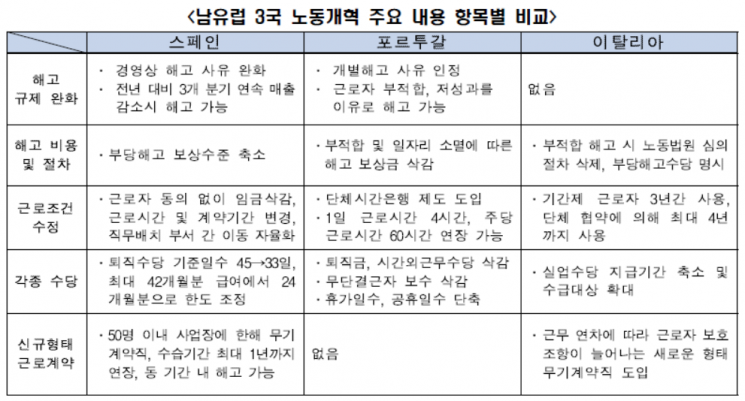
As a result, Spain and Portugal achieved improvements in labor flexibility indicators, unemployment rates, and employment rates about ten years later. Italy, however, showed stagnation. According to the labor market flexibility index published by the Fraser Institute of Canada, Spain and Portugal increased by more than 0.8 points between 2011 and 2020, while Italy decreased by 0.19 points.
Spain and Portugal also pursued public sector reforms and fiscal austerity to resolve national debt and government fiscal deficit issues. The Rajoy administration in Spain reduced public sector spending, including a 14% cut in public investment during its tenure from 2010 to 2017. Portugal implemented a national reform program in 2016, introducing measures such as debt ceilings for state-owned enterprises. Italy, on the other hand, repeatedly failed to implement austerity and public sector reforms.
Consequently, Spain and Portugal rapidly reduced their government expenditure ratios, but Italy showed no significant improvement. Looking at the government expenditure ratio relative to GDP after the fiscal crisis, the three countries were at similar levels in 2012, but Spain and Portugal reduced their ratios by about 7 percentage points over the following seven years, whereas Italy only reduced by about 2 percentage points. The government debt-to-GDP ratio also declined only in Spain and Portugal.

Spain and Portugal achieved opposite results to Italy through these labor and public sector reforms. From 2015 until before the spread of COVID-19 in 2019, they steadily grew by about 2-3% annually. Spain recorded an average growth rate in the 3% range from 2015 to 2017, achieving the fastest economic recovery among the three countries. In contrast, Italy had similar growth rates to Spain and Portugal in 2012 but only managed 0-1% growth until 2019.
The Federation of Korean Industries suggested that since the Korean government has designated this year as the inaugural year of reform, Spain and Portugal should be benchmarked. Kim Bong-man, head of the Federation’s International Headquarters, said, "With inflation and trade deficits expanding economic instability, labor and public sector reforms can become new growth engines. The cases of Spain and Portugal should be actively referenced, and Italy’s case should serve as a cautionary example."
© The Asia Business Daily(www.asiae.co.kr). All rights reserved.
!["The Woman Who Threw Herself into the Water Clutching a Stolen Dior Bag"...A Grotesque Success Story That Shakes the Korean Psyche [Slate]](https://cwcontent.asiae.co.kr/asiaresize/183/2026021902243444107_1771435474.jpg)

















