Reopening of Trials Possible for Decisions Since 2010 if Ruled Unconstitutional
5 Out of 59 Death Row Inmates in Korea Given Chance for Retrial
As the religious community petitions for the abolition of the death penalty, interest is growing in the constitutional court's review of the constitutionality of the death penalty. If the Constitutional Court rules it unconstitutional, only 5 out of the 59 death row inmates in the country will be able to request a retrial.
The Justice and Peace Committee of the Catholic Bishops' Conference of Korea submitted a petition to the National Assembly on the 13th calling for the abolition of the death penalty and the introduction of alternative punishments. The organization stated, "There is no empirical evidence of the crime prevention effect of the death penalty," adding, "If the death penalty is carried out based on a wrongful judgment, it cannot be undone even if the real culprit is later revealed." They pointed out that there is a possibility that innocent citizens could be killed by the state in the event of a misjudgment.
In fact, the abolition movement gained momentum based on the case of Yoon Seong-yeo, who was wrongfully imprisoned for 20 years until Lee Chun-jae was identified as the real culprit of the Gyeonggi Hwaseong serial murder case in 2019.
Currently, the death penalty is on the Constitutional Court's bench. This is the third time the court is reviewing the constitutionality of the death penalty. A ruling of unconstitutionality requires the agreement of at least six justices; in 1996, the decision was constitutional by 7 to 2, and in 2010, it was constitutional by 5 to 4.
As of July last year, there are 59 death row inmates in the country, but even if the Constitutional Court rules the death penalty unconstitutional, only 5 inmates will be able to request a retrial. The rest are likely to remain long-term prisoners. This is because the Constitutional Court Act stipulates that its effect is lost from the day of the previous constitutional decision (February 25, 2010).
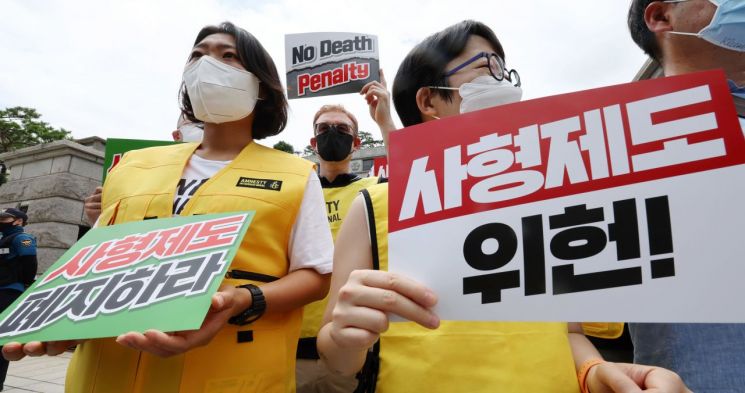 On the afternoon of July 14 last year, participants hold placards at a press conference held by religious, civic, and social organizations regarding the Constitutional Court's public hearing on the death penalty in front of the Constitutional Court in Jongno-gu, Seoul.
 [Image source=Yonhap News]
Among the cases eligible for retrial requests if the death penalty is ruled unconstitutional are the perpetrators Oh Jong-geun and Lee Hyang-yeol of the 'Boseong serial murder case' and the 'Yeongam serial murder case.'
Oh Jong-geun was tried on charges of killing two teenagers who traveled to Boseong on August 31, 2007. He took them on his boat, pushed the male victim into the sea to drown him in order to sexually assault the female victim, and then pushed the resisting female victim into the sea to drown her as well. On September 25 of the same year, he was also tried for killing two college students in their twenties on his boat using the same method.
Lee Hyang-yeol, who had a prior record including special rape, was released on parole in 2005. He was charged with sexually assaulting his cohabiting partner's nephew, tying his hands and feet, placing him in a travel bag, and carrying him in the trunk of a car, causing suffocation death. A week later, Lee sexually assaulted his stepdaughter at his home, strangled and killed her, murdered his cohabiting partner that same night, and early the next morning sexually assaulted both his cohabiting partner's nephew and his own biological daughter.
Other cases eligible for retrial requests if the death penalty is ruled unconstitutional include Kim Min-chan of the 2nd Marine Division shooting incident, Jang Jae-jin who attacked and killed his ex-lover's parents, and Lim Do-bin of the 22nd Division GOP shooting incident.
Previously, the National Human Rights Commission also urged the government to follow the United Nations Human Rights Council's recommendations, including the abolition of the death penalty. Song Doo-hwan, the chairperson of the Human Rights Commission, stated last month that the government should clarify its position on accepting the UN Human Rights Council's recommendations and faithfully implement those accepted. The UN Human Rights Council has recommended the abolition of the death penalty and the enactment of comprehensive anti-discrimination laws.
However, public opinion favors maintaining the death penalty. This is based on expectations that the death penalty will deter serious crimes and the judgment that it is an appropriate punishment commensurate with the brutality of the crimes. In a survey conducted by Gallup Korea in July last year with 1,000 adults nationwide aged 18 and over, 69% of respondents said the death penalty should be maintained.
Similar to Korea, Japan, which has also faced international pressure to abolish the death penalty, reaffirmed its position to maintain the death penalty last month. Under the administration of Prime Minister Fumio Kishida, which took office in October 2021, two executions have already been carried out. In December of the same year, three death row inmates who had been sentenced to death for murder and other crimes were executed, followed by the execution in July last year of Kato Tomohiro, who committed the so-called 'Akihabara random killing incident' that killed seven pedestrians in a city center.
© The Asia Business Daily(www.asiae.co.kr). All rights reserved.
![Clutching a Stolen Dior Bag, Saying "I Hate Being Poor but Real"... The Grotesque Con of a "Human Knockoff" [Slate]](https://cwcontent.asiae.co.kr/asiaresize/183/2026021902243444107_1771435474.jpg)
















