Concerns Over Bank Domino Bankruptcy Emergency Measures
Fund Established to Support Liquidity
US Treasury Guarantees Deposits... "Bailout Nature" Also Analyzed
Low Possibility of Financial System Crisis Spillover
The U.S. government has decided to pay depositors of the bankrupt Silicon Valley Bank (SVB) the full amount of their deposits regardless of the amount. It also plans to lend funds to banks facing liquidity shortages. This is interpreted as an emergency measure to prevent a domino bank run (massive withdrawal of deposits) spreading to other banks, escalating into a crisis across the entire financial system, and causing a megaton-level shock to the global financial market. Although the U.S. Treasury has drawn a line by stating there will be no bailout, some analysts view this as effectively pulling out the bailout card amid inevitable government intervention.
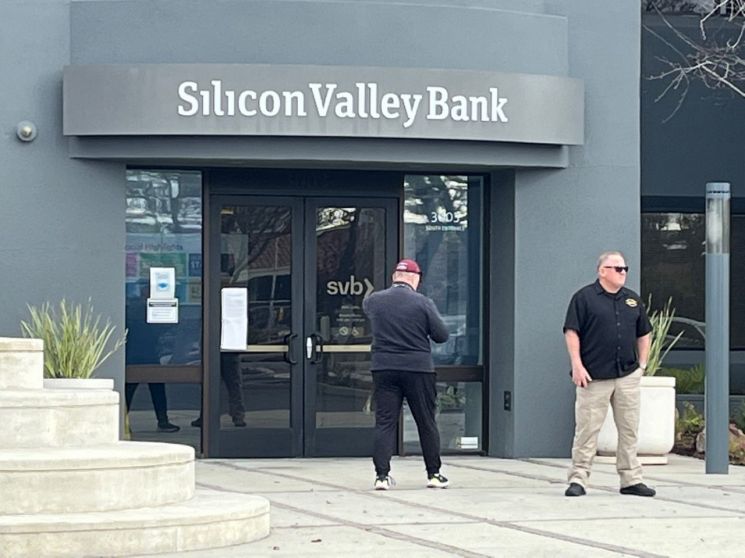
U.S. Government Protects Full Deposits at SVB
On the 12th (local time), the U.S. Treasury, Federal Reserve (Fed), and Federal Deposit Insurance Corporation (FDIC) announced that they would guarantee all customer deposits at SVB regardless of the insurance limit. Treasury Secretary Janet Yellen reported the recommendation from the Fed and FDIC to President Joe Biden, who approved a resolution to fully protect all depositors. However, shareholders and some unsecured creditors were excluded from protection.
The government explained, "SVB depositors will have access to all funds starting Monday, the 13th," and "taxpayers will not bear any losses related to SVB."
Currently, the FDIC deposit insurance limit is up to $250,000. However, under federal banking law, when risks arise in the financial system, it is possible to protect the full amount of deposits beyond the insured limit. The U.S. government found a solution to the SVB crisis based on this provision.
Additionally, the Fed decided to establish a new fund (BTFP) to provide liquidity support to banks. This fund will lend money for one year to banks that pledge U.S. Treasury securities and mortgage-backed securities (MBS) as collateral. Notably, the collateral will be valued at face value rather than market value. This measure considers that many of the Treasury securities held by SVB have declined in value due to the Fed’s interest rate hikes, meaning that selling them immediately would yield less than face value. The U.S. government plans to allow up to $25 billion from the Treasury’s Exchange Stabilization Fund (ESF) to support this fund.
Signature Bank Also Closed... Emergency Measures Amid Domino Bankruptcies Concerns
The U.S. government’s emergency move to fully protect deposits following the SVB bankruptcy is due to concerns that a domino bank run could spread to the U.S. and global financial systems, escalating into a broader crisis. Since this measure was announced ahead of the Asian stock markets opening on the morning of the 13th, it is also seen as a strategy to prevent the shock from spreading worldwide and the SVB crisis from escalating.
Authorities are particularly worried that continued withdrawals from other banks or frozen funds of tech companies and investors could worsen management difficulties, triggering a vicious cycle of further bank runs. The U.S. government is especially cautious about the risk of domino bankruptcies similar to SVB if depositors continue withdrawing funds from other small and medium-sized banks. In fact, it took only 36 hours for SVB, established about 40 years ago, to collapse, indicating how rapidly the crisis is progressing.
This risk is already materializing. U.S. financial authorities closed Signature Bank, based in New York, on the same day. The government stated, "New York state financial regulators, considering similar systemic risks as with SVB, have ordered the closure of Signature Bank as of today." Signature Bank, one of the major banks in the cryptocurrency industry, has total assets of $110.4 billion and deposits of $88.6 billion. Like SVB, the authorities decided to fully protect Signature Bank depositors’ assets.
Yellen Draws a Line but... Criticism of De Facto 'Bailout'
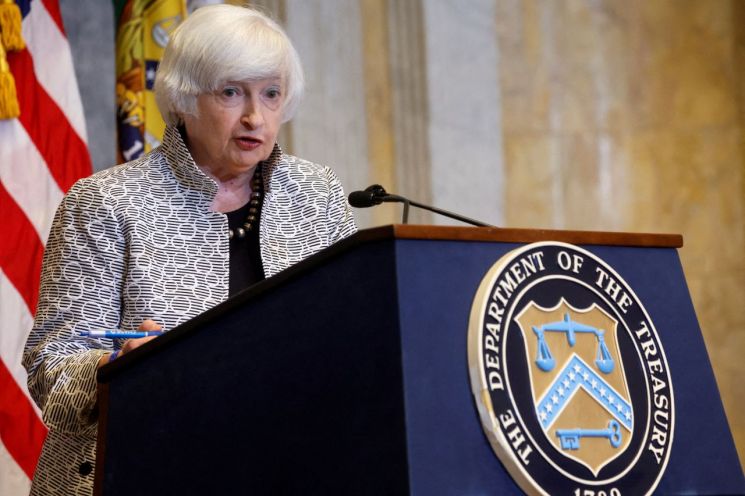
Some analysts argue that the U.S. authorities have effectively pulled out the 'bailout' card. Treasury Secretary Janet Yellen dismissed the possibility of a large-scale bailout similar to the 2008 global financial crisis during an interview with CBS's Face the Nation on the morning of the same day. Amid growing calls for government intervention due to concerns that the SVB bankruptcy shock would spread, she directly ruled out the possibility of a bailout. She explained, "The U.S. banking system is really safe and well-capitalized," adding, "We are focused on worrying about depositors and meeting their needs."
However, since the Treasury ultimately guarantees the deposits, there is analysis that the government could face criticism related to bailouts. The Washington Post (WP) pointed out, "Claims that this measure does not constitute a bailout will face criticism," noting, "Funds going to depositors are paid by U.S. banks but are ultimately backed by the Treasury and, ultimately, U.S. taxpayers."
There is also analysis that public criticism urging the government to intervene early and contain the crisis before it worsens influenced this decision. American venture capitalist David Sacks warned on Twitter on the 11th (local time), "Where are Powell and Yellen? If SVB deposits are not distributed among the top four banks before Monday, the crisis will spread."
Low Possibility of Crisis Spreading Across the Financial System
Some market participants remain cautious, believing that since the SVB crisis was triggered by the Fed’s aggressive tightening, similar shocks could hit other banks in similar situations. Most U.S. banks hold a significant amount of bonds, including U.S. Treasury securities, as assets. Secretary Yellen also hinted in the interview that "the problem in the tech sector is not the core of this crisis," implying that the Fed’s rapid interest rate hikes were the issue.
However, there is a forecast that the SVB crisis is unlikely to spread into a systemic crisis across the entire financial system. Anil Kashyap, professor at the University of Chicago Booth School of Business, emphasized, "The collapse of a bank causes losses to shareholders and economic problems for companies holding deposits, but it does not mean the entire financial system will be at risk like in the 2008 financial crisis," adding, "This is a problem of a mismanaged mid-sized bank, not a systemic event." He further noted, "The current U.S. banking system is highly concentrated, with $13 trillion in assets tied up in the top five financial institutions," and predicted, "Even if a bank of similar size to SVB experiences a bank run, the overall financial system will continue to function."
© The Asia Business Daily(www.asiae.co.kr). All rights reserved.


















