As of the 10th of this month, the cumulative trade deficit has surpassed $20 billion, reaching about half of last year's level. Although imports of the three major energy sources?crude oil, gas, and coal?decreased by more than 20% compared to last month following the end of the winter cold wave, the recovery remains slow due to semiconductor exports, the main export item, still plummeting by over 40%. Analysts also point out that the prolonged export slump in China, Korea's largest trading partner, is affecting the trade deficit.
According to the Korea Customs Service on the 13th, the export value (provisional clearance basis) from the 1st to the 10th of this month was $15.791 billion, down 16.2% compared to the same period last year, while imports increased by 2.7% to $20.786 billion. With exports decreasing and imports increasing, the trade balance recorded a deficit of $4.995 billion last month. Exports have declined for six consecutive months, resulting in a trade deficit for 13 consecutive months since March last year. The annual trade deficit this year reached $22.775 billion, which is 48% of last year's trade deficit ($47.8 billion) in just over two months.
The prolonged trade deficit for 13 months is mainly attributed to the decline in semiconductor exports, Korea's key export item. As of the 10th of this month, semiconductor exports amounted to $2.26 billion, down 41.2% compared to the same period last year. This marks eight consecutive months of export contraction since August last year (-7.8%). The sharp drop of over 40% in semiconductor exports is due to the prolonged weakness in prices of memory semiconductors such as DRAM and NAND, which have a large export share, directly impacting Korea's export downturn. The fixed price of DRAM averaged $3.41 from January to April last year but plunged to $1.81 last month. Experts expect DRAM prices to continue declining until the fourth quarter of this year, forecasting Korea's semiconductor exports to shrink by 11.5% year-on-year to around $116 billion. Due to the semiconductor slump, the export recovery in the second half of the year is also unlikely to be significant.
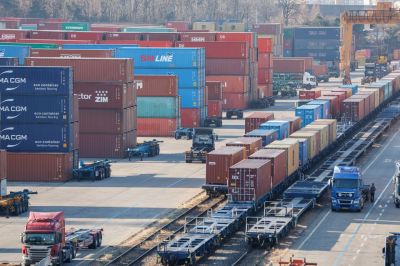 On the 8th, when the government issued an additional work commencement order to the Cargo Solidarity Union, containers were piled up at the Uiwang IDC in Gyeonggi Province. / Uiwang - Photo by Kang Jin-hyung aymsdream@
The trade deficit with China, Korea's largest trading partner, has also prolonged for 10 months, hampering export recovery. As of the 10th of this month, exports to China were $3.177 billion, down 35.3% year-on-year. The reopening effect in China has been slower than expected, failing to translate into visible export growth. Recently, China set a GDP growth target of around 5.0% for this year at the National People's Congress, but considering last year's 3.0% growth and the base effect, there are doubts about achieving this target. Concerns over a global economic recession have also worsened exports to the ASEAN region, further increasing the trade deficit. As of the 10th of this month, exports to Taiwan (-53.6%), Hong Kong (-45.2%), as well as to Vietnam (-16.4%) and Singapore (-25.9%), which serve as overseas production bases for Korean conglomerates, showed significant declines.
The silver lining is that imports of the three major energy sources (crude oil, gas, and coal) decreased by 24.0% compared to last month as the winter cold wave passed. During this period, coal imports ($795 million) increased by 31.9%, but crude oil ($2.514 billion) decreased by 3.1%, and gas ($1.733 billion) also fell by 1.9%, totaling $5.042 billion. Experts predict that if temperatures return to normal from this month, imports of crude oil and gas will significantly decrease, reducing the trade deficit.
© The Asia Business Daily(www.asiae.co.kr). All rights reserved.

















