Following SLBM, Showcasing Diversification of Submarine Missiles
High-Intensity Provocations Including ICBM Announced in Response to Joint Exercises
North Korea has launched a strategic cruise missile from a submarine for the first time. Following the submarine-launched ballistic missile (SLBM), this move appears to showcase the development of various weapons, and is interpreted as a full-scale military response to the joint South Korea-U.S. exercises that began on the 13th.
The Joint Chiefs of Staff announced on the same day, "We detected an unidentified missile launched from a North Korean submarine near Sinpo the previous day." On the same day, the Korean Central News Agency (KCNA) reported, "A strategic cruise missile underwater launch drill was conducted in the early morning of the 12th."
The Sinpo area, the missile launch point, is where North Korea’s submarine and SLBM development facilities are located. The military disclosed the missile launch a day later because the missile’s specifications were not clearly identified and due to concerns about further military actions and deceptive tactics by North Korea. KCNA reported, "The submarine '8.24 Hero' involved in the launch drill fired two strategic cruise missiles in the waters of Kyongpoman, East Sea of Korea."
This is the first time North Korea has launched a cruise missile from a submarine. The 8.24 Hero is a whale-class (2,000-ton class) submarine that was used for the first underwater launch of the Pukkuksong-1 SLBM off the coast of Sinpo, South Hamgyong Province, on August 24, 2016. At that time, North Korea claimed success in the underwater launch and named the submarine the 8.24 Hero.
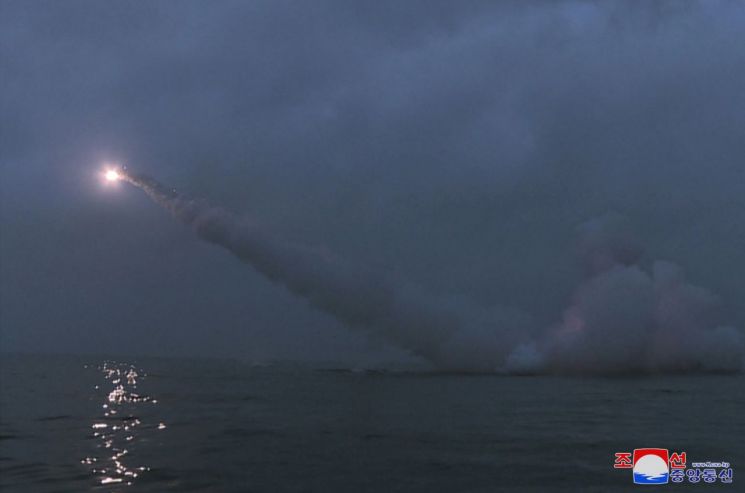
According to North Korea’s announcement, two strategic cruise missiles were launched this time, flying an '8'-shaped elliptical orbit for about two hours over 1,500 km to hit their targets. With a range of approximately 1,500 km, the missiles can strike all of South Korea and U.S. military bases in Japan. Cruise missiles fly at low altitudes after launch and can change their trajectory, making them strategic weapons capable of evading ground and sea interception systems. Unlike the SLBMs launched so far, this means North Korea now possesses another 'underwater strategic weapon.' Last May, North Korea launched short-range ballistic missiles from a submarine near Sinpo, and in October, it fired an SLBM from a reservoir.
Shin Jong-woo, Secretary General of the Korea Defense and Security Forum, said, "North Korea can secretly move submarines southward in the East Sea and launch cruise missile attacks from unexpected flanking positions, allowing them to evade our interception network and conduct precision strikes."
North Korea’s submarine missile launch appears to be a response to the 'Freedom Shield' (FS) South Korea-U.S. joint exercises that began on the same day.
The South Korea-U.S. joint exercises started at midnight on the day, entering the FS phase. Over the next eleven days, more than 20 outdoor live-fire drills and theater-level joint exercises will be conducted continuously for the longest period ever. Linked to FS, joint carrier strike group exercises involving the U.S. nuclear-powered aircraft carrier USS Nimitz (100,000-ton class, CVN 68) and South Korea-U.S.-Japan missile warning drills are also planned for later this month. Deployments of Aegis destroyers with various ballistic missile detection and interception capabilities and nuclear-powered submarines equipped with Tomahawk missiles are also expected.
Accordingly, during the exercise period, various high-intensity military demonstrations are anticipated, including ballistic missile and super-large multiple rocket launcher launches, large-scale joint firepower drills involving army, navy, and air force units including tactical nuclear operation units, and firing within the maritime buffer zone prohibited by the September 19 military agreement. Park Won-gon, a professor of North Korean Studies at Ewha Womans University, analyzed, "While the burden of provocations will be high during the period when U.S. strategic assets are mobilized, since there was a case of provocation during the joint exercises for the first time last November, the possibility of additional provocations cannot be completely ruled out."
© The Asia Business Daily(www.asiae.co.kr). All rights reserved.

















