Samjong KPMG Analyzes Global Consumer Goods M&A Market Trends
M&A 'Active' Due to Preference Fragmentation, Premiumization, Wellness, and Digitalization
[Samjong KPMG Press Release] Although the global consumer goods and retail M&A market has somewhat contracted amid increasing management uncertainties worldwide, there is a growing number of global consumer goods companies boldly investing by identifying sectors with growth potential.
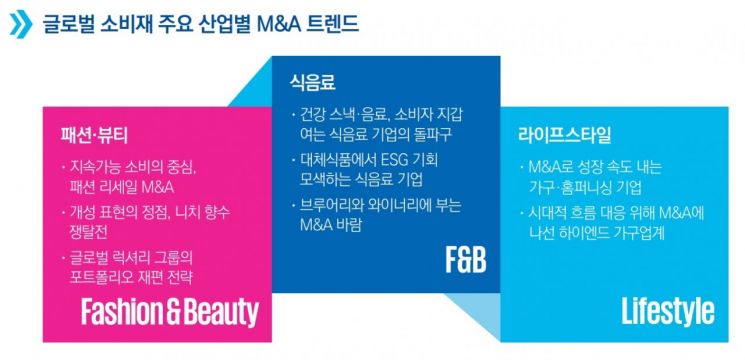
On the 13th, Samjong KPMG highlighted the M&A trends of global consumer goods companies through its report titled ‘Paradigm Shift in the Consumer Goods Market and M&A Trends.’ The report found that global consumer goods companies are actively engaging in M&A activities in key areas such as niche perfumes, healthy snacks, breweries and wineries, and high-end living.
Fashion and beauty companies are focusing on niche perfumes. This is because demand for mass-produced perfumes is declining, while the need for niche perfumes?produced in small quantities based on natural fragrances and thus rare?is expanding.
According to global market research firm Statista, the worldwide prestige perfume market is expected to grow at an average annual rate of 8% from 2021, reaching $18.2 billion by 2025. As demand for niche perfumes is anticipated to increase, global cosmetics companies are restructuring their portfolios around niche perfumes.
Est?e Lauder, which owns many famous perfume brands such as Jo Malone and Fr?d?ric Malle, added Tom Ford to its perfume lineup at the end of last year. Spanish beauty company Puig successfully acquired Byredo, building a solid perfume portfolio, while luxury conglomerate LVMH acquired the high-end perfume brand Maison Francis Kurkdjian and, in 2021, added Buly 1803, a perfume and cosmetics manufacturer rooted in craftsmanship.
As sustainable and health-oriented consumption trends significantly influence food and beverage consumption trends, global snack companies that have traditionally attracted consumers with sweet or salty snacks are strengthening growth momentum in premium and healthy snacks. Mondelez International, famous for ‘Oreo,’ acquired gluten-free chocolate cookies, sugar-free vegan chocolates, and protein energy bar brands. The Hershey Company has also been exploring various snack brands since 2017 to expand its influence beyond chocolates like KitKat and Kisses into the snack market.
With a sharp increase in consumers seeking craft beer instead of regular beer, major beer manufacturers such as AB InBev, Kirin, and Heineken are accelerating acquisitions of breweries, viewing craft beer as a growth engine.
Not only large beer companies but also independent breweries are actively engaging in M&A. The Boston Beer Company, a leading American microbrewery, acquired Dogfish Head Craft Brewery, and Kings & Convicts Brewing in Chicago purchased Ballast Point Brewing Co, a large California-based brewery. The report explains, “The recent consolidation among independent breweries is interpreted as a defensive measure against the entry of global beer giants into the craft beer market.”
Additionally, winery acquisitions have surged. In 2019, Distinguished Vineyards & Wine Partners, a U.S. wine producer, attracted attention by acquiring Markham Vineyard and Textbook Vineyard in Napa Valley, USA. Markham Vineyard and Textbook Vineyard are well-known Napa Valley wineries gaining recognition as wine consumption expands among younger consumers. Furthermore, luxury groups such as LVMH and Kering, as well as luxury and retail companies like Shinsegae Property, have joined the wine M&A trend, intensifying the momentum. This is seen as an effort to discover well-known wineries and lead the diversified and premiumizing alcoholic beverage market.
In lifestyle sectors such as home furnishing, high-end furniture companies are actively creating M&A growth opportunities. Fritz Hansen, a Danish company with a 150-year history, challenged itself to expand its business scope from indoor furniture to outdoor furniture by acquiring Skagerak. Herman Miller expanded its portfolio into home furniture and home furnishing by acquiring HAY, known for its Nordic-style furniture and accessories, and recently reemerged as a giant design furniture company named ‘MillerKnoll’ through a merger with its key competitor Knoll, maximizing synergy effects.
The report sees new growth opportunities in the consumer goods market in the ‘gaps’ of existing category lines such as niche perfumes, healthy snacks, and craft beer. It also analyzes that companies expanding their business into areas that create synergy with their core business stand out, recommending that companies should pursue M&A by targeting subtle gaps where business expansion opportunities exist.
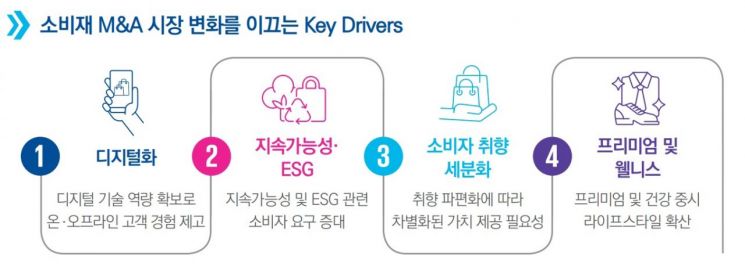
Park Young-geol, Executive Director of Samjong KPMG M&A Center, stated, “Recently, global consumer goods companies are focusing on diversifying their portfolios or exploring new growth engines through M&A, continuously laying the foundation for stable growth. Despite uncertain external conditions, companies must proactively seek opportunities to provide differentiated value based on factors driving changes in the consumer goods market atmosphere and trends, such as digitalization, fragmentation of consumer preferences, and premiumization.”
© The Asia Business Daily(www.asiae.co.kr). All rights reserved.


















