KCCI's 'Corporate Favorability' Survey... 48.6 in 2013 → 55.9 This Year
Social Contribution Activities Shift from 'Negative (40.9)' to 'Positive (53.7)'
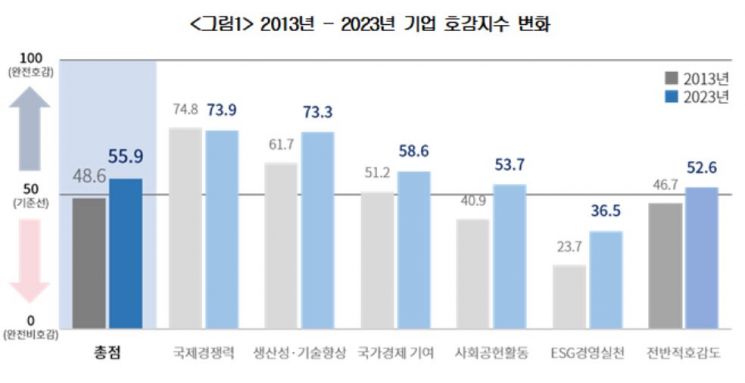
The favorability of our citizens toward companies has significantly increased compared to 10 years ago. In particular, the public's negative perception of corporate social contribution activities has shifted to a positive one.
The Korea Chamber of Commerce and Industry (KCCI), on the occasion of the 50th anniversary of Commerce Day, conducted a survey of 1,000 men and women aged 20 and over nationwide to gauge public favorability toward Korean companies and calculated the 'Corporate Favorability Index,' which recorded a score of 55.9. This is an increase of 7.3 points compared to the favorability index of 48.6 in the first half of 2013, 10 years ago, and is the highest score since the survey began in 2003.
The Corporate Favorability Index quantifies the degree to which the public feels positively toward companies by summing five key elements?contribution to the national economy, ESG management, productivity, international competitiveness, and social contribution?along with overall favorability. Scores close to 100 indicate high favorability, while scores near 0 indicate low favorability. A score above the baseline of 50 means that more people have a favorable view of companies than an unfavorable one.
Social contribution activities shift from negative (40.9) to positive (53.7)... ESG and productivity also see significant increases
Looking at the index changes over the past 10 years by detailed elements, 'social contribution activities' (40.9→53.7) and 'ESG management implementation' (23.7→36.5) rose the most, each by 12.8 points. 'Productivity and technological improvement' (61.7→73.3) and 'contribution to the national economy' (51.2→58.6) also increased by 11.6 points and 7.4 points, respectively. The 'international competitiveness' category, which has shown the highest scores, slightly declined from 74.8 to 73.9 compared to 10 years ago.
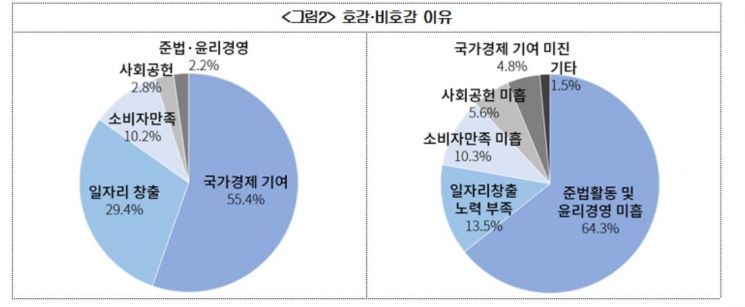
As reasons for favoring companies, the majority of respondents cited 'contribution to the national economy' (55.4%), followed by 'job creation' (29.4%), 'enhancement of consumer satisfaction' (10.2%), 'fulfillment of social responsibilities such as social contribution' (2.8%), and 'compliance and ethical management' (2.2%).
For reasons for unfavorable views toward companies, the public most frequently pointed to 'lack of compliance and ethical management' (64.3%). Other reasons included 'insufficient efforts in job creation' (13.5%), 'lack of consumer satisfaction' (10.3%), 'insufficient social contribution' (5.6%), and 'inadequate contribution to the national economy' (4.8%).
Through which channels do citizens form perceptions of companies? 1st place 'media reports' (47%), 2nd place 'own or acquaintances' companies' (31%)
When asked through which channels they mainly form impressions of companies or businesspeople, the highest response was 'newspaper and broadcast reports' (47.6%), followed by 'direct or indirect experience through working at a company or knowing someone who works there' (31.5%), 'portrayals of companies in dramas and movies' (7.2%), 'statements from political circles and civic groups' (5.3%), and 'images shown through businesspeople’s SNS activities' (4.5%).
Regarding entrepreneurial spirit among Korean businesspeople in a rapidly changing management environment, 27.1% responded that it has 'increased' compared to 10 years ago. The main reasons cited for this increase were 'Korean companies’ achievements on the global stage' (42.8%) and 'active investment in future growth industries' (35.1%). Other reasons included 'high growth of startup companies and emergence of star entrepreneurs' (14.0%), 'active efforts to solve social issues such as environment and local communities' (5.2%), and 'efforts to advance corporate culture' (2.9%).
Top expectations for companies: jobs (59%), worker welfare (46%), customer satisfaction (39%), social contribution (35%)
The top priority that citizens want from companies is 'creation of quality jobs' (59.1%). This was followed by 'improvement of worker welfare' (46.4%), 'customer satisfaction through new product development and service improvement' (39.4%), 'solving environmental and local community issues' (34.8%), 'contribution to overcoming the global economic crisis' (30.1%), 'compliance management and prevention of misconduct' (29.8%), and 'nurturing next-generation talent' (25.9%).
Kang Seok-gu, head of the KCCI Research Division, stated, “The proportion of respondents who answered that social contribution was insufficient as a reason for disliking companies has significantly decreased from 22.5% ten years ago to 5.6%, indicating that the public positively evaluates companies’ steady social contribution efforts. The business community will strive to further enhance corporate competitiveness and practice transparent ESG management to prepare for the rapidly changing international environment.”
© The Asia Business Daily(www.asiae.co.kr). All rights reserved.
![Clutching a Stolen Dior Bag, Saying "I Hate Being Poor but Real"... The Grotesque Con of a "Human Knockoff" [Slate]](https://cwcontent.asiae.co.kr/asiaresize/183/2026021902243444107_1771435474.jpg)

















