Average Temperature in Antarctica Rising by 0.6°C Every 10 Years
Penguins Also Hatch Earlier in Response to Climate Change
As the Antarctic warms due to climate change, the hatching period of penguins has also been observed to advance.
According to researchers from the Seoul National University Wildlife Laboratory who recently returned after monitoring at the Penguin Village near the Antarctic King Sejong Station, the cries of baby penguins are now heard earlier than before as the Antarctic warms.
The Korea Polar Research Institute and the Seoul National University Department of Forest Sciences Wildlife Laboratory conduct "Antarctic Special Protected Area Ecosystem Monitoring" every winter in this Penguin Village.
The Antarctic is known as the place on Earth experiencing the fastest climate change. According to meteorological observation data from the King Sejong Station, the average temperature in the Antarctic is rising by 0.6 degrees every 10 years. The average temperature from 2014 to 2021 increased from -2.4 degrees Celsius to -0.3 degrees Celsius.
As a result, the ice cliffs covering Marian Cove near the station retreated by 738 to 987 meters between 1997 and 2006, retreating approximately 94.7 meters annually. During the same period, the glacier melting in Penguin Village covered an area of 927,525 square meters, equivalent to 130 soccer fields (7,140㎡ each) combined.
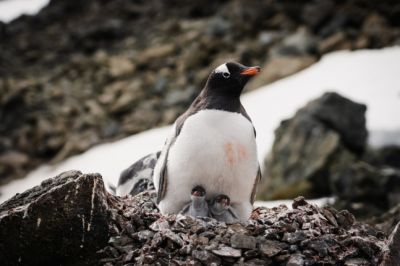 Gentoo Penguin
 [Image source: Provided by the Wildlife Laboratory, Department of Forest Sciences, Seoul National University]
Penguins are also affected by climate change. Except for 2020, when research was not conducted due to the COVID-19 pandemic, monitoring results over the past decade (2012?2022) show that the hatching period of Gentoo penguins and Chinstrap penguins has gradually advanced.
The hatching period of Gentoo penguins moved forward by about ten days, from December 13 during 2012?2016 to December 3 in 2021?2022. In 2021, it was December 6, and last year it was December 1.
The relatively smaller change in the breeding period of Chinstrap penguins compared to Gentoo penguins may be because Chinstrap penguins are more vulnerable to Antarctic climate change. The Gentoo penguin population remained stable, from 2,496 pairs in 2012 to 2,482 pairs in 2021, whereas the Chinstrap penguin population decreased from 3,332 pairs to 2,197 pairs during the same period.
Professor Choi Chang-yong of the Seoul National University Department of Forest Sciences explained, "The change in breeding periods is a positive sign showing efforts to adapt to climate change," but added, "Unlike Gentoo penguins that quickly adapt to environmental changes, the change in breeding periods of Chinstrap penguins was not as significant as expected."
© The Asia Business Daily(www.asiae.co.kr). All rights reserved.

















