Debate Among Office Workers on Attending Company Dinners
"Company Dinners Are Part of Work" vs "Those Who Want to Go, Go"
"Still, Last-Minute Absences Are a Bit..." Majority Opinion
The behavior of a new employee who notified their absence from a company dinner on the day itself without any particular reason is drawing mixed reactions from office workers.
Opinions clash between those who say "there is no problem" in the context that forcing attendance at company dinners is wrong in itself, and those who argue that "not informing about absence on the day is impolite."
On the 10th, an anonymous office worker community called 'Blind' posted a message titled "These days, new hires seem to think company dinners are optional." Mr. A, who works at a public enterprise, complained, "We all agreed and set the date for the company dinner, but they notified on the day that they wouldn't come," adding, "There were no excuses or explanations, is this right?"
This post attracted hundreds of comments within a day, drawing attention from office workers. With perceptions of company dinners divided between enjoyable social gatherings and extensions of coercive work, various opinions are clashing among workers.
"Endless toast speeches... Let those who want to eat go"
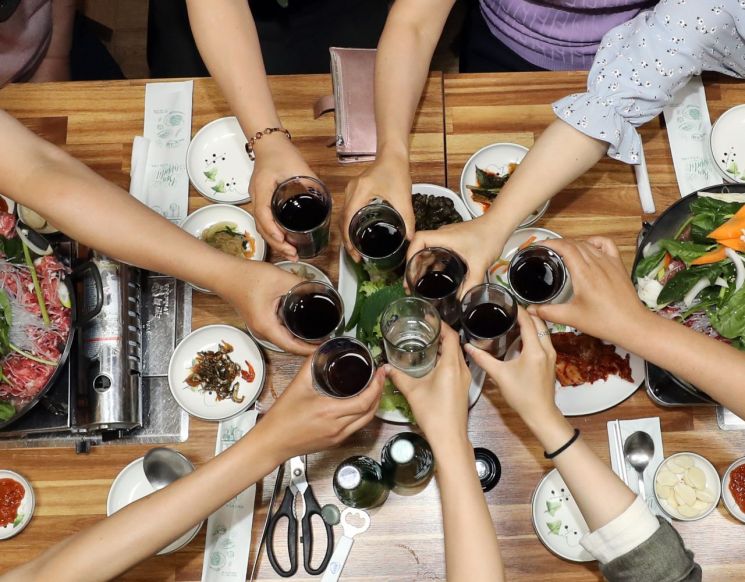 The behavior of a new employee who notified their absence on the day of a company dinner is receiving mixed reactions from office workers. The photo is not related to the specific content of the article. [Photo by Yonhap News]
First, opinions on attending company dinners were divided. One office worker who dislikes company dinners said, "Every time, there are endless toast speeches, and they only talk about work," adding, "I can't even take a vacation, so I want to go home and spend time with my family." Another worker replied, "People who want to eat can gather and eat," asking, "Is it better to eat with people who don't want to?"
On the other hand, another office worker said, "You may not want to go," but defended company dinners by saying, "Is it really something to dislike just because you have to eat one meal after a few hours of socializing?" There was also a comment from a worker who said, "Do colleagues really have so little bonding? It's sad that people assume company dinners are places they don't want to go."
"Should have refused from the start... Canceling on the day is inconsiderate"
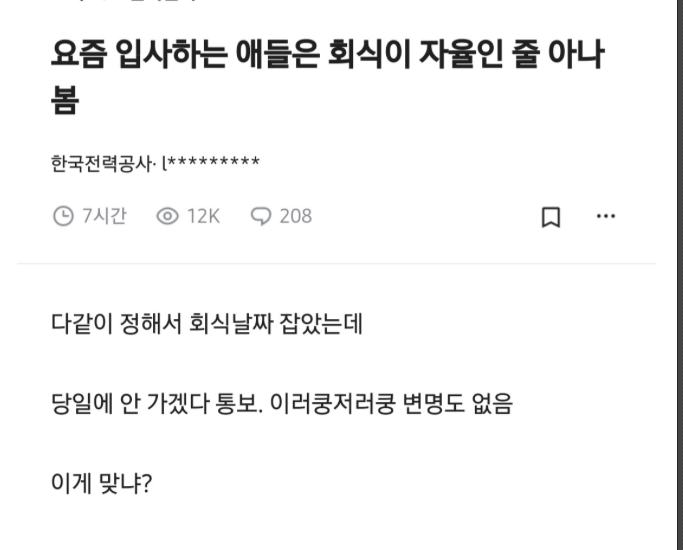 Office worker Mr. A expressed dissatisfaction with a new employee who notified of their absence on the day of the company dinner. [Image source=Blind]
Many office workers pointed out that regardless of whether attendance at company dinners is mandatory, notifying cancellation on the day is wrong. One worker said, "If you felt it was forced, you should have refused," adding, "Notifying on the day was inconsiderate and wasted people's time." Another worker said, "If absence is unavoidable, it's right to express some apology."
Prior to this post, there was controversy over a story where new employees at a team dinner only ate without grilling the meat. Some criticized the new employees for 'lack of manners,' while others pointed out that company dinners themselves are part of 'Kkondae culture' (authoritarian workplace culture).
Meanwhile, according to a survey conducted last year by Incruit targeting 1,013 male and female office workers, more than 9 out of 10 (94.5%) expressed satisfaction with the changed company dinner culture after COVID-19.
The top improvement (multiple answers allowed) was shorter duration and finishing at the first round (61.7%). Other popular changes included small group dinners (36.7%) and lunch dinners (31.0%).
The most preferred form of company dinner to be maintained going forward was "non-alcoholic lunch" (45.8%), especially favored by people in their 20s and 30s. Next was "evening dinner with alcohol after work" (29.7%), which was more popular among people in their 40s and 50s.
© The Asia Business Daily(www.asiae.co.kr). All rights reserved.


















